Loose Lips Sink Assembly Systems

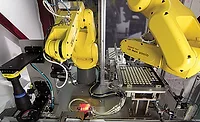
Photo courtesy Becton Dickinson
Want to a know what systems integrators are working on? Good luck! Sometimes their own engineers don’t even know.
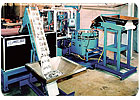
An NDA may prevent an integrator from disclosing a customer’s trade secrets, but it doesn’t necessarily extend to the mechanisms the integrator creates to assemble the product. Photo courtesy Merritech
“We’ve had customers who required us to open post office boxes just for their correspondence, so their names would not be seen by anyone in our building who was not part of the project,” recalls William R. Mutch, program manager for business development at the Specialty Equipment Engineering Div. of Belcan Corp. (Solon, OH). “For another customer, the need to maintain product secrecy was so great, the company built a secure production room within its own assembly plant.”
Such measures may seem paranoid. However, depending on the product, being first to market can confer many benefits. The most obvious, of course, is lack of competition. Being first gives assemblers exclusive market rights, at least for a while. By leveraging their temporary position as the sole provider, assemblers can make significant gains in the short term and plot a strategy to remain competitive when the market gets crowded. Pioneering manufacturers can also make a significant impact on the minds of consumers, setting a standard for others to follow. Assemblers that are first to market also earn exclusive name recognition during the initial stages of the product’s life. As long as they maintain a strong market presence, their name will continue to be identified with the product even after others enter the market.
“Over the past six years, the real thrust of our business has been new products,” says Jim Diederich, vice president of marketing for Assembly and Test Worldwide (Dayton, OH). “Manufacturers aren’t coming to us to increase production of something they’ve been building for 10 years. They are producing something new to address the marketplace in a new way.”
To help their customers maintain a competitive advantage, systems integrators follow a host of standard operating procedures designed to keep secrets under wraps. For example, assemblers routinely ask integrators to sign nondisclosure agreements (NDAs). “We have to do that just to quote on a project,” says Diederich.
An NDA can have as few as four pages or as many as 15. The document stipulates what equipment the integrator is building. It also outlines what constitutes the customer’s intellectual property and what represents the integrator’s intellectual property. An NDA prevents systems integrators from revealing such information as the customer’s identity, the nature of the assembly, design specifications, production rates, target costs and proprietary processes. Everyone involved in the project, from the shop floor to the back office, typically needs to sign the document.
Complying with an NDA may seem like no big deal, but for systems integrators, it can be a challenge. For one thing, automated assembly systems require many products, such as feeder bowls, grippers and cylinders, that the integrator doesn’t make in-house, explains Bob Ensminger, president of Arthur G. Russell Co. (Bristol, CT).
“It’s just not realistic for all these small vendors to sign onto some restrictive agreement,” he says.
It can be a tightrope. Integrators have to reveal enough detail about the project to accurately specify subsystems and get good quotes, yet they can’t disclose so much that they spill the beans about the product to the outside world. In the end, integrators often end up having suppliers sign NDAs, too.
Most NDAs expire once the product reaches the marketplace, but some are enforced for 3 to 10 years after a project is completed. Others insist that the integrator never reveal the customer’s name.
Another common security practice among integrators is to limit access to a project only to those personnel with a need to know. Electronic design files are protected by passwords, while identifying information is redacted from paper drawings and contracts.
To prevent visitors from seeing proprietary equipment, integrators may set up portable walls or screens around work areas on the shop floor. Some integrators even maintain separate, secure rooms in which to build particularly sensitive assembly systems. “Our factory has walls within walls,” says Jim Beretta, marketing services manager of ATS Automation Tooling Systems (Cambridge, ON). “You can’t get into certain areas unless your ID tag is ‘married’ to a project.”
Whether confidentiality requires an NDA, exclusive P.O. boxes, or temporary walls on the shop floor, most integrators say it’s not hard to keep a secret. “Maintaining confidentiality doesn’t make our job more difficult, but it does make us more disciplined,” says Diederich. “You have to make sure you walk through the steps.”
On the other hand, the need to protect one customer’s trade secrets can sometimes prevent an integrator from accepting another customer’s business. “We ran across that with a couple of medical device manufacturers,” recalls Paul Beduze, business development manager for Mikron Corp. Denver (Aurora, CA). “When Company B found out we were working with its rival, Company A, Company B decided not to work with us.”
Fortunately for integrators, such instances are rare. Occasionally, assemblers ask systems integrators not to do business with their competitors. In those instances, integrators typically ask for reciprocity-a guarantee that the assembler will use the integrator exclusively to build future projects.
“With few exceptions, the NDAs we sign are dedicated to a project, not a customer,” says Diederich.
Keeping mum also means integrators can’t always crow about their successes. “It can be frustrating,” admits Beretta. “We want to grow our business and sell our capabilities, but we do walk that fine line. We want to tell people that we build the best darn automation systems in the world for certain products, but sometimes we can’t.”
An NDA may prevent an integrator from disclosing a customer’s trade secrets, but it doesn’t necessarily extend to the mechanisms that the integrator creates to assemble the product. Many integrators have developed their own ways of moving, feeding and handling parts, and they are free to use those methods and mechanisms in any assembly system, regardless of the customer. On the other hand, if the integrator develops a unique technology specifically for a particular product, it typically becomes the customer’s intellectual property. If the assembler has paid for the engineering, it ought to own the results.
“In a couple of cases, when we’ve developed something truly unique, the customer granted us a release, and we have some patents pending,” says Diederich. “Customers are usually willing to grant us that, as long as it doesn’t take away any advantage they might have in the marketplace.”
On a personal level, confidentiality requirements cannot prevent engineers at systems integrators from seeking employment with other integrators. (Indeed, one integrator describes his industry as “quite incestuous.”) However, NDAs can prevent engineers from disclosing how their previous employer solved particular assembly challenges or what projects their previous employer is working on.
“As an engineer, you’re constantly learning things. Once you have knowledge in your head, how do you turn that off?” concedes Beduze. “Sharing secrets, however, would be morally wrong, even if it wasn’t legally prohibited. It would put both integrators at risk. An engineer who did that would not be in the profession long.”
Of course, security has a price. If integrators have to erect temporary walls on the shop floor or spend time chasing down signatures from suppliers, assemblers should have no illusions that such costs won’t be tallied up in the final bill. Do systems integrators ever think their customers’ secrecy requirements are unwarranted? Diederich gives a wry chuckle. “In today’s world, where everything is about being just half a step ahead, I would have a hard time saying to anyone, ‘Is that really necessary?’ We understand what secrecy is all about, and it’s the small details that make a big difference in terms of being ahead in your marketplace,” he says.
“You have to look at it in terms of maintaining relationships with your customers,” adds Ensminger. “You don’t want to sour that. You could [leak a secret] one time, and you’d never get work again.”
Looking for a reprint of this article?
From high-res PDFs to custom plaques, order your copy today!