Automation Profiles: Cabinet Assembly Moves Into 21st Century
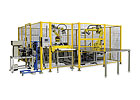
Robots are taught how to pick up wooden parts that vary in size, density and orientation.
Traditionally, cabinet assembly has been a manual trade performed by skilled workers. However, the high stress and physical toll of the process results in high turnover, low productivity and ultimately, higher costs in a highly competitive industry.
Such concerns prompted one cabinetmaker to automate the process with the help of systems integrator JR Automation Technologies LLC and woodworking equipment manufacturer Stiles Machinery Inc. Working together, the companies designed a two-robot cell that automatically assembles face frames for cabinets in a wide variety of sizes and materials.
The cell allows the cabinetmaker to switch from batch processing to one-piece flow without manual data entry or changeover. The cell has enabled the company to reduce inventory as well as improve safety and ergonomics. Although woodworking applications are not a large part of the market, the engineers at JR Automation combined the benefits of machine vision technology with unique end-of-arm tooling to produce a flexible and efficient assembly cell.
For more information on automated assembly systems, call JR Automation at 616-820-3442 or visit www.jrauto.com. For more information on machinery for assembling cabinetry and other wood products, call Stiles at 616-698-7500 or visit www.stilesmachinery.com.
What are the dimensions of the finished assembly? The cell easily handles assemblies up to 48 inches wide by 66 inches long, or as small as 8 inches wide by 18 inches long. The width of each board ranges from 1.5 to 6 inches.
How many parts are assembled to complete the product? The cell assembles frames from four to 20 pieces.
What materials are the parts made of? Various woods, including cherry, alder, oak, hickory, beech and maple.
How are the parts fed? The operator opens a kit of boards and places them in any orientation onto a conveyor. An 18-megapixel vision system scans the boards and identifies each piece. A bowl-feeder and a pneumatic tube feed screws into the automatic screwdriver.
What checks or inspections are included in the process? The vision system measures the wood pieces to ensure their dimensions are correct. The screwdriver measures torque during fastening to verify the quality of the wood. For example, an unnaturally high torque could indicate that the screw has been installed in a knot.
What was the most challenging aspect of designing and building the assembly system? One of the most significant challenges was developing an automated system that could handle a product with so many variants. Wood is never uniform in shape or appearance, so the end-of-arm tools had to be taught how to pick up a piece of wood that could vary in size, density and orientation. Instead of traditional robot programming, these robots are calibrated to learn flexible paths and programmable touch points, allowing for endless assembly solutions.
Because the parts are introduced as a set, they are not loaded in a sequence. The robot has no programmable sequence of operations to follow. JR Automation and Stiles created a new program that essentially gives the robots insight to create new pathways using learned data.
The load robot picks a board from the conveyor and presents it to the glue-dispensing unit. A precise amount of glue is applied, and the board is placed onto a work table. An assembly robot rotates and places the part according to software data, while the load robot returns to the conveyor to pick another part. The sequence repeats, until all parts are placed. The assembly robot moves to a pilot drill, which drills a pilot hole for screw placement. Once the pilot hole is drilled, the assembly robot moves to an automatic screwdriver, which installs the fastener. The driver automatically adjusts torque to match the material and ensures the joint is flush, even when the wood is bowed or flawed.
The assembly robot regrips the frame and repeats the process until the frame is completely assembled. The robot then moves the frame out of the cell, where the operator unloads it. The entire process averages 15 seconds per joint.
Traditionally, cabinet assembly has been a manual trade performed by skilled workers. However, the high stress and physical toll of the process results in high turnover, low productivity and ultimately, higher costs in a highly competitive industry.
Such concerns prompted one cabinetmaker to automate the process with the help of systems integrator JR Automation Technologies LLC and woodworking equipment manufacturer Stiles Machinery Inc. Working together, the companies designed a two-robot cell that automatically assembles face frames for cabinets in a wide variety of sizes and materials.
The cell allows the cabinetmaker to switch from batch processing to one-piece flow without manual data entry or changeover. The cell has enabled the company to reduce inventory as well as improve safety and ergonomics. Although woodworking applications are not a large part of the market, the engineers at JR Automation combined the benefits of machine vision technology with unique end-of-arm tooling to produce a flexible and efficient assembly cell.
For more information on automated assembly systems, call JR Automation at 616-820-3442 or visit www.jrauto.com. For more information on machinery for assembling cabinetry and other wood products, call Stiles at 616-698-7500 or visit www.stilesmachinery.com.
What are the dimensions of the finished assembly? The cell easily handles assemblies up to 48 inches wide by 66 inches long, or as small as 8 inches wide by 18 inches long. The width of each board ranges from 1.5 to 6 inches.
How many parts are assembled to complete the product? The cell assembles frames from four to 20 pieces.
What materials are the parts made of? Various woods, including cherry, alder, oak, hickory, beech and maple.
How are the parts fed? The operator opens a kit of boards and places them in any orientation onto a conveyor. An 18-megapixel vision system scans the boards and identifies each piece. A bowl-feeder and a pneumatic tube feed screws into the automatic screwdriver.
What checks or inspections are included in the process? The vision system measures the wood pieces to ensure their dimensions are correct. The screwdriver measures torque during fastening to verify the quality of the wood. For example, an unnaturally high torque could indicate that the screw has been installed in a knot.
What was the most challenging aspect of designing and building the assembly system? One of the most significant challenges was developing an automated system that could handle a product with so many variants. Wood is never uniform in shape or appearance, so the end-of-arm tools had to be taught how to pick up a piece of wood that could vary in size, density and orientation. Instead of traditional robot programming, these robots are calibrated to learn flexible paths and programmable touch points, allowing for endless assembly solutions.
Because the parts are introduced as a set, they are not loaded in a sequence. The robot has no programmable sequence of operations to follow. JR Automation and Stiles created a new program that essentially gives the robots insight to create new pathways using learned data.
The load robot picks a board from the conveyor and presents it to the glue-dispensing unit. A precise amount of glue is applied, and the board is placed onto a work table. An assembly robot rotates and places the part according to software data, while the load robot returns to the conveyor to pick another part. The sequence repeats, until all parts are placed. The assembly robot moves to a pilot drill, which drills a pilot hole for screw placement. Once the pilot hole is drilled, the assembly robot moves to an automatic screwdriver, which installs the fastener. The driver automatically adjusts torque to match the material and ensures the joint is flush, even when the wood is bowed or flawed.
The assembly robot regrips the frame and repeats the process until the frame is completely assembled. The robot then moves the frame out of the cell, where the operator unloads it. The entire process averages 15 seconds per joint.
Looking for a reprint of this article?
From high-res PDFs to custom plaques, order your copy today!