Assembly in Action: Paint Robots Increase Component Production, Part-Run Flexibility
In late 2008, Classic Metal Finishing began discussing automation as a way to increase production speed, boost flexibility, improve accuracy and lower labor costs.
In late 2008, Classic Metal Finishing, a Jackson, MI, company that anodizes and applies dry film lubricant to components, began discussing automation as a way to increase production speed, boost flexibility, improve accuracy and lower labor costs.
Thierica Equipment Corp., an integrator for FANUC Robotics America, proposed installing two FANUC Paint Mate 200iA robots on the assembly line in a tabletop paint booth with a two-position indexing table.
Thierica and plant manager Phil Morrison had worked together for more than 12 years to pioneer systems that sprayed dry film lubricant to the outside and inside diameters of many parts using a two-axis, fixed-gun spray machine.
“It’s a great compact system that uses minimal floor space,” says Morrison.
Classic Metal Finishing’s anodizing line uses two types of corrosion inhibitor and can dye aluminum in eight colors. Dry film lubricant is applied to parts to help with high-friction tolerance fits and moving assemblies.
The Paint Mate 200iA is a compact six-axis robot with a payload capacity of 5 kilograms and a reach of 27.7 inches. An alternative model, the Paint Mate 200iA/5L, has a reach of 35.1 inches. The robot is approved for FM and ATEX hazardous locations, Class I, II, III and Div. 1 environments.
The R-30iA controller and iPendant have a multiwindow color display, which allows easy input and adjustment of system parameters and provides quick access to built-in diagnostic and help information. Custom user-developed screens and messaging, and the iPendant’s ability to access work instructions and machine setups on the plant network, maximize uptime and productivity.
The controller for Thierica’s spray system stores 1,000 jobs. The operator’s end of the indexing table is equipped with a pair of light curtains. Once the job is selected, the operator adjusts the gun spray to a predetermined setting, loads the part into the machine, and presses the start button.
Thierica also designed quick-change end-of-arm tooling so the robot can use one of two spray guns. The system handles components ranging from 0.1875 to 5 inches in diameter. It can spray two types of material on two different part configurations with any combination. For example, it can apply one type of dry film lubricant to the component’s ID and a second type of dry film lubricant to the component’s OD.
The robot system applies dry film lubricant to a wide range of components with a consistent film thickness. The lubricant is sprayed with an air brush. This material has a 2-second flash time, making it difficult to apply without dry spots and runs. The supply system consists of Graco pressure pots, a fluid pressure regulator, and a back pressure regulator. The air brush has a “Y” fitting so the lubricant continuously recirculates and agitates to keep it flowing past the gun’s needle. This prevents plugged, dried-out tips and keeps the system ready to spray at a moment’s notice.
The robots spray parts in the same manner that an operator would by hand. Manually spraying the lubricant produced 65 parts per hour. A servo-controlled, two-axis fixed spray gun produced 125 parts per hour. The robotic system with only one gun can produce 250 parts per hour with a single spindle or 500 parts per hour with two spindles. That is a 770 percent productivity increase over manual spraying, and a 400 percent increase over a servo-controlled machine.
Due to the accuracy of the Paint Mate 200iA, the system requires less masking of fixtures vs. a manual spray operation or servo-controlled machine. Classic Metal Finishing expects a labor savings of 30 percent to 50 percent and a system payback of three years.
Over time, Classic Metal learned that the robot would spray the lubricant faster than an operator can load the part. To further speed production, the company plans to acquire a vision-guided, six-axis robot to load and unload the components from the indexing table to a conveyor for curing.
For more information on spray equipment, call 616-453-6570 or visit www.thiequip.com. For more information on robotics, call 800-447-6268 or visit www.fanucrobotics.com.
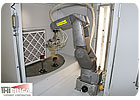
Two Paint Mate 200iA robots are used on the assembly line in a tabletop paint booth.
In late 2008, Classic Metal Finishing, a Jackson, MI, company that anodizes and applies dry film lubricant to components, began discussing automation as a way to increase production speed, boost flexibility, improve accuracy and lower labor costs.
Thierica Equipment Corp., an integrator for FANUC Robotics America, proposed installing two FANUC Paint Mate 200iA robots on the assembly line in a tabletop paint booth with a two-position indexing table.
Thierica and plant manager Phil Morrison had worked together for more than 12 years to pioneer systems that sprayed dry film lubricant to the outside and inside diameters of many parts using a two-axis, fixed-gun spray machine.
“It’s a great compact system that uses minimal floor space,” says Morrison.
Classic Metal Finishing’s anodizing line uses two types of corrosion inhibitor and can dye aluminum in eight colors. Dry film lubricant is applied to parts to help with high-friction tolerance fits and moving assemblies.
The Paint Mate 200iA is a compact six-axis robot with a payload capacity of 5 kilograms and a reach of 27.7 inches. An alternative model, the Paint Mate 200iA/5L, has a reach of 35.1 inches. The robot is approved for FM and ATEX hazardous locations, Class I, II, III and Div. 1 environments.
The R-30iA controller and iPendant have a multiwindow color display, which allows easy input and adjustment of system parameters and provides quick access to built-in diagnostic and help information. Custom user-developed screens and messaging, and the iPendant’s ability to access work instructions and machine setups on the plant network, maximize uptime and productivity.
The controller for Thierica’s spray system stores 1,000 jobs. The operator’s end of the indexing table is equipped with a pair of light curtains. Once the job is selected, the operator adjusts the gun spray to a predetermined setting, loads the part into the machine, and presses the start button.
Thierica also designed quick-change end-of-arm tooling so the robot can use one of two spray guns. The system handles components ranging from 0.1875 to 5 inches in diameter. It can spray two types of material on two different part configurations with any combination. For example, it can apply one type of dry film lubricant to the component’s ID and a second type of dry film lubricant to the component’s OD.
The robot system applies dry film lubricant to a wide range of components with a consistent film thickness. The lubricant is sprayed with an air brush. This material has a 2-second flash time, making it difficult to apply without dry spots and runs. The supply system consists of Graco pressure pots, a fluid pressure regulator, and a back pressure regulator. The air brush has a “Y” fitting so the lubricant continuously recirculates and agitates to keep it flowing past the gun’s needle. This prevents plugged, dried-out tips and keeps the system ready to spray at a moment’s notice.
The robots spray parts in the same manner that an operator would by hand. Manually spraying the lubricant produced 65 parts per hour. A servo-controlled, two-axis fixed spray gun produced 125 parts per hour. The robotic system with only one gun can produce 250 parts per hour with a single spindle or 500 parts per hour with two spindles. That is a 770 percent productivity increase over manual spraying, and a 400 percent increase over a servo-controlled machine.
Due to the accuracy of the Paint Mate 200iA, the system requires less masking of fixtures vs. a manual spray operation or servo-controlled machine. Classic Metal Finishing expects a labor savings of 30 percent to 50 percent and a system payback of three years.
Over time, Classic Metal learned that the robot would spray the lubricant faster than an operator can load the part. To further speed production, the company plans to acquire a vision-guided, six-axis robot to load and unload the components from the indexing table to a conveyor for curing.
For more information on spray equipment, call 616-453-6570 or visit www.thiequip.com. For more information on robotics, call 800-447-6268 or visit www.fanucrobotics.com.
Looking for a reprint of this article?
From high-res PDFs to custom plaques, order your copy today!