Automated Assembly: Get Agile
Now more than ever, manufacturers need agile assembly systems.
Many manufacturers are desperately seeking certainty in an increasingly uncertain world. We’ve all recently observed the wisdom of military strategists, “No plan survives first contact with the enemy.”
Product incubation cycles have become compressed as producers scramble to be first to market with an innovation. Production life cycles have become shorter, as the pace of technology renders designs obsolete by the time they hit the market. Products are being offered in dizzying variety to capitalize on the consumer’s new-found expectation that products be more personalized. And, production volumes are shrinking as niche markets are exploited.
If that’s not enough to worry about, the threat of overseas competition still looms large. The going rate for assembly work in low-wage countries is $0.60 per hour. At the same time, the customer expects zero-defect quality levels.
As a result, assemblers find themselves kicking off production while the product is barely through design, with minimal market research to guide production volumes. They must get into the market fast, make a profit, then quickly launch the next product.
* You have the opportunity to win business if you can launch production in eight weeks.
* Volume drops 40 percent.
* A competitor emerges priced 25 percent lower than you.
* The product design changes significantly after production starts.
* A customer just became a competitor.
Any attempt to create long-term forecasts based on a snapshot of the landscape today will lead to fragile conclusions. A better strategy comes from military planning: Be prepared.
Even standard return-on-investment (ROI) calculations are obsolete for guiding decisions today. The time between start of production and product obsolescence is becoming shorter than the useful life of the equipment.
In this climate, manufacturers face a dilemma. They must automate to achieve the quality and cost structure to remain competitive. Yet, they can’t justify investing in automation because short production runs, low volume and high uncertainty defy standard ROI analysis.
What if you could simultaneously solve these conflicting constraints, insure your investment against disruptive change, pull your customers closer, and win new business? Agile automation does just that. Agile automation handles two important tasks: It efficiently produces the products in your plan, and it adapts quickly when that plan changes.
Agile automation was forged from lean manufacturing principles, Japanese machine building techniques, and key insights from our own manufacturing operations.
Over a decade ago, we had an epiphany. On our shop floor were modern CNC machine tools that were highly automated, yet so generic as to be able to produce an unimaginable variety of parts. Why should assembly automation be any different? We discovered that a CNC machine owes its flexibility to standardized, crisp dividing lines between the process machinery and part-specific tooling.
In traditional automated assembly equipment, part-specific hardware, sensors, air lines and software are hopelessly entangled with core machine elements. Agile equipment decouples part-specific tooling from process-specific machinery. It’s a simple idea that yields explosive returns.
Traditional hard automation lies at the least agile end of the spectrum. These systems have zero flexibility. One step up are systems with replaceable tooling. Technicians and hand tools are required for changeover, which may take more than 20 minutes. Some adjustments may be required after restart.
Somewhat better are systems with quick-change tooling. Operators are still required for changeover, but at least they don’t need tools. Changeover is accomplished in one to five minutes. Ideally, the system won’t need tweaking after restart.
Better yet are systems in which changeover is fully automatic. Changeover occurs in less than a minute, and operators are not required.
The most agile systems are capable of sequential mixed production. Changeover is instant.
When correctly implemented, agile equipment returns benefits well beyond the shop floor. Operational benefits include:
* Reduced changeover time. By reducing or eliminating part-specific tooling, changeover times are driven as close to zero as possible.
* Less work-in-process (WIP). More efficient changeover allows more frequent changeover, which reduces WIP. Reducing WIP frees cash that would otherwise be tied up in inventory.
* Reduced floor space. One agile system can run a variety of parts that would otherwise require multiple machines with their associated floor space. At the end of an assembly’s production life, manufacturers can simply store any part-specific tooling rather than mothballing entire machines.
* Consistent quality on changeover. By minimizing human intervention during changeover, agile systems ensure consistent quality on startup and after changeover.
* Continuous improvement. Standardized machines with interchangeable tooling simplify continuous improvement. New process improvement ideas can be switched in and out quickly without risking production stability. Trials can be conducted during breaks rather than waiting for weekends. Now your ideas move ahead faster.
Strategic benefits include:
* Risk management. There is no shortage of risks inherent to an investment in automated equipment-design changes, program cancellation or volume decrease, poor capacity balance, missing a production launch date, and project failure. Agile automation allows you to invest confidently despite these risks. Think of any cost premium associated with agile features as inexpensive investment insurance. Of course, when the benefits of agility are fully recognized, there is often no cost premium.
* Delayed obsolescence. Modular design lends itself to reconfiguration for new production demands. Whether the end of production comes according to plan or otherwise, agile systems have value that is not lost. Contrast that with fixed automation, which ends up rusting in the back lot when change comes around.
* Reduced launch costs. Product launches represent a larger percentage of product life cycle costs as production volumes shrink. A launch on agile equipment usually involves simple tooling and programming changes. The result is minimal tooling cost and reduced process development time.
* Reduced cost and risk for new jobs. Launch new jobs with a small tooling investment instead of entirely new machinery. You can add new machinery as throughput requires. Agile automation lowers both tooling costs and reduces capital investment required for new business.
* Tighten customer relationships. Satisfy your customers by responding quickly to product changes, prototype requests and emergency orders. Cement customer relationships by offering product design flexibility that’s not constrained by your equipment. The process of designing an agile system involves discussing variations in future products. This conversation deepens your level of customer involvement.
* Win new business. When you demonstrate your agility to your customers, they’ll notice. Most importantly, your new cost structure allows you to profitably produce the lower volumes that your competitors can’t touch.
Developing agile automation requires a different perspective.
Here are the key ideas for designing agile systems:
* Decoupling. Create a crisp division between the product-specific tooling and the machine. Define logical subsystem breaks in the mechanical, electrical and software design to reduce the cost of reconfiguring assets.
* Commonization. Work with the product design team to establish common features or “hard points” in the product design that will not change across different models.
* Variation analysis. Ask the product design team what parameters are likely to vary and by how much. Then, discuss with your machine builder the likely costs of each point of variation. Remember, you’re devising a system for parts that are three to five years away. They haven’t even been designed yet. Expect that you will be adding extra mental energy, content and cost initially. The return comes when the machine survives many new product cycles without extensive modification or replacement.
A variety of technologies can be creatively combined to achieve agility.
Robots are inherently more flexible than fixed automation. The real value of a robot is its ability to accommodate surprises. We can’t count the number of times that agile designs have pulled a customer’s bacon out of the fire due to a surprise or reasonable oversight.
Many technologies can make robots even more agile. Servo-driven grippers allow the robot to adapt on the fly to different parts or tasks. Automatic tool changers enable one robot to accomplish multiple tasks. Vision-guidance systems reduce the need for fixed tooling or precise shipping dunnage.
Using a robot as a workpiece positioner provides inherent flexibility. This part-to-process method works especially well for single-point operations, such as dispensing, resistance welding, punching and assembly.
Vision systems can replace numerous discrete photoelectric sensors. This works especially well in high-mix environments where dozens of discrete sensors would be impractical. Mounting a camera to a low-cost robot allows near infinite inspection possibilities.
Programmable, servo-driven locating features are a low-cost means to provide error-proof instant changeover.
Automatic guided vehicles can transport parts over long distances. They can also be put into service as highly flexible alternatives to conveyors for large-part assembly.
Agile tooling can be changed without hand tools to minimize downtime. Built-in identification systems ensure the correct tool is in place before cycling. Agile tooling has automatic couplings for pneumatic, hydraulic and electrical signals.
Control systems should decouple mechanical subsystems as much as possible. Fieldbus I/O should be used wherever possible. The programmable parameters required to run a job should be stored in a centralized, easy-to-manage operator interface.
Many manufacturers are desperately seeking certainty in an increasingly uncertain world. We’ve all recently observed the wisdom of military strategists, “No plan survives first contact with the enemy.”
Product incubation cycles have become compressed as producers scramble to be first to market with an innovation. Production life cycles have become shorter, as the pace of technology renders designs obsolete by the time they hit the market. Products are being offered in dizzying variety to capitalize on the consumer’s new-found expectation that products be more personalized. And, production volumes are shrinking as niche markets are exploited.
If that’s not enough to worry about, the threat of overseas competition still looms large. The going rate for assembly work in low-wage countries is $0.60 per hour. At the same time, the customer expects zero-defect quality levels.
As a result, assemblers find themselves kicking off production while the product is barely through design, with minimal market research to guide production volumes. They must get into the market fast, make a profit, then quickly launch the next product.
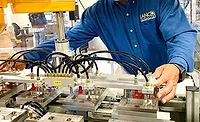
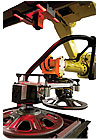
Stepped tooling is a simple way to accommodate a wide range of parts.
Curveballs and Chainsaws
In our fast-changing world, customers will throw you curveballs. Sometimes they’ll throw you chainsaws. How well is your company prepared to handle the following?* You have the opportunity to win business if you can launch production in eight weeks.
* Volume drops 40 percent.
* A competitor emerges priced 25 percent lower than you.
* The product design changes significantly after production starts.
* A customer just became a competitor.
Any attempt to create long-term forecasts based on a snapshot of the landscape today will lead to fragile conclusions. A better strategy comes from military planning: Be prepared.
Even standard return-on-investment (ROI) calculations are obsolete for guiding decisions today. The time between start of production and product obsolescence is becoming shorter than the useful life of the equipment.
In this climate, manufacturers face a dilemma. They must automate to achieve the quality and cost structure to remain competitive. Yet, they can’t justify investing in automation because short production runs, low volume and high uncertainty defy standard ROI analysis.
What if you could simultaneously solve these conflicting constraints, insure your investment against disruptive change, pull your customers closer, and win new business? Agile automation does just that. Agile automation handles two important tasks: It efficiently produces the products in your plan, and it adapts quickly when that plan changes.
Agile automation was forged from lean manufacturing principles, Japanese machine building techniques, and key insights from our own manufacturing operations.
Over a decade ago, we had an epiphany. On our shop floor were modern CNC machine tools that were highly automated, yet so generic as to be able to produce an unimaginable variety of parts. Why should assembly automation be any different? We discovered that a CNC machine owes its flexibility to standardized, crisp dividing lines between the process machinery and part-specific tooling.
In traditional automated assembly equipment, part-specific hardware, sensors, air lines and software are hopelessly entangled with core machine elements. Agile equipment decouples part-specific tooling from process-specific machinery. It’s a simple idea that yields explosive returns.
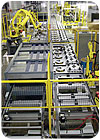
This assembly cell for an automotive molding process uses a conveyor rather than a traditional turntable. This agile design optimized flow and brought tooling costs from a baseline of $250,000 to less than $60,000. Seven robots and two operators perform 12 operations.
Defining Agile
To create a common understanding, Kinemetrix has defined various levels of agility.Traditional hard automation lies at the least agile end of the spectrum. These systems have zero flexibility. One step up are systems with replaceable tooling. Technicians and hand tools are required for changeover, which may take more than 20 minutes. Some adjustments may be required after restart.
Somewhat better are systems with quick-change tooling. Operators are still required for changeover, but at least they don’t need tools. Changeover is accomplished in one to five minutes. Ideally, the system won’t need tweaking after restart.
Better yet are systems in which changeover is fully automatic. Changeover occurs in less than a minute, and operators are not required.
The most agile systems are capable of sequential mixed production. Changeover is instant.
When correctly implemented, agile equipment returns benefits well beyond the shop floor. Operational benefits include:
* Reduced changeover time. By reducing or eliminating part-specific tooling, changeover times are driven as close to zero as possible.
* Less work-in-process (WIP). More efficient changeover allows more frequent changeover, which reduces WIP. Reducing WIP frees cash that would otherwise be tied up in inventory.
* Reduced floor space. One agile system can run a variety of parts that would otherwise require multiple machines with their associated floor space. At the end of an assembly’s production life, manufacturers can simply store any part-specific tooling rather than mothballing entire machines.
* Consistent quality on changeover. By minimizing human intervention during changeover, agile systems ensure consistent quality on startup and after changeover.
* Continuous improvement. Standardized machines with interchangeable tooling simplify continuous improvement. New process improvement ideas can be switched in and out quickly without risking production stability. Trials can be conducted during breaks rather than waiting for weekends. Now your ideas move ahead faster.
Strategic benefits include:
* Risk management. There is no shortage of risks inherent to an investment in automated equipment-design changes, program cancellation or volume decrease, poor capacity balance, missing a production launch date, and project failure. Agile automation allows you to invest confidently despite these risks. Think of any cost premium associated with agile features as inexpensive investment insurance. Of course, when the benefits of agility are fully recognized, there is often no cost premium.
* Delayed obsolescence. Modular design lends itself to reconfiguration for new production demands. Whether the end of production comes according to plan or otherwise, agile systems have value that is not lost. Contrast that with fixed automation, which ends up rusting in the back lot when change comes around.
* Reduced launch costs. Product launches represent a larger percentage of product life cycle costs as production volumes shrink. A launch on agile equipment usually involves simple tooling and programming changes. The result is minimal tooling cost and reduced process development time.
* Reduced cost and risk for new jobs. Launch new jobs with a small tooling investment instead of entirely new machinery. You can add new machinery as throughput requires. Agile automation lowers both tooling costs and reduces capital investment required for new business.
* Tighten customer relationships. Satisfy your customers by responding quickly to product changes, prototype requests and emergency orders. Cement customer relationships by offering product design flexibility that’s not constrained by your equipment. The process of designing an agile system involves discussing variations in future products. This conversation deepens your level of customer involvement.
* Win new business. When you demonstrate your agility to your customers, they’ll notice. Most importantly, your new cost structure allows you to profitably produce the lower volumes that your competitors can’t touch.
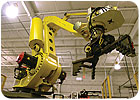
Robots are inherently more flexible than fixed automation.
Agile Automation Techniques
Would you buy a new stamping press then weld a die in place? Probably not. So why do we commonly buy expensive automation that is dedicated to the fixed number of products immediately in front of us?Developing agile automation requires a different perspective.
Here are the key ideas for designing agile systems:
* Decoupling. Create a crisp division between the product-specific tooling and the machine. Define logical subsystem breaks in the mechanical, electrical and software design to reduce the cost of reconfiguring assets.
* Commonization. Work with the product design team to establish common features or “hard points” in the product design that will not change across different models.
* Variation analysis. Ask the product design team what parameters are likely to vary and by how much. Then, discuss with your machine builder the likely costs of each point of variation. Remember, you’re devising a system for parts that are three to five years away. They haven’t even been designed yet. Expect that you will be adding extra mental energy, content and cost initially. The return comes when the machine survives many new product cycles without extensive modification or replacement.
A variety of technologies can be creatively combined to achieve agility.
Robots are inherently more flexible than fixed automation. The real value of a robot is its ability to accommodate surprises. We can’t count the number of times that agile designs have pulled a customer’s bacon out of the fire due to a surprise or reasonable oversight.
Many technologies can make robots even more agile. Servo-driven grippers allow the robot to adapt on the fly to different parts or tasks. Automatic tool changers enable one robot to accomplish multiple tasks. Vision-guidance systems reduce the need for fixed tooling or precise shipping dunnage.
Using a robot as a workpiece positioner provides inherent flexibility. This part-to-process method works especially well for single-point operations, such as dispensing, resistance welding, punching and assembly.
Vision systems can replace numerous discrete photoelectric sensors. This works especially well in high-mix environments where dozens of discrete sensors would be impractical. Mounting a camera to a low-cost robot allows near infinite inspection possibilities.
Programmable, servo-driven locating features are a low-cost means to provide error-proof instant changeover.
Automatic guided vehicles can transport parts over long distances. They can also be put into service as highly flexible alternatives to conveyors for large-part assembly.
Agile tooling can be changed without hand tools to minimize downtime. Built-in identification systems ensure the correct tool is in place before cycling. Agile tooling has automatic couplings for pneumatic, hydraulic and electrical signals.
Control systems should decouple mechanical subsystems as much as possible. Fieldbus I/O should be used wherever possible. The programmable parameters required to run a job should be stored in a centralized, easy-to-manage operator interface.
Looking for a reprint of this article?
From high-res PDFs to custom plaques, order your copy today!