Potting for Protection
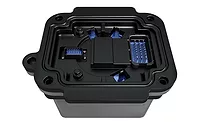
Potting covers an electronic or electrical device with a compound to protect it from the surrounding environment. Most of the time, the device needs protection from water or moisture. However, it might need to be electrically insulated so that it will operate correctly. Potting can also provide heat dissipation, shock protection and be a flame retardant. Electronic components most likely to need potting include capacitors, switches, transducers and temperature sensors.
The most common method of potting involves testing the device and placing it in a pot, case or shell. After the device is mounted in the case, the potting compound is poured inside, completely covering the device and encasing it. The case becomes part of the finished unit.
Selecting Potting Compounds
When selecting a potting compound, consider the end use, the environment the unit will experience, the number of units to be potted per hour and the design of the unit. Also keep in mind that very fluid compounds are used for potting narrow gaps and small surfaces. Highly viscous products are better for filling larger gaps.There are six basic types of potting compounds. Five are thermosetting materials: epoxies, urethanes, silicones, acrylics and polyesters. The sixth type is hot-melt materials, which are thermoplastics. These can also be combined to form other compounds. Each compound has positive and negative characteristics.
Epoxies are stable materials before and after hardening. They are easy to use and predictable. They have good high temperature resistance (up to 200 C) and chemical resistance. However, they suffer under some acids, such as lactic acid. They are strong and adhere well to metals and porous surfaces. They are hardened with many chemicals, which gives them a full range of hardened properties.
However, even a small crack in the compound will easily spread through the hardened piece. This cracking problem limits their use in high-impact situations unless special techniques are used. Use on printed circuit boards with surface mount components is not recommended. The bond to some plastics is not good, because when the plastic bends, the bond is easily broken. Epoxy is also a high surface energy material, and some plastics are low surface energy. Therefore, they are not easily wet by the epoxy.
Urethanes possess a broad range of hardness. They are suitable for use with surface mount printed circuit boards. Their gel time can be changed with an accelerator without changing their properties, and they can be modified to meet specific hardening speed requirements.
Resistance to elevated temperatures is limited to 130 C in continuous use or 150 C in intermittent use. Its chemical resistance is not as good as epoxy. It can withstand splashes of chemicals but not immersion.
Silicones have excellent high-temperature and low-temperature properties. They are good candidates for potting components on printed circuit boards. However, they are costly. Adhesion can someArial be a problem that requires use of primers.
Looking for quick answers on assembly and manufacturing topics? Try Ask ASM, our new smart AI search tool. Ask ASM
Acrylics can be cured with ultraviolet light or heat. These clear compounds harden quickly and have adequate chemical resistance. But they are costly and cannot be applied in thick layers.
Polyesters are inexpensive and have good chemical resistance. Like acrylics, they are clear. Weaknesses include shrinkage and cracking with temperature cycling. They must be highly filled to stop cracking.
Hot-melt materials are low-cost thermoplastic materials that resist water. However, their weaknesses include shrinkage, limited high-temperature tolerance and virtually no chemical resistance.
Metering, Mixing and Dispensing Compounds
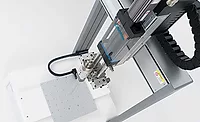
Successful potting requires precise metering, mixing and dispensing.Two-part potting materials require meter-mix-dispense systems to mix the compound and hardener together. This mixed material is then dispensed into or over the part.
The cylinder-piston method is widely used for meter-mix-dispense potting systems. The cylinders containing compound and hardener are sized so that when the pistons move through the cylinders, the volume ratio is pushed into the mixing area. Two-component compounds are available in disposable cartridges for small applications. For continuous operation, the cylinders are typically replenished from reservoirs.
The rod displacement method uses a solid rod instead of a piston to displace the compound. Because this equipment uses fewer seals than the piston method, it requires less maintenance, even when dispensing filled materials.
In the progressive cavity method, two screws are turned by separate, electronically controlled motors. The screws are turned at the correct speed so that they dispense the compound and hardener in the correct ratio. This method is a continuous dispensing method. The chambers, from which the screws are extruding material, are replenished continuously. As the screws wear, their speed can be electronically adjusted to compensate.
The diaphragm method uses two diaphragm pumps. One side of each is filled with the resin or hardener, and the other side is filled with oil. The oil sides are connected to cylinders that are sized for the volume ratio of the compound. This is similar to the cylinder-piston method, except that oil pressure on the diaphragms forces resin and hardener into the mixer.
The gear method is similar to the progressive cavity method. However, this method uses precision gear pumps instead of screws. It can deliver consistent flow rates, which are critical in continuous flow applications. However, it is limited to only unfilled compounds, because filler wears the gears. This makes the ratio incorrect.
After the resin and hardener are metered, they flow into the mixing area. There are two methods of mixing—static and dynamic.
In the static method, the metered materials flow through a nozzle made of steel or disposable plastic. A convoluted rod inside the nozzle mixes the two components together. The flow is divided in half. Then that part is divided in half again and so on until the components are mixed.
In the dynamic method, a rotating blade inside the chamber thoroughly mixes the compound and hardener.
For dispensing one-part materials, assemblers have other options. The dispenser can be controlled by turning air pressure on and off with a valve that interrupts the flow from a pressurized source—the pressure-time system; by manipulating a valve that interrupts the flow from a pressurized source; or by turning a positive-displacement pump on and off.
Most dispensers use pressure-time systems. Pressure-time systems require less maintenance than mechanical dispensing technologies. But because these systems may be unable to maintain volumetric repeatability, the dispensing heads can be fitted with valve and metering enhancements for improved control. Material viscosity can also affect the accuracy of pressure-time dispensers.
Some valve-type dispensers use a diaphragm, which is recommended for fine flow control with low- to medium-viscosity fluids. Others use a piston—for medium- to high-viscosity fluids. This provides a slight suck-back at the end of the dispense cycle for positive fluid cutoff.
Positive-displacement means that an exact, metered amount of fluid is forced from the pump during every cycle. The two types of mechanical pumps for high-speed dispensing are the Archimedes screw metering pump and piston positive-displacement pump. The Archimedes screw system offers continuous material feed and fast activation. The piston positive-displacement pump is less sensitive to changes in material viscosities or material levels.
Dispensers with a teach function are particularly useful for potting applications, because they make it simple to determine the correct amount of potting compound to use for each situation. Once this amount is determined and stored in the dispenser’s or valve controller’s memory, the user can apply an identical amount of compound in each cavity.
Avoiding a Potting Problem
Bubbling can be a major potting problem, especially when it occurs on printed circuit boards. It occurs when air is trapped inside the potted device. Bubbles can be removed in a vacuum chamber. Once bubbles have been removed, the material should be handled carefully so that bubbles are not reintroduced.Filling from the bottom up, rather than dispensing compound from the top, can reduce bubbles and voids. When filling from the bottom of the unit, the air is pushed out ahead of the compound. To do this, a space that allows the dispensing tube to go to the bottom of the unit is needed.
Dispensers that deliver consistent shot sizes eliminate, or at least reduce, the need to top off with additional material or scrape off excess compound with a razor blade. This also reduces health and safety risks by reducing fumes, spills and user contact with the material.
If bottom-filling is not possible, the unit should be designed with places where the compound can be poured from the top so that it can then flow all the way to the bottom and across the unit. Horizontal surfaces should have 1/8-inch holes for air release. If the compound can flow from one side to the other quickly, then the operator will have less tendency to cover the top totally with compound, trapping air in the part.
Curing Compounds
There are two types of potting compounds—two-part and one-part. In two-part materials, the resin and the hardener are separate. When they are mixed, the hardening reaction starts. The two-part materials require the resin and hardener to be thoroughly mixed and in the correct ratio. Two-part materials can be hardened faster or more slowly by raising or lowering the temperature after mixing.In a one-part material, the hardener is relatively inactive when mixed with the resin. Heat or ultraviolet light is needed to start the reaction. The advantage of this material is that no mixing is required, and no ratio measurement is needed. Increasing the temperature or the amount of light energy can increase hardening speed.
Looking for a reprint of this article?
From high-res PDFs to custom plaques, order your copy today!