Assembly magazine
Home
Online
Industry Headlines
AssemblyBlog
ASSEMBLYtv
Buyers Guide
Showrooms
Product Review
How To Guides
Webinar
Ask ASSEMBLY
Calendar of Events
eNewsletter
Current Issue
Cover Story
Features
Departments
Digital Edition
Resources
Podcasts
Archives
Job Search
White Papers
Industry Links
Contract Assembly Services
Website Review
E-Cards
Market Research
List Rental
Classified Ads
ASSEMBLY Info
Advertise
Subscribe
About Assembly
Staff Directory
Editorial Calendar
Reprints
Search in: EditorialProductsCompanies
Design Lean Cells for Flexibility

February 27, 2008

ARTICLE TOOLS
EmailEmailPrintPrintReprintsReprintsshareShare


Becoming lean means more than putting together a few U-shaped work cells. It's a philosophy that drives you to reduce waste. To implement lean, you need to consider how materials, people and information flow through your manufacturing process.

Optimizing the Flow
The first step is to segment the assembly process into time-balanced increments of work.

To do this, perform time and motion studies with a stopwatch. Then, pare the assembly process down to value-added processes only. Optimize these and eliminate everything else.

Creating time-balanced segments doesn't mean that each operation should take the same amount of time. It means laying out the cell so the work can be divided into time-balanced increments for one, two or three operators-shifting resources into and out of the cell to match demand and remove waste.

One-piece Flow: Optimizing Material and People
The key to optimizing material and people flow is to insist on one-piece flow: Making one complete part at a time or passing completed work to the next operator only when that operator is ready for it.

In a poorly balanced cell, work-in-process (WIP) stacks up between each station. This is waste. And quality re-work means you have to find the error and re-make lots of inventory. With one-piece flow, you find errors immediately and can fix the problem.

Proper Work Cell Design
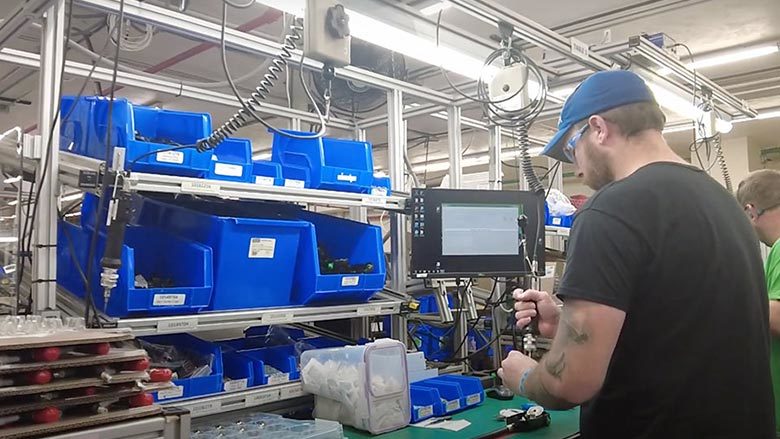
Cells designed to eliminate waste help optimize material, people and information flow. U, J, or L-shaped cells, with stations interlinked by manual roller conveyors, eliminate wasted space so operators can move swiftly from station to station with no wasted steps or energy.

Ergonomic principles can minimize reach distances and times and help eliminate worker fatigue. Parts should be provided from the rear of the cell via parts "stores" with bins on wheeled racks. This simplifies replenishment and any line changeovers.

A Word on Information Flow
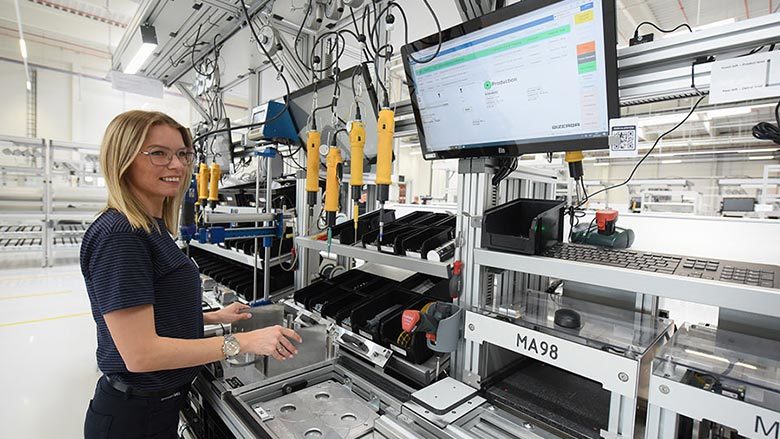
Finally, one glance into a well-designed work cell will tell you everything: which product is being produced, whether line-side parts stores are low, and whether any trouble spots exist. Good visual indicators make for good information flow and continuous process improvement. Even the best cells can be improved.


Download a Lean Guidebook

Once you start implementing the "lean principle" you'll find that you can apply it just about anywhere. For more information, download the free guidebook, The 9 Principles of Lean Manufacturing-Systems, Tools and Methods. Visit www.boschrexroth-us.com and enter Web Code US0235.

Bosch Rexoth Corporation
1-800-REXROTH (739-7684)
www.boschrexroth-us.com


Did you enjoy this article? Click here to subscribe to the magazine.

Most Emailed Articles

  1. Webcast to Discuss How to Prevent Failure of Plastic Parts
  2. Putting Cars on a Diet
  3. Pulse Tools Get Smart
  4. Reptiles Delay Construction of Assembly Plant
  5. Design Lean Cells for Flexibility
  6. It's All About the Battery
  7. GM Centennial: Trendsetting Plants
  8. Plastics Assembly: Design for X
  9. GM Centennial: Worldwide Growth Is Driven by China
  10. It's All About the Battery

Top Searches

  1. Lean Workstation
  2. leak testing
  3. torque
  4. lean
  5. wave solder
  6. Plants
  7. model t
  8. fuel cell
  9. robots
  10. ritter

Most Popular Articles

  1. Mind the Gap 2/20/08
  2. Leading Lean: Build on Your Success 12/17/07
  3. Assembly in Action: Supplier Key to Machine Builderís Success 5/25/07
  4. Ball Grid Array Soldering 1/25/08
  5. Putting the Squeeze on Rivets 12/17/07
  6. Nanotechnology Transforms Lithium-ion Batteries 2/4/08
  7. Successful Design For Assembly 2/26/07
  8. Leading Lean: Make Everything Visual 6/25/07
  9. Leading Lean: Your Lean Library 11/27/07
  10. Select a Workstation for Lean Manufacturing 7/16/07
© 2008 BNP Media. All rights reserved. | Privacy Policy