Assembly magazine
Home
Subscription Customer Service
Online
Industry Headlines
AssemblyBlog
ASSEMBLYtv
Assembly Radio
Web Extras
Buyers Guide
Showrooms
Product Review
How To Guides
Webinar
Ask ASSEMBLY
Calendar of Events
eNewsletter
Current Issue
Cover Story
Features
Departments
Digital Edition
Resources
Archives
Job Search
White Papers
Industry Links
Website Review
E-Cards
Market Research
List Rental
Classified Ads
ASSEMBLY Info
June 2009 BPA Statement
Subscribe
About Assembly
Staff Directory
Advertise
Reprints
Search in: EditorialProductsCompanies
How To Prevent Threaded Assembly Failure

March 22, 2010

ARTICLE TOOLS
EmailEmailPrintPrintReprintsReprintsshareShare


Threaded fasteners are the most common detachable hardware, used on thousands of products including automobiles, aircraft, household appliances, and industrial machinery. With more than 300 billion fasteners used annually in the U.S., it is crucial that these fasteners predictably and reliably maintain clamp force on the parts they join.

Why Threaded Assemblies Fail
Threaded fastener loosening due to vibration is the number one cause for catastrophic machinery failure. Such failure occurs when clamp load is not maintained. Gaps that naturally exist between the mating surfaces of threads directly impact the fastener’s ability to stay tightly fixed. These tiny gaps allow side-to-side movement on exposure to vibration and thermal expansion or contraction. Side-to-side movement loosens the mated parts, reducing clamp load and ultimately causing the fastener to fail.

Mechanical locking devices were invented to solve the problem of loosening, but all designs have inherent flaws:
* Split ring or spring washers are designed for increased friction, which reduces clamp loads. These mechanical locking devices are not reliable when exposed to dynamic loads.
* Tooth or ribbed flange bolts are expensive and require large flange-bearing surfaces. They also can damage the surfaces of the mating parts.
* Tab washers, split pins, and castle nuts are costly and time- consuming to lock as they require that components be lined up appropriately before being set.
* Nylon nuts increase friction, which results in inaccurate torque during assembly.

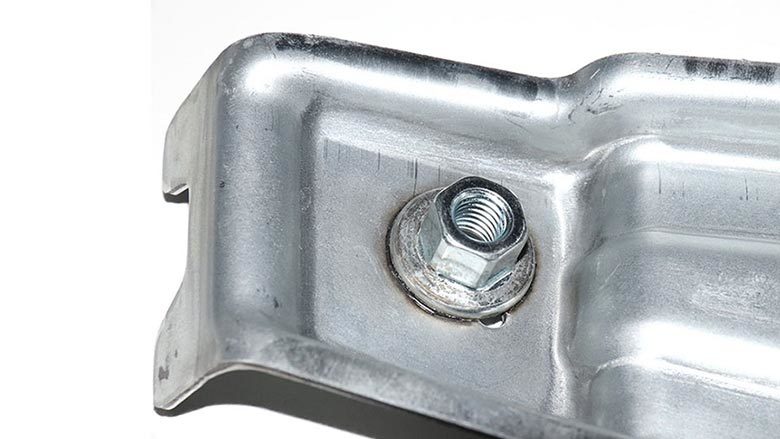
Many of these locking devices loosen over time when exposed to vibration, thermal expansion or improper torque. Mechanical locking devices require that the user keep an extensive and costly parts inventory to fit all fastener shapes and sizes. They do not seal the threads, leaving assemblies susceptible to rust and corrosion.


Preventing Threaded Assembly Failures

Loctite Threadlockers provide better clamp load retention compared to all mechanical locking devices.
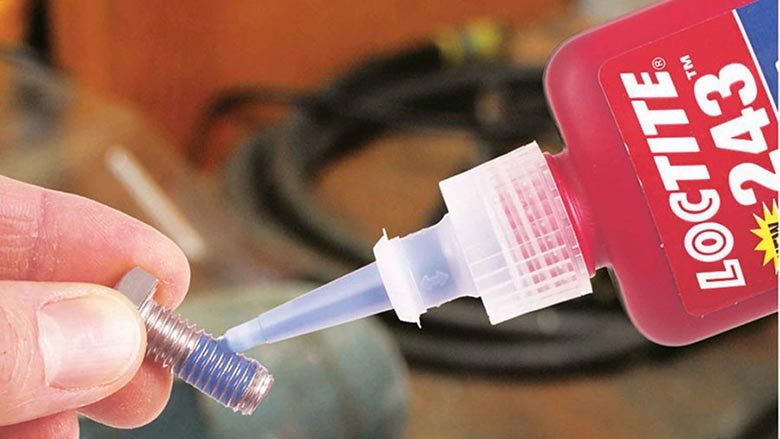
Invented more than 50 years ago by Henkel Corporation (then Loctite), anaerobic threadlockers are single-component adhesives that cure into tough thermoset plastics when exposed to active metals and deprived of air. Threadlockers completely fill the voids between interfacing threads, which prevents side-to-side movement and ultimately prevents loosening.

Threadlocking adhesives are the most reliable and cost-effective method to ensure that a threaded assembly will remain locked and sealed for its entire service life. Available in a variety of strengths, they offer excellent temperature resistance, rapid fixture/cure speeds, and easy dispensing. For ease of use, they are available in liquid, gel, stick, and tape forms, and can be used on any shape or size fastener. The newest threadlocking adhesives chemistries provide higher temperature resistance, improved oil tolerance, and primerless performance.

Anaerobic threadlockers act as lubricants during fastener tightening, which allows applied torque to be converted into high clamp load instead of dissipating as friction or heat. Once cured, threadlockers provide a reliable seal, preventing leaks, galling, and corrosion that can seize threads and prevent disassembly.


Spec in Reliability with Anaerobic Threadlockers

For through-hole assemblies, threadlockers are applied where the nut and bolt will meet when fully tightened. For blind-hole assemblies, threadlockers are applied to both the bolt and the mating threads. Water-thin liquid threadlockers can be applied post-assembly.
Anaerobic threadlockers have dramatically increased the reliability of threaded assemblies.

To spec in reliability, specify Loctite® anaerobic threadlockers. When it comes to resisting vibration, preventing corrosion/leakage, improving quality, and reducing weight, size and overall cost of an assembly, mechanical fasteners just don’t hold up.

For more information or the Loctite® Threadlocking User’s Guide, go to www.useloctite.com/AA22 or for technical assistance, call 1-800-LOCTITE (562-8483).


|PrintEmail

Did you enjoy this article? Click here to subscribe to the magazine.

Most Emailed Articles

  1. Wire Processing: Auto Industry Goes Metric
  2. This Is Not Your Father's Retirement
  3. Wire Processing: Auto Industry Goes Metric
  4. Budde on Assembly Automation: Getting the Most Out of Your Assembly and Test Equipment Provider
  5. New Great Dane Plant to be Built in GA
  6. Web Exclusive: More Techniques to Reduce Robot Cycle Times
  7. Leading Lean: Lean and Human Resources
  8. Fastening: Avoiding ESD During Fastening
  9. 50 Years of Assembly: Riveting Technology Forges Ahead
  10. Successful Design For Assembly

Top Searches

  1. Lean Workstation
  2. leak testing
  3. torque
  4. lean
  5. wave solder
  6. Plants
  7. model t
  8. fuel cell
  9. robots
  10. ritter

Most Popular Articles

  1. Mind the Gap 2/20/08
  2. Leading Lean: Build on Your Success 12/17/07
  3. Assembly in Action: Supplier Key to Machine Builderís Success 5/25/07
  4. Ball Grid Array Soldering 1/25/08
  5. Putting the Squeeze on Rivets 12/17/07
  6. Nanotechnology Transforms Lithium-ion Batteries 2/4/08
  7. Successful Design For Assembly 2/26/07
  8. Leading Lean: Make Everything Visual 6/25/07
  9. Leading Lean: Your Lean Library 11/27/07
  10. Select a Workstation for Lean Manufacturing 7/16/07
© 2010 BNP Media. All rights reserved. | Privacy Policy