Assembly Magazine logo
search
Ask ASSEMBLY AI
cart
facebook twitter linkedin youtube
  • Sign In
  • Create Account
  • Sign Out
  • My Account
Assembly Magazine logo
  • TRENDS
    • Ask ASSEMBLY AI
    • Trends
    • News
    • New Products
  • INDUSTRIES
    • Aerospace
    • Appliance
    • DFMA Assembly
    • Medical Devices
    • Green Manufacturing
    • Lean Manufacturing
    • Machinery Assembly
    • Electronics Assembly
    • Automotive
  • TECHNOLOGIES
    • Adhesives & Dispensing
    • Assembly Presses
    • Automated Assembly Systems
    • Manufacturing Management
    • Manufacturing Software
    • Motion Control
    • Screwdriving & Riveting
    • Robotics
    • Test & Inspection
    • Plastics & Metal Welding
    • Wire Processing
    • Workstations
  • AUTONOMOUS & ELECTRIC MOBILITY
    • AEM Magazine Archives
    • Autonomy
    • Electrification
    • Mobility Services
    • Assembly & Testing
    • AV/EM News
  • MEDIA
    • Ask ASSEMBLY AI
    • Podcasts
    • Assembly News Now
    • Assembly TV
    • Webinars
    • eBooks
  • EVENTS
    • Calendar
    • The ASSEMBLY Show
  • MORE
    • Exclusives >
      • Plant of the Year
      • Capital Spending
    • Buyers Guide >
      • Supplier Insights
    • Classifieds
    • Featured Products
    • Newsletters
    • Store
    • White Papers
    • Columns
    • Sponsor Insights
  • INFOCENTER
    • Assembly & Test Solutions
  • EMAGAZINE
    • eMagazine
    • Archive Issues
    • Advertise
    • Contact Us
    • Sign Up

Automation Gets Smart and Agile

October 1, 2001

For manufacturers of medical, automotive, electrical, computer and telecommunications products, the next century will bring many of the same challenges as the previous century. Assemblies will get smaller. Product life cycles—and, therefore, time to market—will get shorter. Qualified technical help will be harder to find.

The need for smaller, more precise as-semblies will stimulate major changes in assembly technology during the year 2000 and beyond. For example, new, smaller medical products are being developed at an accelerated pace each year. This is creating demand for compact, precise, high-speed assembly systems that can operate in clean rooms and meet Food and Drug Administration requirements. Similarly, in the automotive industry, assemblies are getting smaller and more precise. Moreover, manufacturers throughout the auto industry are requiring suppliers of assembly systems to be ISO 9001 certified. And by 2010, most automotive manufacturers will re-quire assembly systems suppliers to be QS 9001 certified.

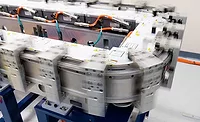
To meet this demand, automation suppliers will offer standard assembly systems. These systems will be engineered for low cost, high reliability, and ease of use and maintenance. Because they can be built to a forecast, rather than to order, standard assembly systems can be delivered faster and take much less time to install and commission. This will allow assemblers to get new products to market faster.

Feeder bowls and pneumatic pick-and-place devices are common in today’s automated assembly systems. In the next century, these devices will increasingly be replaced with flexible parts feeders and robots. Adaptable feeders and robots can be reprogrammed to feed and assemble different parts, with little or no mechanical changes. These agile systems will be able to build many product variants on the same line at the same time. Flexible feeding systems will also let assemblers implement demand-pull systems, building to order instead of forecasts. This will help assemblers reduce their dependence on costly inventory.

The shortage of qualified technical support personnel will continue into the 21st century. As a result, automated assembly systems must continue to get simpler to operate. Systems must get smarter so that less technically skilled personnel can operate them successfully. "Smarter" means that systems must self-diagnose problems and alert the operator before the process fails. In some cases, assembly systems must be able to self-correct processes that are trending out of specification. The need for smarter systems will drive the conversion from assembly systems controlled by programmable logic controllers (PLCs) to those controlled by personal computers with PLC emulators.

The shortage of qualified personnel, coupled with shorter time-to-market demands, will increase the need for outsourcing. Manufacturers will be forced to push the building of subassemblies and complete assemblies upstream to their suppliers. This will create strong growth in contract assembly. And, it will allow manufacturers in industries with short product life cycles to concentrate on their core competencies of product development, marketing and sales.

To meet manufacturers’ time to market demands, machine builders and systems integrators will have to deliver assembly systems in less time. Moreover, those systems will have to produce more assemblies per square foot of plant space, at a lower total cost per assembly. In turn, these demands will flow down to the suppliers of assembly technologies that go into multistation automated assembly systems, such as ultrasonic welders, laser welders, screwdrivers, riveters, epoxy dispensers, leak testers, controllers, parts feeders, robots and vision systems.

Compared with today’s equipment, the purchase cost per part for assembly automation will decrease during the next century—a result of increasing cost pressures from assemblers. This will be achieved with the use of compact, high-speed, cam-operated assembly systems. However, as assembly systems get more flexible and more able to build multiple product models, the total cost per system may increase while the cost per part decreases.

June 1999

Looking for quick answers on assembly and manufacturing topics? Try Ask ASM, our new smart AI search tool. Ask ASM →

Share This Story

Looking for a reprint of this article?
From high-res PDFs to custom plaques, order your copy today!

Recommended Content

JOIN TODAY
To unlock your recommendations.

Already have an account? Sign In

  • Made in the U.S.A.

    Consumer Products Manufacturing: Made in the USA

    Supply chain lessons learned during the coronavirus...
    Automated Assembly Systems
    By: Austin Weber
  • Best Practices for Press-Fit Assembly

    Best Practices for Press-Fit Assembly

    In manufacturing, ironclad formulas for success are hard...
    Assembly Presses
    By: Jim Camillo
  • aem0523leader-tesla1.jpg

    Tesla Rethinks the Assembly Line

    Engineers at Tesla Inc. have developed a new process that...
    Assembly and Testing
    By: Austin Weber
Manage My Account
  • eMagazine Subscription
  • Assembly Newsletters
  • Online Registration
  • Subscription Customer Service
  • Manage My Preferences

More Videos

Sponsored Content

Sponsored Content is a special paid section where industry companies provide high quality, objective, non-commercial content around topics of interest to the ASSEMBLY audience. All Sponsored Content is supplied by the advertising company and any opinions expressed in this article are those of the author and not necessarily reflect the views of ASSEMBLY or its parent company, BNP Media. Interested in participating in our Sponsored Content section? Contact your local rep!

close
  • ultrasonic welding
    Sponsored bySonobond Ultrasonics

    Engineering Efficiency in High-Performance Assembly: How Ultrasonic Welding Enhances Throughput, Reliability and Quality

  • UV curing system
    Sponsored byDymax

    Why UV Intensity Alone Doesn’t Define Curing Performance

  • wooden pallets
    Sponsored byLEAN Manufacturing Products

    Eliminating Waste on the Shop Floor: Applying Lean Principles to Improve Manufacturing Efficiency

Popular Stories

ASSEMBLY News Now, episode-30: Volvo Redesigns EV Manufacturing

Volvo Redesigns EV Manufacturing

Boeing CEO Kelly Ortberg announces 1 billion investment

Boeing Plans $1 Billion Wichita Investment, Workforce Training Center

automated consumer goods assembly system

Best Practices for Cycle Time Optimization

Watch the latest episode of ANN now!

Events

July 24, 2025

From Shop Floor to CFO: How Manufacturers Are Closing the Loop Between Operations and Finance

On Demand Learn how manufacturers are bridging the gap between the shop floor and ERP systems to gain real-time visibility, streamline operations, and kick-start digital transformation—without waiting years.

Sponsored by:

PicoStratusGreen
July 30, 2025

Buffer Analysis and Design Fundamentals for Manufacturing Excellence

On Demand In this presentation, Dr. Herman Tang shares practical insights from his industry experience and research on buffer management in manufacturing operations.

View All Submit An Event

Poll

Difficult Assembly Processes

Which assembly process gives you the most difficulty?
View Results Poll Archive

Products

Manufacturing Cost Policy Deployment (MCPD) Profitability Scenarios: Systematic and Systemic Improvement of Manufacturing Costs

Manufacturing Cost Policy Deployment (MCPD) Profitability Scenarios: Systematic and Systemic Improvement of Manufacturing Costs

See More Products
Register for webinar - Modernizing Automotive Assembly: Why Upgrading Legacy MES is a Business Imperative

Related Articles

  • Motion Control Gets Smart

    Motion Control Gets Smart

    See More
  • Power Distribution Gets Smart

    Power Distribution Gets Smart

    See More
  • Automation Profiles: Agile Robotic System Clads Car Wheels

    See More

Related Products

See More Products
  • smart.jpg

    Handbook of Smart Manufacturing Forecasting the Future of Industry 4.0

  • advanced.jpg

    Functional and Smart Materials

  • smart.jpg

    Smart Manufacturing: The Lean Six Sigma Way

See More Products

Related Directories

  • Quartic

    Decision Intelligence for Manufacturing Operations Management. Deliver responsive, agile operations with smart manufacturing solutions powered by AI and DataOps for real-time context.
×

Never miss the latest news and trends driving the manufacturing industry

Stay in the know on the latest assembly trends.

JOIN TODAY!
  • RESOURCES
    • Advertise
    • Contact Us
    • Directories
    • Manufacturing Division
    • Store
    • Want More?
  • SIGN UP TODAY
    • Create Account
    • eMagazine
    • Newsletters
    • Customer Service
    • Manage Preferences
  • SERVICES
    • Marketing Services
    • Reprints
    • Market Research
    • List Rental
    • Survey/Respondent Access
  • STAY CONNECTED
    • LinkedIn
    • Facebook
    • Instagram
    • YouTube
    • X (Twitter)
  • PRIVACY
    • PRIVACY POLICY
    • TERMS & CONDITIONS
    • DO NOT SELL MY PERSONAL INFORMATION
    • PRIVACY REQUEST
    • ACCESSIBILITY

Copyright ©2026. All Rights Reserved BNP Media, Inc. and BNP Media II, LLC.

Design, CMS, Hosting & Web Development :: ePublishing