Bonding Lines: "Epoxy Those Parts"

The verb form, “to epoxy,” has become so synonymous with adhesive bonding that “I epoxied it” commonly refers to joining parts with any adhesive, regardless of the adhesive chemistry that was actually used. What is an epoxy, and what is it about this ubiquitous adhesive that has elevated it to generic status?
Epoxies were among the first high-performance adhesives and date back more than 60 years. They are often produced by “epoxidizing” phenolic resins, themselves derived from nature to be among the first synthetic polymers. The epoxide ring, or oxirane, readily reacts with and joins acids or bases, giving rise to wide-ranging curing possibilities. A multi-epoxide having two or more epoxy groups can react with multifunctional acids or bases producing a polymer. Most curing agents are amine-based but may contain sulfur, acid groups or other phenolics. The ring-opening reaction “condenses” or adds the chain having the reactant and also produces a pendant alcohol group, forming a “polyol” of sorts.
Secondary reactions with the alcohol group are possible. Adding isocyanate produces a urethane crosslink while adding acids or anhydrides produces a polyester crosslink. Normally the alcohol group is left unreacted, which leaves a site for moisture attraction over time. Secondary reactions not only expand the operating range and properties for the system, they can also improve moisture resistance.
The performance of most common epoxies derives from the included chain of phenolic rings. This imparts high internal strength and chain stiffness, along with temperature, chemical and electrical resistance. Most curing agents add to the polymer, allowing adhesive properties to be tailored by choice of curing agents. Some curing agents do not add, meaning the formulator must choose blends of epoxidized resins that will co-cure. Additionally, reactive rubber modifiers are included to impart toughness, along with several filler types to impart rheological and other properties.
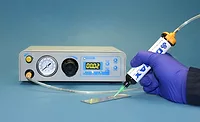
Epoxy adhesives come in liquid, paste or film form. Many liquid and paste adhesives are two-part systems that require mixing in a prescribed ratio. Some pastes and most films are one-part systems that contain a curing agent insoluble at room temperature. The curing agent dissolves on heating to start the cure. Films require freezer storage although many one-part pastes are shelf-stable for months. Epoxies are dispensed using many methods including cup-and-stick mixing, premeasured cartridge systems, syringes and pumps.
Common epoxy-phenolic resins thin substantially with increasing temperature enabling them to wet surfaces easily when externally heated or during self-heating for room temperature cure. This outstanding wetting property enables them to bond well to many surfaces, especially treated surfaces, and is a major reason for their exceptional usefulness and versatility.
The ability to bond with a wide variety of substrates, and inherent strength, make epoxies popular for structural bonding in many industries. For aerospace applications, composites, honeycomb structures, and many metals are bonded with epoxy pastes or films. Epoxies, along with acrylics and urethanes, are used to bond metals and composites in the automotive industry, and composites in the marine industry. Medical and electronics applications for epoxies include potting, encapsulating and structural bonding. Epoxies are also formulated to be conductive adhesives.
Epoxies have relatively slow curing speed, usually requiring hours to cure, compared with acrylics or urethanes, which often cure in minutes. Fast-cure epoxies exist, often producing a more brittle material, but are very useful for rapid high-strength repair. Using ovens or induction heating to accelerate epoxy curing is common. Accelerated curing frees the formulator to include the best combination of polymer properties without making sacrifices for curing speed. UV-curable epoxies contain a latent curing system that liberates acid to initiate curing when they are exposed to UV light. Like their acrylic counterparts, these cure in seconds.
Some epoxy resins and curing agents may induce contact dermatitis, raising health concerns. Simple industrial hygiene practices limiting skin contact address this. Cured epoxies can usually be discarded as nonhazardous waste but, being thermoset polymers, they are not readily recyclable.
Epoxy adhesives often set the structural performance benchmark for competitive technologies. There are hundreds of products available in many forms coming from suppliers worldwide. They are easy to use and, given the right surface preparation, there are few materials combinations they won’t bond. It is little wonder this class of adhesives has earned the honorific of universal acceptance: “I just epoxied it.”
Looking for a reprint of this article?
From high-res PDFs to custom plaques, order your copy today!