Automatic Adhesive Dispensing Equipment Provides High Repeatability for Manufacturer of Stove Parts
Casbe Industries in Temecula, CA, manufactures components for gas cook stoves, including filters, tube assemblies, injection molded components, valves, fittings, door gaskets and burner knobs.
Recently, the company implemented an LDS9000 positive-displacement dispenser from Fishman Corp. to colorize engraved lettering on oven door handles for kitchen-equipment manufacturer Imperial Range. Although the task may sound like an easy one, getting precise, consistent results proved surprisingly difficult.
“We first tried to paint the color in the engraved area. But, we couldn’t get the edge quality and color consistency that we needed,” says Casbe CEO Everton Cope. After that, the company tried using a pneumatic dispenser to fill the engraved letters with a urethane-based epoxy that had a colorant mixed in. However, this approach proved problematic due to the unreliability of the company’s pneumatic dispensing system.
Specifically, being pneumatically operated, the dispenser depended on a column of air to apply pressure to a piston in a syringe to push out the epoxy. Unfortunately, the amount dispensed would vary as the syringe went from being full to nearly empty. This, in turn, would result in partially filled or overfilled letters, with the color of the epoxy varying from dark blue to light blue, depending on the thickness of the amount dispensed. To achieve acceptable color consistency, the epoxy layer needs to be between 0.01- and 0.015-inch thick.
“Clearly, we had to have a better solution, and we began to look around for other means of dispensing the epoxy,” Cope says. “Eventually, we came upon the Fishman LDS9000…. Within days, we had a prototype up and running, and the improvement was dramatic, both in terms of precision and repeatability.”
In contrast to pneumatic systems, the Fishman dispenser employs a linear actuator, which provides a highly controllable positive-displacement force on the piston. Because of the stability of the drive mechanism, the viscosity of the material and the amount in the syringe have minimal impact on dispense volume. Simply activating the control, either manually or automatically, ensures high repeatability. After a dot of adhesive is dispensed, a programmable pullback of the piston prevents fluid ooze.
“A big help to us was the fact that dispensing of the epoxy is essentially unaffected by either temperature, changing viscosity or the amount of material in the syringe. You get the same preprogrammed amount of epoxy with each shot. As a matter of fact, the gun can’t deliver anything but that amount, until the control unit is programmed for a different amount,” Cope says.
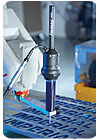
Fishman dispensers can be used in a handheld mode, or they can be mounted on bench-top stands or ganged in fixtures and programmed for automated operation. In the case of the American Stove Parts application, the company initially operated the dispensers manually. But, it has since teamed up with engineers at Fishman to develop a robotic system, with the dispensing gun mounted on a robotic arm. A foot pedal is employed to initiate both the mechanical movement of the arm and the programmed dispensing of the epoxy.
“Movement of the arm is controlled and does not change from part to part,” Cope says. “Between the dispensing system and the robotics, we have achieved the precision and repeatability we need, and we’ve eliminated possible causes of variations in the results.”
For more on dispensing, visit www.fishmancorp.com or call 800-433-2115.
Looking for quick answers on assembly and manufacturing topics? Try Ask ASM, our new smart AI search tool. Ask ASM
Looking for a reprint of this article?
From high-res PDFs to custom plaques, order your copy today!