Assembly in Action: Motion Control Critical to Machine's Success
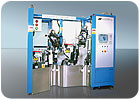
Lambert Engineering Ltd. (North Yorkshire, England) builds automated production equipment for a wide range of customers, including those in the automotive industry. Recently, the company landed a contract with automotive supplier TI Automotive Group (Oxford, England) to build an automated workstation to assemble plastic fuel-line components for four-wheel-drive vehicles.
In addition to handling a number of complex component shapes, the system performs a series of hotplate welding operations to attach a hose assembly to a large molded plastic component known as a “carrier.” Following installation, this carrier is surrounded by the vehicle’s fuel tank in such a way that it is impossible to inspect and repair. Therefore, all hose connections need to be of the highest integrity to ensure long-term reliability.
Central to the machine’s success has been a battery of servo-pneumatic drives and valves from Festo Corp. (Hauppauge, NY), which performs a variety of motion and positioning functions.
“We use Festo pneumatic components, including servo technology, for many of our automation designs, and consider them to be the most reliable and cost-effective products on the market,” says Lambert industrial engineer Matthew Cox. “This particular machine also employs Festo pneumatic cylinders and Profibus-controlled CPV compact valve terminals on many of its other motion axes.”
In its final configuration, the carrier machine includes two functionally independent assembly stations, which are housed in the same cabinet and share the same control system. This is because TI Automotive builds two slightly different carriers for use with gas or diesel engines. Specifically, diesel-style carriers are fitted with a single breather pipe and valve, while the gas-style carriers have two valves. Each assembly station is equipped with a pair of hotplate welders, for attaching the different pipes and valve assemblies.
The entire machine is controlled by a PLC, using a Profibus network for communication with the system’s various I/O functions, including hotplate temperature control and most of the pneumatic control valves.
In operation, an employee loads the hose and valve assemblies along with the carrier body onto a set of pneumatically actuated grippers. The operator then pushes a button to initiate the assembly process. Built-in light guards ensure safety, immediately shutting the machine down if anyone crosses the threshold. The machine checks that the correct components have been loaded before performing any welds.
To attach each carrier’s valve assemblies, a hotplate is driven into position by three separate pneumatic cylinders, trapping the plate between the carrier body and the valve assembly to preheat the surfaces. The main drive cylinder in the welding unit-a Festo ADVU unit-initially exerts a high force to square up the surfaces, after which it reduces the compressive force as the heat penetrates the components. The hotplate is then withdrawn, and the main drive cylinder joins the two components, backing off a little as the weld sets.
Profibus-based multiloop temperature controllers monitor hotplate temperature, and the main drive cylinder is fitted with a linear variable displacement transducer to provide position data to the PLC. Welding and heating forces are measured via a load cell located between the cylinder’s output rod and the component gripper unit. After amplification, this force signal is fed back to the PLC.
Once all processes have been successfully completed, the machine opens the gripper clamps and deactivates the light guard, allowing the operator to remove the completed assembly and reload the machine. Any process errors are immediately flagged by the system controller and are added to an “empirical history file,” which enables the system to make running adjustments to ensure process consistency.
“This machine provides a unique solution,” Cox says. “It is consistently achieving an overall cycle time of 55 seconds-the weld processes takes up some 70 percent of this figure-enabling TI Automotive to meet its customer’s demands for volume delivery of high quality components.”
For more on motion control, visit www.festo.com.
For more on automated assembly machines, visit www.lamberteng.com.
Looking for a reprint of this article?
From high-res PDFs to custom plaques, order your copy today!