Adhesive Bonding
New Adhesive Combines Silicones and Hot-Melts
Silicone reactive hot-melt adhesive is ideal for bonding low-surface-energy materials and dissimilar substrates.
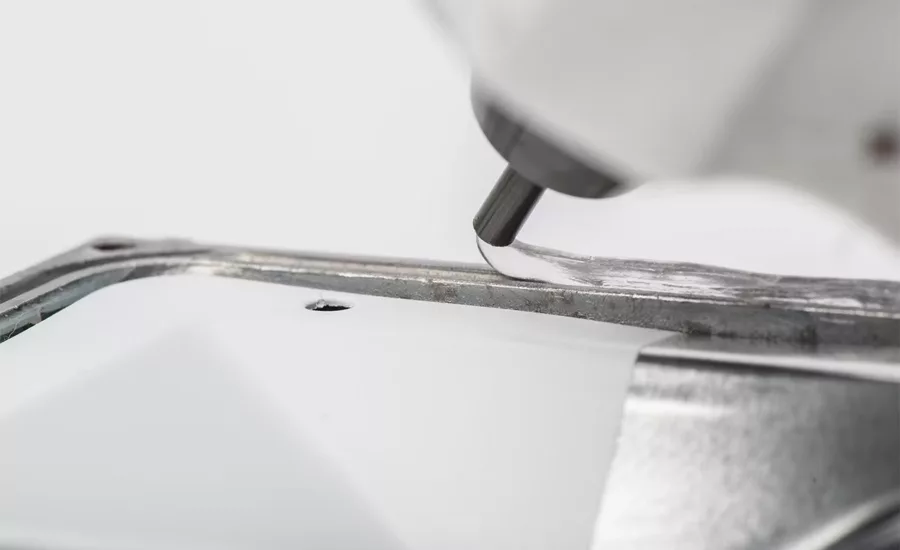
A new adhesive and sealant has been introduced that combines the best characteristics of two established chemistries-silicones and hot-melts. The new material, silicone reactive hot-melt, promises to improve performance, reduce assembly time, and decrease costs when bonding and sealing glass, metal and plastic. Photo courtesy Down Corning
A new adhesive and sealant has been introduced that combines the best characteristics of two established chemistries-silicones and hot-melts. The new material, silicone reactive hot-melt, promises to improve performance, reduce assembly time, and decrease costs when bonding and sealing glass, metal and plastic.
Hot-melts are solvent-free adhesives that are solid at temperatures below 180 F. Above that temperature, they are low-viscosity liquids that rapidly set upon cooling. They are used in many applications, including bookbinding, carton sealing and wood laminating. They’re also used in product assembly applications, such as bonding glass to frames or headliners to car interiors. While liquid adhesives can take 8 to 24 hours to set, hot-melts typically have hold times between 1 and 5 minutes. This lowers assembly time and decreases work-in-process inventory.
Silicone adhesives are highly flexible, though they lack the tensile strength of epoxies or acrylics. Available in both one- and two-part formulations, they resist water, polar solvents, ultraviolet (UV) radiation, ozone and temperatures as high as 600 F or as low as –175 F. They can be electrically conductive or electrically insulating. Curing mechanisms for silicones include moisture, UV light or heat.
A silicone reactive hot-melt adhesive combines attributes of silicones and hot-melts. Its viscosity is 210,000 centipoise at 248 F. The material has a pot life of 24 hours and an open time of 15 minutes. The adhesive is normally clear, but coloring can be added to match a particular assembly.
It has a green strength of 18 psi after 15 minutes and 28 psi after 1 hour. Fully cured, it has a tensile strength of 350 psi, and it can elongate 1,000 percent before breaking. It’s highly resistant to the elements, and it withstands service temperatures from –25 to 200 F.
The adhesive has some unique properties. It behaves like a high-modulus elastomer at low temperatures or under high strain. At the same time, it behaves like a low-modulus elastomer at high temperatures or under constant load.
Silicone reactive hot-melts bond well to plastics, including those with low surface energies, such as polyethylene, polycarbonate, polypropylene, acrylic and polyvinyl chloride. The adhesives also adhere well to glass, aluminum, and painted and treated wood. Primers or surface treatments are not required, but some ambient humidity is necessary to completely cure the material.
Looking for quick answers on assembly and manufacturing topics? Try Ask ASM, our new smart AI search tool. Ask ASM
The adhesive should not be used on surfaces that might bleed oils, plasticizers or solvents. Although it is water-resistant, it should not be used in applications that will be continuously immersed in water. Silicone reactive hot-melts have not been tested or approved for medical applications.
Already, silicone reactive hot-melts are being used to assemble automotive headlamps, solar cells and steam irons. The material is also being used to bond glass windows in a tractor cab and a circuit board to a polypropylene housing.
The adhesive is available in 50-gram cartridges, 304-milliliter cartridges, 18-kilogram pails, 27-kilogram pails and 205-kilogram drums.
Silicone vs. Organic Hot-Melts
Most hot-melt adhesives form strong bonds, set rapidly upon cooling, and are relatively easy to handle. However, their performance characteristics vary widely depending on their chemical structures. Hot-melts fall into two primary groups: silicones and organics (butyls, acrylics and polyurethanes).
Three criteria can help assemblers determine which hot-melt material best meets their needs: productivity, adhesion speed and durability.
Because of their fast curing time and ease of application, hot-melts enable fast and efficient assembly. For example, on a window glazing line employing one or two people, switching from a manually applied tape to an automatically dispensed hot-melt can significantly increase productivity without increasing labor. Compared with acrylic and polyurethane hot-melt sealants, silicone hot-melts have several additional advantages. First, there’s no need for priming or surface activation on most substrates. Second, silicone hot-melts have a longer pot life and longer open time, which gives assemblers time to adjust parts before the adhesive sets. Finally, silicone hot-melts have a higher green strength than organic hot-melts and are easier to clean up.
Silicone has a low heat capacity, so silicone hot-melts cool and thicken very quickly. Silicone hot-melts are “reactive” materials. That is, they initiate a state change in response to a force. Within 30 seconds after applying the material and assembling the parts, the silicone hot-melt cools to provide an “instant” bond. This early bond strength comes both from an increase in the material’s viscosity and the pressure-sensitive adhesive (PSA) character of the material. These two properties give the material a high green strength, which allows assemblies to move from one station to the next without any hold time.
Once cured, silicone hot-melts are much more flexible than organic hot-melts, thanks to their silicone-oxygen backbone. This flexibility results in lower stress on the adhesive and on the bond line. Additionally, silicone hot-melts have lower glass-transition temperatures than their organic counterparts. This allows the sealants to remain flexible well below 0 F, where many organic materials become brittle. Silicone hot-melts also meet environmental standards for volatile organic compounds.
Silicone adhesives have long been the “gold standard” in glazing and other bonding applications that must withstand the elements. Silicone reactive hot-melts share this characteristic. Compared with organic hot-melts, silicone hot-melts are unaffected by long-term exposure to UV light or extreme hot and cold temperatures. The flexibility of the material enables parts to expand and contract, minimizing stress on the joint. This makes the adhesive ideal for bonding materials with widely different coefficients of thermal expansion, such as plastic to aluminum.
Five Tips for Selecting a Sealant
With so many products to choose from, finding the right sealant can be challenging. Using the wrong sealant, or applying the correct sealant in the wrong manner, can have serious consequences. Keep the application in mind, and make sure the sealant has the following characteristics:
1. Stability over a wide temperature range. Once fully cured, high-quality sealants perform across a wide range of temperatures. The best sealants can withstand temperatures ranging from –85 to 600 F. Select a sealant that functions reliably at temperatures outside the performance range to accommodate unexpected temperature changes.
2. Weather resistance and chemical stability. Ultraviolet rays, radiation and weather can cause low-quality sealants to crack, crumble and become brittle, compromising the seal over time. Look for sealants with good resistance to these and other erosive factors. Also, some organic sealants react to atmospheric pollutants or chemicals much like iron reacts with water to produce rust. Use a sealant that does not readily degrade after prolonged contact with common elements and industrial chemicals.
3. Good bond strength. Good sealants provide durable adhesion to a variety of materials, including glass, ceramics, wood, masonry, metals and plastics. A variety of factors contribute to the bond strength of sealants, including chemical composition, cure type and substrate penetration.
4. Electrical properties. If electrical properties are a concern, be aware that some organic sealants are less suited to applications where they may be exposed to electricity. In such instances, a high-quality silicone sealant may be a better option.
5. Low flammability. Some sealants are more burn-resistant than others. Silicone sealants, in particular, are especially difficult to burn and many comply with UL flammability standards.
Looking for a reprint of this article?
From high-res PDFs to custom plaques, order your copy today!