Assembly Magazine logo
search
Ask ASSEMBLY AI
cart
facebook twitter linkedin youtube
  • Sign In
  • Create Account
  • Sign Out
  • My Account
Assembly Magazine logo
  • TRENDS
    • Ask ASSEMBLY AI
    • Trends
    • News
    • New Products
  • INDUSTRIES
    • Aerospace
    • Appliance
    • DFMA Assembly
    • Medical Devices
    • Green Manufacturing
    • Lean Manufacturing
    • Machinery Assembly
    • Electronics Assembly
    • Automotive
  • TECHNOLOGIES
    • Adhesives & Dispensing
    • Assembly Presses
    • Automated Assembly Systems
    • Manufacturing Management
    • Manufacturing Software
    • Motion Control
    • Screwdriving & Riveting
    • Robotics
    • Test & Inspection
    • Plastics & Metal Welding
    • Wire Processing
    • Workstations
  • AUTONOMOUS & ELECTRIC MOBILITY
    • AEM Magazine Archives
    • Autonomy
    • Electrification
    • Mobility Services
    • Assembly & Testing
    • AV/EM News
  • MEDIA
    • Ask ASSEMBLY AI
    • Podcasts
    • Assembly News Now
    • Assembly TV
    • Webinars
    • eBooks
  • EVENTS
    • Calendar
    • The ASSEMBLY Show
  • MORE
    • Exclusives >
      • Plant of the Year
      • Capital Spending
    • Buyers Guide >
      • Supplier Insights
    • Classifieds
    • Featured Products
    • Newsletters
    • Store
    • White Papers
    • Columns
    • Sponsor Insights
  • INFOCENTER
    • Assembly & Test Solutions
  • EMAGAZINE
    • eMagazine
    • Archive Issues
    • Advertise
    • Contact Us
    • Sign Up
Automotive AssemblyAdhesives & Dispensing Assembly

Adhesives for Trailer Assembly

By Brian Noonan
June 30, 2009

Structural adhesives help assemblers of trucks, trailers, buses and other specialty vehicles reduce costs, boost throughput and improve aesthetics.

Henkel engineers assembled this trailer almost entirely with adhesives and sealants. Photo courtesy Henkel Corp.

Manufacturers of specialty vehicles, such as trailers, truck bodies, buses and construction machinery, are increasingly using adhesives and sealants to assemble frames, panels, booms and cabs made of metal, plastic and composites. By building these components with adhesives and sealants instead of welds, threaded fasteners or rivets, engineers can reduce assembly costs, increase throughput, distribute stress more uniformly and improve aesthetics.

To prove the efficiency, durability and cost-effectiveness of adhesive assembly, we acquired a trailer frame-7 feet wide and 10 feet long-and constructed a work trailer almost exclusively using adhesives and sealants. The few fasteners that did make it into the trailer were used to temporarily hold components in place while the adhesives cured. No fasteners were used to provide structural stability.

Some adhesive applications on our trailer have already been tried and tested in the field. However, we also tried many new applications for adhesives and sealants. The end result is a tougher, more reliable, better-looking trailer that cost less to build than a conventional model.

 

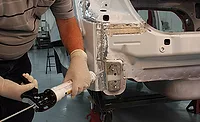
On a traditional trailer, diamond plate is riveted onto the skin, then sealed with caulk. Henkel engineers bonded the plate using a methacrylate adhesive, eliminating mechanical fasteners altogether. The adhesive unitized the assembly and avoided the possibility of rattling. Photo courtesy Henkel Corp.

Step by Step

Bonding bed to frame. In traditional trailer construction, the floor is attached to the frame using mechanical fasteners, a time-intensive process that leaves the trailer susceptible to water damage.

In our project, we bonded the wood floor to the frame using Loctite 5570, an elastic adhesive and sealant that distributes the load evenly over the entire frame and prevents water from leaking in through the floor panels. Only four screws per panel were required to install the entire floor. All totaled, we installed the floor in just 10 percent of the time that would have been necessary had we used fasteners alone.

Loctite 5570 is a one-part adhesive based on a modified silane polymer. The adhesive cures by reacting with atmospheric moisture. Skin formation and curing times depend on humidity, temperature and joint depth. Under normal conditions, the adhesive develops functional strength in 24 hours and fully cures in seven days.

Looking for quick answers on assembly and manufacturing topics? Try Ask ASM, our new smart AI search tool. Ask ASM →

This odorless, noncorrosive adhesive does not contain solvents, isocyanates, silicones or polyvinylchloride. Besides wood, it adheres to stainless steel, galvanized steel, aluminum, glass, fiberglass and plastics. It is compatible with most paint formulations. Resistant to ultraviolet radiation, the adhesive can be used for both interior and exterior applications.

Bonding skins to frame. The sheet-metal skin covering the sides of a trailer are usually riveted or bolted onto the frame.

Instead, we used two fast-fixturing structural acrylics: Loctite H4500 and H8600. During the cure process, we used screws to fixture the skin in place. By bonding the skins to the frame with adhesive, 90 percent fewer fasteners were needed for assembly, resulting in a better looking, stronger, more leak-resistant trailer. This same process was used to bond the door and roof skins.

Loctite H4500 is a highly thixotropic, two-part methacrylate adhesive for bonding metals, such as steel, stainless steel and aluminum. It also bonds epoxy-coated metal, sheet-molding compound and many plastics. The adhesive bonds to metals without a primer. It contains a corrosion-inhibiting additive to ensure long-term bond durability even when exposed to moisture. Mixed at a ratio of 10-to-1, the adhesive reaches fixture strength in 15 to 20 minutes at 70°F.

Loctite H8600 is two-part methacrylate for structural bonding of galvanized steel. Mixed at a ratio of 2-to-1, it reaches fixture strength in 55 minutes at 72°F. This toughened adhesive has a high peel strength. A thick material, it can be applied to vertical surfaces without sagging.

Seam sealing the frame and skins. On standard trailers, polyurethane or silicone caulks seal gaps and prevent water penetration. These sealants work well, but they will yellow over time and do not last long in the harsh environment of the road.

On our trailer, we used Loctite 5510 to seal gaps in the frame and all the skins, including the door and roof. Like the adhesive we used to bond the floor, Loctite 5510 is a one-part adhesive based on a modified silane polymer.

Free of isocyanates, solvents and silicones, this low-odor, highly flexible sealant resists vibration, movement and impact. Because it is impervious to UV light, the sealant will not degrade or crack over time. It fixtures quickly and can be color-matched to the skins for seamless assembly.

The adhesive cures by reacting with atmospheric moisture. It develops functional strength in 24 hours and fully cures in seven days, but these times can be shortened by increasing exposure to moisture.

Bonding and sealing panel trim. The panel trim located around the trailer’s frame was bonded using Loctite H4500 and 5570. Panel trim is normally riveted in place, then sealed with polyurethane or silicone caulks. The adhesives in our project simultaneously bond and seal trim materials, even in critical areas such as wheel wells. While fasteners were still needed to help secure the panel trim, the use of adhesive reduced the number of fasteners by 90 percent and shortened assembly time by 40 percent.

Bonding diamond plate and nose to skins. On a traditional trailer, the diamond plate is riveted onto the trailer skin, while the nose is bolted or riveted in place, then sealed with caulk. On our trailer, the diamond plate was bonded with Loctite H4500, eliminating mechanical fasteners altogether. The adhesive unitized the assembly, eliminating any potential for rattling and producing a higher quality appearance.

For the nose assembly, we used the same structural adhesive to bond and seal the nose to the skins, eliminating rivets. Because the nose assembly on our trailer came with predrilled holes, screws had to be inserted to prevent leakage. Still, bonding reduced assembly time by 20 percent and fastener count by 30 percent. In the future, the nose assembly could be redesigned to eliminate predrilled holes, thereby eliminating the need for fasteners.

Bonding internal brackets. Most trailer interiors have galvanized steel brackets for tying down cargo. Ordinarily, we would have secured the bracket plate to the trailer walls using two screws per frame member. The bracket itself would have been secured to the plate using 200 screws.

Instead, we used Loctite H4500 to bond both the plate and the bracket. As a result, we needed only one screw per frame member to fixture the bracket plate, and we needed just 20 screws to install the bracket. Assembly time was 70 percent faster using adhesives, and stress is distributed evenly along the length of the bracket, making it more durable. Adhesive bonding reduced fastener use for this application by 90 percent.

Threadlockers for miscellaneous hardware. For the limited number of threaded fasteners on our trailer, we applied Loctite 2033 threadlocker to prevent vibrational loosening and seizing. This medium-strength gel adhesive locks and seals threaded joints ranging from 0.25 to 1 inch in diameter. It cures in the absence of air between close-fitting metal surfaces. It resists most chemicals, liquids and gases.
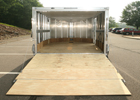
 

Usually, the trailer floor is attached to the frame using mechanical fasteners. Henkel engineers bonded the wooden floor panels to the frame using a one-part modified silane polymer adhesive. The engineers installed the floor in just 10 percent of the time that would have been necessary had they used fasteners. Photo courtesy Henkel Corp.

The Results

The trailer was completed in April 2008. Since then, it’s been on the road, hauling a motorcycle and an all-terrain vehicle throughout the country. The exterior of the trailer is decorated with graphics that were applied without concern for the placement of metal fasteners. As of January 2009, the trailer has logged 7,000 miles and experienced no problems with structural integrity or leakage. In early February, the trailer started a tour of manufacturing locations along the East Coast.

For videos of each step of this assembly project, visit www.gluemytrailer.com.

KEYWORDS: methacrylate adhesive sheet metal bonding structural adhesives threadlockers truck and trailer manufacturing

Share This Story

Looking for a reprint of this article?
From high-res PDFs to custom plaques, order your copy today!

Application Engineer
Henkel Corp.
Rocky Hill, CT

Recommended Content

JOIN TODAY
To unlock your recommendations.

Already have an account? Sign In

  • Made in the U.S.A.

    Consumer Products Manufacturing: Made in the USA

    Supply chain lessons learned during the coronavirus...
    Automated Assembly Systems
    By: Austin Weber
  • Best Practices for Press-Fit Assembly

    Best Practices for Press-Fit Assembly

    In manufacturing, ironclad formulas for success are hard...
    Assembly Presses
    By: Jim Camillo
  • aem0523leader-tesla1.jpg

    Tesla Rethinks the Assembly Line

    Engineers at Tesla Inc. have developed a new process that...
    Industries
    By: Austin Weber
Manage My Account
  • eMagazine Subscription
  • Assembly Newsletters
  • Online Registration
  • Subscription Customer Service
  • Manage My Preferences

More Videos

Sponsored Content

Sponsored Content is a special paid section where industry companies provide high quality, objective, non-commercial content around topics of interest to the ASSEMBLY audience. All Sponsored Content is supplied by the advertising company and any opinions expressed in this article are those of the author and not necessarily reflect the views of ASSEMBLY or its parent company, BNP Media. Interested in participating in our Sponsored Content section? Contact your local rep!

close
  • ultrasonic welding
    Sponsored bySonobond Ultrasonics

    Engineering Efficiency in High-Performance Assembly: How Ultrasonic Welding Enhances Throughput, Reliability and Quality

  • UV curing system
    Sponsored byDymax

    Why UV Intensity Alone Doesn’t Define Curing Performance

  • wooden pallets
    Sponsored byLEAN Manufacturing Products

    Eliminating Waste on the Shop Floor: Applying Lean Principles to Improve Manufacturing Efficiency

Popular Stories

ASSEMBLY News Now, episode-30: Volvo Redesigns EV Manufacturing

Volvo Redesigns EV Manufacturing

Boeing CEO Kelly Ortberg announces 1 billion investment

Boeing Plans $1 Billion Wichita Investment, Workforce Training Center

automated consumer goods assembly system

Best Practices for Cycle Time Optimization

Watch the latest episode of ANN now!

Events

July 24, 2025

From Shop Floor to CFO: How Manufacturers Are Closing the Loop Between Operations and Finance

On Demand Learn how manufacturers are bridging the gap between the shop floor and ERP systems to gain real-time visibility, streamline operations, and kick-start digital transformation—without waiting years.

Sponsored by:

PicoStratusGreen
July 30, 2025

Buffer Analysis and Design Fundamentals for Manufacturing Excellence

On Demand In this presentation, Dr. Herman Tang shares practical insights from his industry experience and research on buffer management in manufacturing operations.

View All Submit An Event

Poll

Difficult Assembly Processes

Which assembly process gives you the most difficulty?
View Results Poll Archive

Products

Manufacturing Cost Policy Deployment (MCPD) Profitability Scenarios: Systematic and Systemic Improvement of Manufacturing Costs

Manufacturing Cost Policy Deployment (MCPD) Profitability Scenarios: Systematic and Systemic Improvement of Manufacturing Costs

See More Products
Register for webinar - Modernizing Automotive Assembly: Why Upgrading Legacy MES is a Business Imperative

Related Articles

  • Adhesives Aid Truck and Trailer Assembly

    Adhesives Aid Truck and Trailer Assembly

    See More
  • Fire Damages Trailer Assembly Plant

    See More
  • Automation Stars at New Trailer Assembly Plant

    See More

Related Products

See More Products
  • Product Design for Manufacture and Assembly, Third Edition

  • 0001346.jpeg

    Designing Plastic Parts for Assembly 9E

  • 0001349.jpeg

    Adhesion and Adhesives Technology 4e

See More Products

Events

View AllSubmit An Event
  • August 14, 2025

    Adhesives, Dispensing and Curing Technology Panel Discussion

    On Demand Get ready for The ASSEMBLY Show happening October 21 – 23 at the Donald E. Stephens Convention Center in Rosemont, Illinois. Join us for an exclusive pre-show webinar to learn about the pros and cons of major adhesive chemistries and how to choose the best dispensing method for your application.
View AllSubmit An Event

Related Directories

  • Retrocausal - AI Copilots For Manufacturing Assembly Optimization

  • Permabond Engineering Adhesives

    Permabond is a global manufacturer, formulator, and innovator of engineering adhesives and sealants. Technologies include cyanoacrylates (instant adhesives), anaerobic (for threadlocking, retaining, gasketing, and pipe sealing), structural adhesives, modified epoxies, MS polymers, polyurethanes, and UV curable adhesives. ISO 9001
  • Adhesives Research Inc.

    Adhesives Research is a global leader in providing adhesive design flexibility, fast development capabilities, combined with unique turnkey solutions. Adhesives Research has a broad range of commercially available products and specially developed adhesive and coating platform technologies for the bonding, assembly and functional performance of Medical devices, Electronics and Industrial applications.
×

Never miss the latest news and trends driving the manufacturing industry

Stay in the know on the latest assembly trends.

JOIN TODAY!
  • RESOURCES
    • Advertise
    • Contact Us
    • Directories
    • Manufacturing Division
    • Store
    • Want More?
  • SIGN UP TODAY
    • Create Account
    • eMagazine
    • Newsletters
    • Customer Service
    • Manage Preferences
  • SERVICES
    • Marketing Services
    • Reprints
    • Market Research
    • List Rental
    • Survey/Respondent Access
  • STAY CONNECTED
    • LinkedIn
    • Facebook
    • Instagram
    • YouTube
    • X (Twitter)
  • PRIVACY
    • PRIVACY POLICY
    • TERMS & CONDITIONS
    • DO NOT SELL MY PERSONAL INFORMATION
    • PRIVACY REQUEST
    • ACCESSIBILITY

Copyright ©2026. All Rights Reserved BNP Media, Inc. and BNP Media II, LLC.

Design, CMS, Hosting & Web Development :: ePublishing