Soldering: Riding the Mini Wave
Automated selective soldering technology saves EMS facilities time and money.
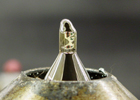
Selective soldering with a miniature wave or fountain of molten solder offers many advantages compared with conventional wave soldering equipment. It requires less energy, generates less dross, provides more control, and can reach certain joints that would otherwise be inaccessible. Moreover, there’s no need for custom-made pallets or shielding for the boards.
These systems can be equipped with a single circular nozzle 2 to 20 millimeters in diameter, a rectangular nozzle 4 to 8 inches long, or multiple nozzles for soldering more than one joint simultaneously. Molten solder is pumped through the nozzle to create a fountain with a directional or spherical shape.
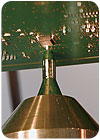
In some systems, the printed circuit board is held stationary, and the solder fountain moves beneath it to solder pins, rows and connectors. The fountain travels in three axes (X, Y and Z) up to solder points and down and around bottom-side components. Precise motion control and the small size of the wave prevent damage to nearby components and pads.
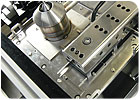
Other systems hold the fountain stationary and move the PCB. Often referred to as “top-side gantry” systems, these machines can position boards along two additional axes of motion: tilt and rotation.
These fourth and fifth axes enable the solder wave to get around bottom-side components and penetrate areas that otherwise could not be reached by a three-axis system. In addition, top-side gantry systems can tilt boards for angled soldering, which can improve yields.
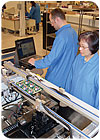
Dave Sackett is a consulting engineer in Maplewood, MN, who has worked with many electronics assemblers. He recommends selective soldering systems driven by precision servomotors, as opposed to inexpensive stepper motors. Automatic loading is also a good feature.
“Handling of PCBs should be tool-free when possible,” he says. “Some systems use expensive and time-consuming tooling for different sizes of PCBs. [This] can substantially reduce the usefulness of the system as an economical and high-mix production tool.”
Programmability is particularly important for any machine in a high-mix assembly environment. “Software should provide a simple user interface and utilize scanned images or Gerber data,” Sackett says. “It should only take minutes to select solder points and nozzle configurations. A simple jog-to-teach set-up camera could also be used to program a board,” he says.
For high-mix production, the system should be able to store an unlimited array of soldering programs. To save time and prevent errors, programs can be triggered automatically through a bar code reader.
With production runs between 500 and 10,000 pieces, manual soldering is costly, not only in terms of labor, but also in quality control.
Two years ago, the company invested in its first selective soldering system. Today, it has three in-line machines running both lead-free and standard boards.
E.I. Microcircuits assembles many boards that require significant masking or large copper ground planes, which are difficult to solder manually. Selective soldering with a mini wave provides constant heat like traditional wave soldering equipment, but with less waste. “We expect volumes to increase in these applications,” King says. “[These boards] will go directly to selective soldering, bypassing wave or hand soldering entirely.”
In the past, E.I. Microcircuits would sometimes run mixed-technology assemblies through a wave soldering machine and then another soldering operation for difficult through-hole components. Now, these assemblies go directly to the selective soldering system. “It can get in-between deep, tight parts and navigate around large components with consistent repeatability,” says King. “You simply can’t get that manually, regardless of how adept the operators might be. ...We have decreased the cost of labor by at least half [using selective soldering],” he says.
“Everything was customized,” he recalls. “You designed the board, and then you had the selective soldering [machine] designed around it. If you needed fast changeover, too bad. Plus, the footprint of the machines was almost the size of a standard wave machine.”
Being a high-mix assembler, Ayrshire needed flexibility. The company finally invested in a mini-wave system that can easily switch from one program to another. “It’s not tied to one product line or niche,” Beard says. “It can do point-to-point when needed, or drag soldering and a mini wave for some larger areas if needed. The system is integrated in-line for complete automated assembly, and the best part is that the footprint is 3.5 feet by 4 feet.”
After a short while, Ayrshire completely eliminated wave soldering on its assembly line. A standard wave soldering system produces a wave that is 18 to 24 inches wide, whereas most PCBs are much smaller. This means the machine is heating a lot of solder and producing a lot of dross unnecessarily, explains Beard.
With their smaller wave nozzles, selective soldering systems are much better suited for boards that are 4 inches wide. The system can accommodate boards that are more than 4 inches wide by moving them in a serpentine pattern over the wave.
Soldering programs can be adjusted to optimize key parameters, such as speed, immersion depth, dwell time and temperature. The net result is that while the smaller wave nozzle solders joints at a slightly slower rate than a traditional wave-soldering machine, it’s more efficient in the long run when maintenance, uptime, consumables and defect rates are factored in.
“We specialize in low- to medium-volume, high-mix, double-sided, surface-mount boards with maybe one or two through-hole parts on them,” says Beard. “Instead of using a wave solder [machine, which required] custom pallets or a masking step, our assemblies now go directly from the dispensing line to the selective soldering step and then on to various inspections.”
Eliminating the wave soldering system saved Ayrshire approximately $120 per day in energy costs and eliminated some 3,500 pounds of dross. “The dross from selective soldering is only spoonfuls,” Beard says.
Ayrshire also saved on labor. “When we went to selective soldering two and a half years ago, we had 16 people doing hand soldering during the first shift, eight people on the second shift, and four on the third,” Beard recalls. “Today, we are building the same volume and same mix of products, and we are down to six people on the day shift. That’s a manpower reduction of 75 percent.”
Selective soldering has made a difference in defect rates, too, particularly with small boards for radio frequency applications. “[If there’s] a tiny icicle on a joint, all of a sudden you have an antenna and it throws off the whole board,” Beard says. “That’s where selective soldering really shines. It has cut our defects-bridging, damage to other parts, and so forth-down to virtually zero.”
Selective soldering with a miniature wave or fountain of molten solder offers many advantages compared with conventional wave soldering equipment. It requires less energy, generates less dross, provides more control, and can reach certain joints that would otherwise be inaccessible. Moreover, there’s no need for custom-made pallets or shielding for the boards.
These systems can be equipped with a single circular nozzle 2 to 20 millimeters in diameter, a rectangular nozzle 4 to 8 inches long, or multiple nozzles for soldering more than one joint simultaneously. Molten solder is pumped through the nozzle to create a fountain with a directional or spherical shape.
In some systems, the printed circuit board is held stationary, and the solder fountain moves beneath it to solder pins, rows and connectors. The fountain travels in three axes (X, Y and Z) up to solder points and down and around bottom-side components. Precise motion control and the small size of the wave prevent damage to nearby components and pads.
Other systems hold the fountain stationary and move the PCB. Often referred to as “top-side gantry” systems, these machines can position boards along two additional axes of motion: tilt and rotation.
These fourth and fifth axes enable the solder wave to get around bottom-side components and penetrate areas that otherwise could not be reached by a three-axis system. In addition, top-side gantry systems can tilt boards for angled soldering, which can improve yields.
Soldering nozzles come in various shapes and sizes to suit specific applications.
Different Strokes: EMS Views
Change is a constant in electronics assembly. New alloys, fluxes and temperature demands are the norm. Production volumes increase and decrease quickly, and design life cycles can be short. Floor space is at a premium, and there is a constant push to reduce costs, increase productivity and improve quality. In this environment, assemblers must run lean, green and mean. This has opened up opportunities for selective soldering technology.Dave Sackett is a consulting engineer in Maplewood, MN, who has worked with many electronics assemblers. He recommends selective soldering systems driven by precision servomotors, as opposed to inexpensive stepper motors. Automatic loading is also a good feature.
“Handling of PCBs should be tool-free when possible,” he says. “Some systems use expensive and time-consuming tooling for different sizes of PCBs. [This] can substantially reduce the usefulness of the system as an economical and high-mix production tool.”
Programmability is particularly important for any machine in a high-mix assembly environment. “Software should provide a simple user interface and utilize scanned images or Gerber data,” Sackett says. “It should only take minutes to select solder points and nozzle configurations. A simple jog-to-teach set-up camera could also be used to program a board,” he says.
For high-mix production, the system should be able to store an unlimited array of soldering programs. To save time and prevent errors, programs can be triggered automatically through a bar code reader.
Programmability is particularly important for any machine in a high-mix assembly environment. Soldering software should provide a simple user interface and use scanned images or Gerber data.
Filling a Gap
In the past, high-mix, low-volume assemblers had two choices for assembling mixed-technology boards: wave soldering or manual soldering. “Our first choice was always wave soldering,” recalls Todd King, vice president of operations at E.I. Microcircuits Inc. in Mankato, MN. “It is the highest volume and the most economical. What prevents wave soldering are unique components and some tight configurations particularly in [radio frequency applications], or large components that cannot be waved or masked. Then we [reverted] to hand soldering.”With production runs between 500 and 10,000 pieces, manual soldering is costly, not only in terms of labor, but also in quality control.
Two years ago, the company invested in its first selective soldering system. Today, it has three in-line machines running both lead-free and standard boards.
E.I. Microcircuits assembles many boards that require significant masking or large copper ground planes, which are difficult to solder manually. Selective soldering with a mini wave provides constant heat like traditional wave soldering equipment, but with less waste. “We expect volumes to increase in these applications,” King says. “[These boards] will go directly to selective soldering, bypassing wave or hand soldering entirely.”
In the past, E.I. Microcircuits would sometimes run mixed-technology assemblies through a wave soldering machine and then another soldering operation for difficult through-hole components. Now, these assemblies go directly to the selective soldering system. “It can get in-between deep, tight parts and navigate around large components with consistent repeatability,” says King. “You simply can’t get that manually, regardless of how adept the operators might be. ...We have decreased the cost of labor by at least half [using selective soldering],” he says.
In some selective soldering systems, the board is held stationary, and the solder fountain moves beneath it. In others, the fountain remains stationary, and the board moves.
Replacing Wave
When Ayrshire Electronics first began looking at selective soldering technology, it had some concerns. James Beard, director of manufacturing for Ayrshire’s Oakdale, MN, facility, says the first machines he looked at were not flexible or easy to program.“Everything was customized,” he recalls. “You designed the board, and then you had the selective soldering [machine] designed around it. If you needed fast changeover, too bad. Plus, the footprint of the machines was almost the size of a standard wave machine.”
Being a high-mix assembler, Ayrshire needed flexibility. The company finally invested in a mini-wave system that can easily switch from one program to another. “It’s not tied to one product line or niche,” Beard says. “It can do point-to-point when needed, or drag soldering and a mini wave for some larger areas if needed. The system is integrated in-line for complete automated assembly, and the best part is that the footprint is 3.5 feet by 4 feet.”
After a short while, Ayrshire completely eliminated wave soldering on its assembly line. A standard wave soldering system produces a wave that is 18 to 24 inches wide, whereas most PCBs are much smaller. This means the machine is heating a lot of solder and producing a lot of dross unnecessarily, explains Beard.
With their smaller wave nozzles, selective soldering systems are much better suited for boards that are 4 inches wide. The system can accommodate boards that are more than 4 inches wide by moving them in a serpentine pattern over the wave.
Soldering programs can be adjusted to optimize key parameters, such as speed, immersion depth, dwell time and temperature. The net result is that while the smaller wave nozzle solders joints at a slightly slower rate than a traditional wave-soldering machine, it’s more efficient in the long run when maintenance, uptime, consumables and defect rates are factored in.
“We specialize in low- to medium-volume, high-mix, double-sided, surface-mount boards with maybe one or two through-hole parts on them,” says Beard. “Instead of using a wave solder [machine, which required] custom pallets or a masking step, our assemblies now go directly from the dispensing line to the selective soldering step and then on to various inspections.”
Eliminating the wave soldering system saved Ayrshire approximately $120 per day in energy costs and eliminated some 3,500 pounds of dross. “The dross from selective soldering is only spoonfuls,” Beard says.
Ayrshire also saved on labor. “When we went to selective soldering two and a half years ago, we had 16 people doing hand soldering during the first shift, eight people on the second shift, and four on the third,” Beard recalls. “Today, we are building the same volume and same mix of products, and we are down to six people on the day shift. That’s a manpower reduction of 75 percent.”
Selective soldering has made a difference in defect rates, too, particularly with small boards for radio frequency applications. “[If there’s] a tiny icicle on a joint, all of a sudden you have an antenna and it throws off the whole board,” Beard says. “That’s where selective soldering really shines. It has cut our defects-bridging, damage to other parts, and so forth-down to virtually zero.”
Looking for a reprint of this article?
From high-res PDFs to custom plaques, order your copy today!