AIA: Magna Uses Robots, Adhesive on Hatches
Magna Door Systems/Uniport (Hambach, France) is a Tier 1 automotive supplier that manufactures hatchback assemblies for DaimlerChrysler's MCC Smart Car. As is the case with many automotive models, the Smart Car incorporates adhesives in a number of assemblies to reduce weight and cost. Adhesives also serve to effectively join dissimilar materials like glass, plastics and metals. In the case of the rear hatch, a number of thermoplastic subassemblies are glued directly to a glass pane, including a closure handle and gas-pressure dampers.
To streamline the assembly process and ensure consistency, Magna Door Systems employs robots from Reis Robotics (Obernburg, Germany) as well as adhesives from Dow Automotive Ltd. (Schwalbach, Germany, formerly Gurit-Essex GmbH).
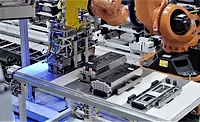
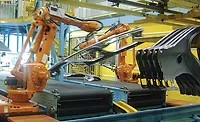
Midway down the hatchback line is an assembly cell comprised of five joining stations and two RV16 articulated-arm robots. The five stations are arranged in a line, with a robot operating on each side. One robot positions the rear hatches and their various components in the stations. The other applies a two-component polyurethane adhesive.
Before entering the cell, each glass pane is coated with a primer at a loading station, where the handling robot picks it up. The handling robot, which is controlled by an RLV 10 processor, uses a multifunction gripper incorporating a combination of vacuum, tensioning, centering and magnetic technologies to both position the glass pane and load its various attendant parts. When the new pane and parts are positioned, the handling robot shifts position and removes a finished pane assembly from one of the other stations, moving it to an off-loading station where an operator performs a visual inspection.
While this is happening, the second "adhesive dosing" robot is applying short beads of Betamate 2800 adhesive to the recently deposited pane and parts. Once this is done, a set of automatic clamps join and clench the components, and the adhesive is cured using infrared light, which heats the joints to 65 C. At the end of the curing cycle, the automatic clamps release the assembly and signal the handling robot that the hatch is ready to be removed.
The two components of the Betamate 2800 adhesive are combined at a 1-to-1 ratio using a static synthetic mixer. The adhesive can be applied while the primer coat is still wet, which reduces cycle times. According to Magna, using an adhesive to bond the parts is actually faster than using screws or rivets. The one stipulation is that the adhesive must be precisely placed to create an effective joint. This is made possible by the high repeatability of the dosing robot, which, like the handling robot, is controlled by an RLV 10 processor.
For more on robotic parts positioning and dispensing, call 847-741-9500 or visit www.reisrobotics.com.
For more on adhesives assembly, call 49-6196-566-614 or visit www.dow.com/automotive.
Looking for quick answers on assembly and manufacturing topics? Try Ask ASM, our new smart AI search tool. Ask ASM
Looking for a reprint of this article?
From high-res PDFs to custom plaques, order your copy today!