Assembly Magazine logo
search
Ask ASSEMBLY AI
cart
facebook twitter linkedin youtube
  • Sign In
  • Create Account
  • Sign Out
  • My Account
Assembly Magazine logo
  • TRENDS
    • Ask ASSEMBLY AI
    • Trends
    • News
    • New Products
  • INDUSTRIES
    • Aerospace
    • Appliance
    • DFMA Assembly
    • Medical Devices
    • Green Manufacturing
    • Lean Manufacturing
    • Machinery Assembly
    • Electronics Assembly
    • Automotive
  • TECHNOLOGIES
    • Adhesives & Dispensing
    • Assembly Presses
    • Automated Assembly Systems
    • Manufacturing Management
    • Manufacturing Software
    • Motion Control
    • Screwdriving & Riveting
    • Robotics
    • Test & Inspection
    • Plastics & Metal Welding
    • Wire Processing
    • Workstations
  • AUTONOMOUS & ELECTRIC MOBILITY
    • AEM Magazine Archives
    • Autonomy
    • Electrification
    • Mobility Services
    • Assembly & Testing
    • AV/EM News
  • MEDIA
    • Ask ASSEMBLY AI
    • Podcasts
    • Assembly News Now
    • Assembly TV
    • Webinars
    • eBooks
  • EVENTS
    • Calendar
    • The ASSEMBLY Show
  • MORE
    • Exclusives >
      • Plant of the Year
      • Capital Spending
    • Buyers Guide >
      • Supplier Insights
    • Classifieds
    • Featured Products
    • Newsletters
    • Store
    • White Papers
    • Columns
    • Sponsor Insights
  • INFOCENTER
    • Assembly & Test Solutions
  • EMAGAZINE
    • eMagazine
    • Archive Issues
    • Advertise
    • Contact Us
    • Sign Up
ColumnsMachinery AssemblyTest and Inspection Assembly

Deere Keeps Tractors Cool With Leak Tester
deere assembly plant
May 3, 2005

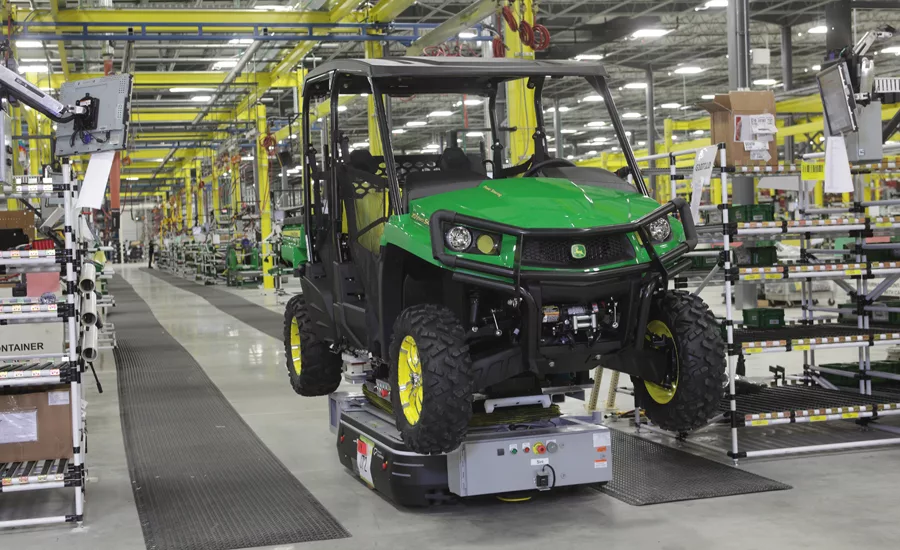
The Deere & Co. assembly plant in Augusta, GA, uses automated guided vehicles (AGVs) to build the company's Series 5000 tractor. In an integrated and networked process that takes less than 4 hours, each AGV transits a 1,452-foot assembly line along which approximately 3,500 tasks are performed as each tractor passes through 106 workstations.

One of the critical steps in the tractor assembly process is leak testing of the air conditioning system. A single leak the size of a bacteria cell can cause the loss of 1 gram of refrigerant per year, potentially rendering an air conditioning system inoperable in a few years.

"Our customers depend on the reliability of our air conditioning systems," says Bill Tasch, assembly engineer at the Augusta plant. "They sit in the tractor's glass cab for hours at a time, and it would not be easy to haul a tractor to a shop for repairs if the AC system had a slow leak. To maintain high customer satisfaction, we make sure we have a tight AC system before we charge it with refrigerant, and before it leaves the factory."

Because of the complexity of its operations, Deere needed a leak-detection tool that could be integrated into the automated assembly process. This meant reliably and consistently performing within the cycle time allowed at each workstation along the AGVs' path.

Traditional wet methods of air conditioner leak testing-submersion and soap-bubble testing-were not viable options because they could not be easily automated. These methods are also prone to operator error and incapable of detecting leaks as small as those of concern to Deere engineers.

The company evaluated a leak testing method using helium as a tracer gas, but this method proved to be too expensive due to the price of the helium gas and the cost of the sophisticated helium mass spectrometry equipment. There were also concerns about the difficulty of maintaining the testing apparatus.

Ultimately, the company installed the Sensistor ISH2000 hydrogen leak detector from Inficon.

Looking for quick answers on assembly and manufacturing topics? Try Ask ASM, our new smart AI search tool. Ask ASM →

"The instrument fits perfectly into our new automated assembly process with its mistake-proofing system," says Tasch. "The test procedure is straightforward, and the operator is guided through each step."

After the cab is installed on a tractor chassis, the AGV brings the tractor to the leak testing station. Once it is there, the air conditioning system is automatically evacuated of air and filled to the correct pressure with a gas mixture containing 5 percent hydrogen and 95 percent nitrogen, using a TGC 28 tracer gas controller, also from Inficon.

The operator searches for leaks by positioning the hydrogen probe at seven joints. A programmable logic controller (PLC) with a touch screen interface displays graphical images of each test location. Auditory signals lead an operator sequentially through a 10-second test of each joint.

In the event there is a leak, the probe sounds an alarm, after which the operator is usually able to repair the problem by tightening a connection or replacing a seal. Retests can be performed immediately, because the hydrogen tracer gas dissipates readily. One of the advantages of using hydrogen is that it does not cling to surfaces like other tracer gasses and refrigerants, therefore eliminating false rejections on retests.

Once the air conditioning system has been shown to be leakproof, the AGV moves the tractor to the next station, where the air conditioning system is charged with refrigerant.

"We test with hydrogen trace gas prior to filling the system with refrigerant, because it would be environmentally irresponsible to inject refrigerant into an untested system," explains Tasch. "It is also easier to perform repairs on systems that do not contain refrigerant. We simply perform the repair, and then retest and send the tractor on its way to the next workstation."

For more on leak testing, call Inficon at 315-434-1100 or visit www.inficon.com.


KEYWORDS: Deere leak testing tractor manufacturing

Share This Story

Looking for a reprint of this article?
From high-res PDFs to custom plaques, order your copy today!

Recommended Content

JOIN TODAY
To unlock your recommendations.

Already have an account? Sign In

  • Made in the U.S.A.

    Consumer Products Manufacturing: Made in the USA

    Supply chain lessons learned during the coronavirus...
    Automated Assembly Systems
    By: Austin Weber
  • Best Practices for Press-Fit Assembly

    Best Practices for Press-Fit Assembly

    In manufacturing, ironclad formulas for success are hard...
    Assembly Presses
    By: Jim Camillo
  • aem0523leader-tesla1.jpg

    Tesla Rethinks the Assembly Line

    Engineers at Tesla Inc. have developed a new process that...
    Industries
    By: Austin Weber
Manage My Account
  • eMagazine Subscription
  • Assembly Newsletters
  • Online Registration
  • Subscription Customer Service
  • Manage My Preferences

More Videos

Sponsored Content

Sponsored Content is a special paid section where industry companies provide high quality, objective, non-commercial content around topics of interest to the ASSEMBLY audience. All Sponsored Content is supplied by the advertising company and any opinions expressed in this article are those of the author and not necessarily reflect the views of ASSEMBLY or its parent company, BNP Media. Interested in participating in our Sponsored Content section? Contact your local rep!

close
  • ultrasonic welding
    Sponsored bySonobond Ultrasonics

    Engineering Efficiency in High-Performance Assembly: How Ultrasonic Welding Enhances Throughput, Reliability and Quality

  • UV curing system
    Sponsored byDymax

    Why UV Intensity Alone Doesn’t Define Curing Performance

  • wooden pallets
    Sponsored byLEAN Manufacturing Products

    Eliminating Waste on the Shop Floor: Applying Lean Principles to Improve Manufacturing Efficiency

Popular Stories

ASSEMBLY News Now, episode-30: Volvo Redesigns EV Manufacturing

Volvo Redesigns EV Manufacturing

Boeing CEO Kelly Ortberg announces 1 billion investment

Boeing Plans $1 Billion Wichita Investment, Workforce Training Center

automated consumer goods assembly system

Best Practices for Cycle Time Optimization

Watch the latest episode of ANN now!

Events

July 24, 2025

From Shop Floor to CFO: How Manufacturers Are Closing the Loop Between Operations and Finance

On Demand Learn how manufacturers are bridging the gap between the shop floor and ERP systems to gain real-time visibility, streamline operations, and kick-start digital transformation—without waiting years.

Sponsored by:

PicoStratusGreen
July 30, 2025

Buffer Analysis and Design Fundamentals for Manufacturing Excellence

On Demand In this presentation, Dr. Herman Tang shares practical insights from his industry experience and research on buffer management in manufacturing operations.

View All Submit An Event

Poll

Difficult Assembly Processes

Which assembly process gives you the most difficulty?
View Results Poll Archive

Products

Manufacturing Cost Policy Deployment (MCPD) Profitability Scenarios: Systematic and Systemic Improvement of Manufacturing Costs

Manufacturing Cost Policy Deployment (MCPD) Profitability Scenarios: Systematic and Systemic Improvement of Manufacturing Costs

See More Products
Register for webinar - Modernizing Automotive Assembly: Why Upgrading Legacy MES is a Business Imperative

Related Articles

  • MED75y leak testing device

    Leak Tester for Medical Devices

    See More
  • Leak Tester Quickens Production of Quality Parts

    Leak Tester Quickens Production of Quality Parts

    See More
  • hologic

    Medical Device Manufacturer Uses Pressure-Decay Leak Tester to Improve Throughput, Efficiency

    See More

Related Products

See More Products
  • Designing with Plastics

  • reducing.jpg

    Reducing Process Costs with Lean, Six Sigma, and Value Engineering Techniques

  • integration.jpg

    Integration of Mechanical and Manufacturing Engineering with IoT: A Digital Transformation

See More Products

Related Directories

  • LeakMaster Inc.

    LeakMaster is an American leak testing manufacturer, innovating the industry's fastest and most repeatable pressure decay, mass flow and vacuum leak testers. Our experienced team works with you to determine the best method for your specific leak testing application. LeakMaster, industry leaders in high speed, value driven leak testing solutions.
  • YFT Leak Test

  • ZELTWANGER Leak Testing & Automation

    ZELTWANGER is a technology leader and pioneer in leak testing - covering modern instruments, devices, tooling and turnkey automation machinery. We use air, helium or other tracing gases to detect leaks on products, and apply all modern techniques with pressure or vacuum, as well as various mass flow, pressure and differential pressure decay methods. Applications range from batteries, fuel cells and antomotive components, all the way to medical, life science or general industry parts. We have couple locations in North America and laboratories for try-outs and validation.
×

Never miss the latest news and trends driving the manufacturing industry

Stay in the know on the latest assembly trends.

JOIN TODAY!
  • RESOURCES
    • Advertise
    • Contact Us
    • Directories
    • Manufacturing Division
    • Store
    • Want More?
  • SIGN UP TODAY
    • Create Account
    • eMagazine
    • Newsletters
    • Customer Service
    • Manage Preferences
  • SERVICES
    • Marketing Services
    • Reprints
    • Market Research
    • List Rental
    • Survey/Respondent Access
  • STAY CONNECTED
    • LinkedIn
    • Facebook
    • Instagram
    • YouTube
    • X (Twitter)
  • PRIVACY
    • PRIVACY POLICY
    • TERMS & CONDITIONS
    • DO NOT SELL MY PERSONAL INFORMATION
    • PRIVACY REQUEST
    • ACCESSIBILITY

Copyright ©2026. All Rights Reserved BNP Media, Inc. and BNP Media II, LLC.

Design, CMS, Hosting & Web Development :: ePublishing