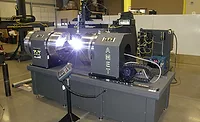
Laser Welding of Plastics
Although expensive and still a rarity, there is little doubt that laser welding of thermoplastics will grow in popularity. There are a number of reasons for this. For one thing, laser welding is extremely precise and does not generate flash or particulates, in contrast to other methods such as ultrasonic, spin, vibration and heat welding. This makes laser welding ideal for assembling medical devices and automotive taillights. It is also energy efficient and fast, with cycle times of 2 seconds or less. Finally, it is a noncontact process that leaves no marks on the finished product and can reach recesses that are inaccessible to other welding methods.
To create a weld, a laser system uses a glass plate to hold two parts together, one on top of the other. The top part is made of a transparent material, while the bottom part is made of a material that absorbs near-infrared light. The laser light is then directed through the plate and the transparent upper part so that it strikes the near-infrared-absorbent part on the bottom. When this layer heats up, it melts the surrounding plastic and creates the weld.
Originally, the absorbent layer would be molded from tinted or opaque plastic. Not surprisingly, this severely limited the number of applications in which laser welding could be used, because entirely transparent assemblies were out of the question. However, plastics companies like BASF (Florham Park, NJ) and the Clearweld division of Gentex Corp. (Carbondale, PA) are now marketing transparent near-infrared-absorbent pigments that have opened up a range of new options. Pigments are also available that are opaque to the human eye, but do not absorb near-infrared light, making it possible to weld entirely opaque assemblies, like those used for under-the-hood components in cars.
According to Michelle Burrell, development manager for materials joining technology at Clearweld, her company's additives are available in two forms: either as an additive that can be incorporated into the resin used to mold the actual part; or as a coating that is applied to the joint interface prior to welding. The latter type is available as a low-viscosity liquid that is applied via needle tip or microsolenoid dispenser. The coatings can also be sprayed for covering a wider area.
When incorporated into the parts themselves, the additives impart a slight coloration or tint to the plastic. But according to Burrell, these additives can be combined with other pigments to create, say, the blue tint that is commonly found in disposable medical products. When a coating is used, the additive is actually consumed in the course of the welding process. This leaves a joint that is as clear as the plastic from which it is made.
When thinking about laser welding it's important to be aware that there are a number of different techniques, including simultaneous welding, contour welding, mask welding, quasi-simultaneous welding, scan and Globo welding. Although all these approaches are based on the same basic laser technology, they offer different advantages and disadvantages, depending on the nature of a give assembly.
For example, with laser contour, or spot, welding, the laser is focused to a single point, which is then directed along a preprogrammed path to create the weld. According to Jerry Zybko, general manager for Leister Technologies (Itasca, IL), the ideal spot size for this kind of welding is 1 to 2 millimeters, although spot sizes can vary from 0.6 to 2.5 millimeters, depending on the application.
Looking for quick answers on assembly and manufacturing topics? Try Ask ASM, our new smart AI search tool. Ask ASM
The advantage to this method is flexibility. Almost any welding path can be programmed into the welding machine, which can direct the beam using robotics, a moving stage, or a system of mirrors and servomotors. Once the programs have been entered into the controller, changeovers from one assembly to another can be performed with the push of a button.
Less flexible, but faster is simultaneous line welding, in which the laser light is directed, or collimated, along a straight line. Typical weld dimensions are 1 to 2 millimeters by 30 millimeters, with a cycle time of 1 to 2 seconds. Multiple lasers can be used to create square or rectangular contours. Optics also exist that can create curved lines.
With mask welding-a proprietary technique developed by Leister Technologies-the laser configuration is similar to that with line welding, only the line sweeps across the entire part, which has been masked so that only those portions left exposed will melt to create a weld. The technique can be used to create extremely precise and complex weld patterns. Applications have included sensors and microfluidic components in medical diagnostic devices. Weld lines as narrow as 100 micrometers have been successfully made. Masks are produced via a photolithographic process involving metal-coated glass.
Similar to line welding is quasi-simultaneous welding, in which a set of servo-driven mirrors directs a single point of laser light along the weld path at a rate of 40 circuits per second. Although not as flexible as contour welding-it is limited to flat or slightly contoured joints-it generally offers faster cycle times. In fact, as long as the weld is a small one, cycles times are comparable to that of simultaneous welding. Because servomotors are used to trace out weld geometries, a single laser head can be used for multiple welds.
Also similar to line welding is scan, or curtain, welding, in which a line-focused laser is scanned over the parts to be joined, creating welds wherever it encounters any NIR-absorbent material. As is the case with quasi-simultaneous laser welding, this method offers flexibility in that the same welding head can be used to weld a variety of parts. NIR-absorbent coatings like those from Clearweld lend themselves to this kind of assembly, because they can be used to trace out an infinite variety of weld geometries, simply by changing the programming of an automated dispenser.
Finally, there is the Globo welding process, unveiled by Leister Technologies in late 2004. A variation on traditional contour welding, the Globo system uses a welding head that looks a little like an oversized ballpoint pen, with a rotating glass sphere that both focuses the laser beam and presses against the parts being welded.
Manipulated via a robotic arm, Globo welding offers flexibility and the ability to weld complex joint geometries. The glass sphere also facilitates the optimal synchronization of clamping pressure and energy application.
Looking for a reprint of this article?
From high-res PDFs to custom plaques, order your copy today!