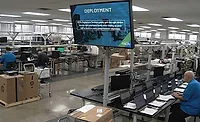
Workstations Help Printer Manufacturer Meet Customer Demands
TransAct Technologies Inc. of Ithaca, NY, was founded in 1983 to develop, design and market stand-alone point-of-sale (POS) printers. The company developed a line of open PC-based printers that were targeted toward smaller retailers. The company has grown rapidly since the late 1980s, and now employs more than 100 people.
TransAct saw a need among small retailers for POS printers that provide data on inventory control and sales records. Small retailers’ demands were not unlike those of larger organizations, but many of them could not afford the more expensive POS systems. TransAct focuses on customizing durable POS printers. This demands a high level of flexibility in production planning.
Andrew Hoffman, senior vice president of operations, identified three keys to TransAct’s business success:
- reliability of product.
- timelessness of delivery.
- customization.
These factors were important in determining the most effective manufacturing approach. As production levels increased, the company looked to improve its manufacturing processes to facilitate custom production and ensure short lead times.
In early 1997, the company’s assembly workbenches were identified as needing improvement. These tables were not ideal for short production runs of custom printers. Short production runs contain many small components and entail constant changeovers. Each requires a different setup, which is difficult to accomplish using worktables that do not have good storage facilities. The pressure to reduce lead times further highlighted the need to develop an assembly solution that could support customer needs.
Production Basics was chosen to design workstations that address these assembly issues. Together with Aloi Material Handling, it helped TransAct build a customized product more efficiently while reducing lead time.
Workstations now have a smaller work surface that is suitable for the various assembly operations. Each station has a parts bin rail and an articulating parts bin dock so that all components can be readily accessible for the assembler without taking up valuable space on the work surface. All stations are height-adjustable with adjustable footrests to take into account the operator’s comfort and the different assembly operations.
The decision to invest in ergonomically designed workstations has greatly improved TransAct’s manufacturing flexibility, which enabled the company to:
- assemble customized printers more efficiently.
- eliminate many of the ergonomic problems by bringing the operator closer to the assembly components.
- set up another assembly line with the extra space that was created by using a 48-inch-wide work surface instead of 60 inches.
- accommodate future anticipated changes in the production process.
For more information on workstations, call Production Basics at 617-926-8100 or visit www.pbasics.com.
Looking for quick answers on assembly and manufacturing topics? Try Ask ASM, our new smart AI search tool. Ask ASM
Looking for a reprint of this article?
From high-res PDFs to custom plaques, order your copy today!