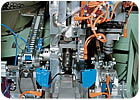
The hands of a wristwatch are joined to their pinion shafts with an interference fit. However, before the hands can be installed, the precise location of the watch face must be determined. That's because the height of the face inside the case can vary by several microns, due to tolerance buildups. If the hands are pressed too far, the watch could be damaged. To get this critical measurement, watchmakers use laser sensors.
Laser sensors work like any photoelectric sensor, except that the emitter is a laser instead of an LED, says Wayne Meyer, product manager for SICK Inc. (Bloomington, MN). Like all photoelectrics, laser sensors can operate in opposed, proximity and retroreflective modes. And, like all photoelectrics, laser sensors can be used to detect parts or part features in switching, counting and error-proofing applications.
However, laser sensors have distinct advantages over other photoelectric sensors, thanks to the unique qualities of their light source. Lasers produce high-energy light in a tightly focused, highly collimated beam. This enables laser sensors to detect very small objects at long distances, and it lets engineers set precise switching points. The dense, powerful beam cuts through airborne particulates better than other light sources. In addition, lasers produce a clearly visible spot or line of light, which helps with aiming the sensor.
"Laser sensors can detect an increment as small as 2 microns and do it very quickly-as fast as 300 microseconds," says Stephen Petronio, photoelectric product manager at Baumer Electric (Southington, CT).
These sensors can detect almost any material, including metal, plastic, rubber, wood and textiles. The material can be shiny or dull, light or dark, smooth or rough. Like all photoelectric sensors, however, laser sensors may have difficulty detecting transparent objects.
Besides object-detection applications, laser sensors can be used to measure distances or dimensions in gauging, inspection and positioning applications. Capable of measuring objects or distances with micron-level accuracy, these sensors have different receivers than object-detection sensors. Some models have a linear receiver that measures the angle of the light reflected back to the sensor. The sensor then determines the distance to the target through triangulation. Other models, known as time-of-flight sensors, calculate target distance by measuring how much time it takes for the laser light to get to and from an object.
"Triangulation sensors are used to measure short distances, as in assembly applications," says Meyer. "Time-of-flight sensors are used to measure long distances, as in material handling applications."
The range of laser sensors varies widely. Depending on the laser, receiver, application and sensing mode, the sensor's maximum range can be anywhere from 16 millimeters to 60 meters.
Assemblers need not be overly concerned with eye safety when using laser sensors, says Jeffrey Curtis, senior applications engineer with Banner Engineering Corp. (Minneapolis). The emitter is a Class 1 or Class 2 laser. A Class 1 laser does not produce optical radiation that is harmful to the human eye. A Class 2 laser is a little more powerful. Because of its brightness, a Class 2 laser is too dazzling to stare into for extended periods. However, momentary viewing is not considered hazardous.
When ordering a laser sensor, engineers should specify: the target material; target range; sensor resolution (the smallest distance or dimension the sensor must detect); footprint and mounting requirements; output signal; target speed; response time; environmental protection requirements; and connection requirements.
Ironically, the narrow focus of the laser can be the sensor's undoing in the wrong application, warns Meyer. For example, if there's excessive vibration or backlash in the positioning system, the laser could pass nearby the target without detecting it. In this case, a standard photoelectric sensor with a wide beam pattern would be more appropriate.