Wire Harness Assembly
Wire Harness Boards and Fixtures
Choosing the right wire harness boards and fixtures can improve productivity.
Wire harnesses are used in everything from sports cars to washing machines and business jets to video arcade games. But, assembling them can be a daunting task. Choosing the right wire harness boards and fixtures can improve productivity.
“All wire harness manufacturers are facing the same challenges,” notes Bob Simmons, national sales manager at Pro-Line (Haverhill, MA). “They are trying to reduce costs and increase productivity in the face of rising energy and raw material costs.”
Many companies are turning to lean production principles, such as poka yoke or error-proofing. They are also using one-piece flow and kitting in place of traditional batch processing, which enables them to assemble small quantities of harnesses more efficiently.
“We are seeing more and more interest in lean manufacturing and cost reduction as it relates to assembling harnesses,” says Brent Stringham, director of sales and marketing at Cirris Systems Corp. (Salt Lake City, UT). “Everybody wants to get more efficient, both for cost-cutting and quality improvement reasons. More harness manufacturers are discovering that building quality into the process gives them lower costs due to eliminating the cost of rework and scrap.”
Because there are so many unique applications today, many boards are custom-built. Although standard boards exist, there are thousands of different ways to configure wire harnesses.
“We build our own boards to suit the application they are being used for,” explains Al Poole, president of Live Wire Harnesses (North Bay, ON). “Early on, we tended to build boards based on testing parameters instead of assembly parameters.
“As we have become better at this, we have improved our boards by incorporating work instructions and testing specifications to attempt to error-proof the assembly,” says Poole. “This is also driving better efficiency, [because we do not have] to remove the harness for validation.
“When we are in a preproduction phase for a new product and begin work on the harness board, we include our assembly team in the design discussion so that the board doesn’t inhibit the ability to produce a high-quality product efficiently,” adds Poole. “We attempt to ensure that the board is easy to use for the operator. [It’s also important that the board] fits with the rest of the workstation so that staging bins can be positioned near the areas where the leads are going to be added to the harness.”
According to HellermannTyton’s Christie, board design is becoming more important than ever. “Getting it right the first time is key to increasing throughput,” he points out. For instance, Christie says more manufacturers are using electrified boards, which are back-wired for testing. That helps reduce time wasted moving harnesses from the assembly line to a testing station. “One major automotive wire harness supplier tests 60 percent to 70 percent of its boards as they are built,” Christie points out.
Cablescan Inc. (Ontario, CA) offers custom harness boards that feature work surfaces with full-scale cable-routing information and all harness termination points. “All harness electrical points are connected through back-wiring to interface connectors mounted on the harness board, which you can then connect through interface cables to a tester,” explains Ken Rockwell, general manager and engineering manager. The harness board fixture includes an extruded aluminum frame, a ¾-inch plywood top with a reverse-printed mylar work surface, and a 3/8-inch plywood backing for protection of the back-wiring.
Cirris Systems also offers both low-voltage and high-voltage versions of its popular easy-wire system. “They run the exact same software, making it easy for manufacturers to use one harness tester supplier for all of their needs,” claims Stringham. “One of the things we are trying to bring to the game is the ability to assure correct wiring as the harness is being assembled, combined with final electrical test-including hipot or high-voltage test-with the same piece of equipment.”
Whenever harnesses are built using a “first-sided pinning, second-sided pinning” approach, manufacturers discover that most wiring mistakes occur during the first-sided pinning part of the operation.
“We are working on more sophisticated methods for assuring, with electrical test, that the first side is pinned correctly and that all labeled wires are truly inserted into the correct cavities,” Stringham points out. “Only then can guided assembly at second-sided pinning be effectively implemented.”
“Board changeover speed is critical to reduce costs,” says Christie. “[The new] systems allow for a variety of flexible manufacturing options while maintaining a very high level of quality and repeatability.”
Some wire harness workstations use modular designs and ergonomic platforms to help increase productivity. For instance, Pro-Line offers a product that features height adjustability and tilt options. The platform is larger than a conventional workstation, but does not have a work surface, since harnesses are built on boards. It features an adjustable front lip to accommodate different size boards, in addition to slanted shelving and bins for parts storage.
“The adjustable height and tilt features keep operators fresher through the day by bringing the work to them,” says Simmons. “This is very important in wire harness assembly, since some boards are 48 inches deep. If you need to bend over or walk around a board this size all day long, you are wasting energy.
“For shops that do short production runs, the adjustable front lip that [holds] the board helps in quick changeover to another product,” adds Simmons. “Our uprights also accept power supplies, air quick-disconnects, overhead lighting, steel pegboards and tool suspension frames. Keeping power, air and tools within quick reach of the operator helps productivity.”
According to Simmons, the newest thing in wire harness assembly is customization of the stations. “Companies are looking to modify units to meet the special challenges they may face,” he explains. “We recently had an airplane manufacturer that required stations 96 inches long and 48 inches deep that could work independent, as well as in series, to make a single unit 32 feet long, with 0.125 inch tolerance over the 32-foot span. Through a control panel with a series of relays and voltage transformers with low-voltage cables, we were able to meet these specifications. Others have requested special size platforms or different tilt angles.”
When choosing a workstation, Simmons says it’s important to make sure the platform is large enough to hold the required boards. “Look for a modular design, so options can be added with ease,” he advises.
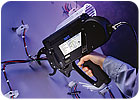
Tools for wire harness assembly have also become more complex, often incorporating a higher level of automation to drive down costs. “The quality and reliability of these systems have improved, creating less downtime issues and production loss time,” says Christie. “The ability for different systems to be compatible and communicate with each other is also becoming more [important].”
Christie says end users are looking for lower insertion forces and higher extraction forces, as well as the ability to work on several different applications without the need to specify additional parts. “In our automatic cable tie application tools, we have designed three basic systems that handle virtually the entire range of bundle sizes in the wire harness market,” he points out. “We have evolved this concept to include a variety of different style ties including arrow head, fir tree and edge clip.”
Of course, automation is not always the best solution for some manufacturers. “We are seeing an increasing number of customers wanting to have harnesses with multi-conductor cables,” notes Live Wire Harnesses’ Poole. “This reduces the amount of automation available and therefore increases the amount of labor in the assembly.
“Being a small shop, this makes it more difficult to compete with Asia and other low-cost markets,” Poole laments. “We try to address this by educating our customers on different cable types, connectors, and protection methods to increase automation and quality while becoming more cost-competitive.”
Wire harnesses are used in everything from sports cars to washing machines and business jets to video arcade games. But, assembling them can be a daunting task. With numerous sizes, lengths and colors of wire, cable, connectors, terminal blocks and other components to choose from, it’s similar to putting together a giant jigsaw puzzle.
Harness boards, fixtures and workbenches can make the job easier and less stressful. They all play a critical role in error-free assembly, quick response and continuous improvement.
The front-end of most wire processing applications is highly automated. Indeed, automatic wire cutters, markers, splicers, strippers, wrappers and other production equipment is commonly used by manufacturers to boost throughput and ensure consistent quality.
But, the process of dressing boards remains a manual, labor-intensive task. That’s why many wire harness manufacturers have flocked to Mexico and other low-cost regions.
“Manufacturers are looking for ways to take cost out of the assembly process,” says Mark Christie, director of tool systems at HellermannTyton (Milwaukee). “With raw material prices and labor variables increasing, finding more efficient and cost-effective methods of assembly are critical.
“In the United States, automation of these processes allows companies to [compete] against other NAFTA countries,” explains Christie. “And, in Mexico, despite considerably lower labor rates, the [ability] to compete against Chinese companies is of primary importance. The need for improved quality measures and the ability to improve flow of the manufacturing process, as well as the repeatability of the work, are key factors in the industry.”
Harness boards, fixtures and workbenches can make the job easier and less stressful. They all play a critical role in error-free assembly, quick response and continuous improvement.
The front-end of most wire processing applications is highly automated. Indeed, automatic wire cutters, markers, splicers, strippers, wrappers and other production equipment is commonly used by manufacturers to boost throughput and ensure consistent quality.
But, the process of dressing boards remains a manual, labor-intensive task. That’s why many wire harness manufacturers have flocked to Mexico and other low-cost regions.
“Manufacturers are looking for ways to take cost out of the assembly process,” says Mark Christie, director of tool systems at HellermannTyton (Milwaukee). “With raw material prices and labor variables increasing, finding more efficient and cost-effective methods of assembly are critical.
“In the United States, automation of these processes allows companies to [compete] against other NAFTA countries,” explains Christie. “And, in Mexico, despite considerably lower labor rates, the [ability] to compete against Chinese companies is of primary importance. The need for improved quality measures and the ability to improve flow of the manufacturing process, as well as the repeatability of the work, are key factors in the industry.”
According to Christie, harness assemblers face several challenges today, such as:
- Being cost-competitive and profitable.
- Being flexible to accommodate high-mix, low-volume applications.
- Moving quickly from one job to another with minimal downtime.
- Dealing with short lead times from customers and just-in-time delivery requirements, without holding too much inventory because of costs or the risk of engineering changes.
- Improving ergonomics to reduce repetitive motion disorders and healthcare claims.
- Finding qualified workers and retaining them.
“All wire harness manufacturers are facing the same challenges,” notes Bob Simmons, national sales manager at Pro-Line (Haverhill, MA). “They are trying to reduce costs and increase productivity in the face of rising energy and raw material costs.”
Many companies are turning to lean production principles, such as poka yoke or error-proofing. They are also using one-piece flow and kitting in place of traditional batch processing, which enables them to assemble small quantities of harnesses more efficiently.
“We are seeing more and more interest in lean manufacturing and cost reduction as it relates to assembling harnesses,” says Brent Stringham, director of sales and marketing at Cirris Systems Corp. (Salt Lake City, UT). “Everybody wants to get more efficient, both for cost-cutting and quality improvement reasons. More harness manufacturers are discovering that building quality into the process gives them lower costs due to eliminating the cost of rework and scrap.”
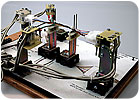
Vise blocks, harness brackets and other board components make it easy to assemble complex wire harnesses.
Increasing Complexity
As automakers and appliance manufacturers add more and more electrical and electronic components to their products, wiring harnesses are becoming increasingly complex. Harness boards and fixtures have also evolved beyond basic metal frames.Because there are so many unique applications today, many boards are custom-built. Although standard boards exist, there are thousands of different ways to configure wire harnesses.
“We build our own boards to suit the application they are being used for,” explains Al Poole, president of Live Wire Harnesses (North Bay, ON). “Early on, we tended to build boards based on testing parameters instead of assembly parameters.
“As we have become better at this, we have improved our boards by incorporating work instructions and testing specifications to attempt to error-proof the assembly,” says Poole. “This is also driving better efficiency, [because we do not have] to remove the harness for validation.
“When we are in a preproduction phase for a new product and begin work on the harness board, we include our assembly team in the design discussion so that the board doesn’t inhibit the ability to produce a high-quality product efficiently,” adds Poole. “We attempt to ensure that the board is easy to use for the operator. [It’s also important that the board] fits with the rest of the workstation so that staging bins can be positioned near the areas where the leads are going to be added to the harness.”
According to HellermannTyton’s Christie, board design is becoming more important than ever. “Getting it right the first time is key to increasing throughput,” he points out. For instance, Christie says more manufacturers are using electrified boards, which are back-wired for testing. That helps reduce time wasted moving harnesses from the assembly line to a testing station. “One major automotive wire harness supplier tests 60 percent to 70 percent of its boards as they are built,” Christie points out.
Cablescan Inc. (Ontario, CA) offers custom harness boards that feature work surfaces with full-scale cable-routing information and all harness termination points. “All harness electrical points are connected through back-wiring to interface connectors mounted on the harness board, which you can then connect through interface cables to a tester,” explains Ken Rockwell, general manager and engineering manager. The harness board fixture includes an extruded aluminum frame, a ¾-inch plywood top with a reverse-printed mylar work surface, and a 3/8-inch plywood backing for protection of the back-wiring.
Cirris Systems also offers both low-voltage and high-voltage versions of its popular easy-wire system. “They run the exact same software, making it easy for manufacturers to use one harness tester supplier for all of their needs,” claims Stringham. “One of the things we are trying to bring to the game is the ability to assure correct wiring as the harness is being assembled, combined with final electrical test-including hipot or high-voltage test-with the same piece of equipment.”
Whenever harnesses are built using a “first-sided pinning, second-sided pinning” approach, manufacturers discover that most wiring mistakes occur during the first-sided pinning part of the operation.
“We are working on more sophisticated methods for assuring, with electrical test, that the first side is pinned correctly and that all labeled wires are truly inserted into the correct cavities,” Stringham points out. “Only then can guided assembly at second-sided pinning be effectively implemented.”
Wire harness manufacturers are looking for ways to improve productivity.
Changeover Speed
New boards, fixtures and workstations have also allowed wire harness manufacturers to become more flexible. Changeover time becomes more important when lot sizes get smaller. The need to quickly move from job to job has created a demand for workcells that can be frequently reconfigured.“Board changeover speed is critical to reduce costs,” says Christie. “[The new] systems allow for a variety of flexible manufacturing options while maintaining a very high level of quality and repeatability.”
Some wire harness workstations use modular designs and ergonomic platforms to help increase productivity. For instance, Pro-Line offers a product that features height adjustability and tilt options. The platform is larger than a conventional workstation, but does not have a work surface, since harnesses are built on boards. It features an adjustable front lip to accommodate different size boards, in addition to slanted shelving and bins for parts storage.
“The adjustable height and tilt features keep operators fresher through the day by bringing the work to them,” says Simmons. “This is very important in wire harness assembly, since some boards are 48 inches deep. If you need to bend over or walk around a board this size all day long, you are wasting energy.
“For shops that do short production runs, the adjustable front lip that [holds] the board helps in quick changeover to another product,” adds Simmons. “Our uprights also accept power supplies, air quick-disconnects, overhead lighting, steel pegboards and tool suspension frames. Keeping power, air and tools within quick reach of the operator helps productivity.”
According to Simmons, the newest thing in wire harness assembly is customization of the stations. “Companies are looking to modify units to meet the special challenges they may face,” he explains. “We recently had an airplane manufacturer that required stations 96 inches long and 48 inches deep that could work independent, as well as in series, to make a single unit 32 feet long, with 0.125 inch tolerance over the 32-foot span. Through a control panel with a series of relays and voltage transformers with low-voltage cables, we were able to meet these specifications. Others have requested special size platforms or different tilt angles.”
When choosing a workstation, Simmons says it’s important to make sure the platform is large enough to hold the required boards. “Look for a modular design, so options can be added with ease,” he advises.
Tools for wire harness assembly have also become more complex, often incorporating a higher level of automation to drive down costs. “The quality and reliability of these systems have improved, creating less downtime issues and production loss time,” says Christie. “The ability for different systems to be compatible and communicate with each other is also becoming more [important].”
Christie says end users are looking for lower insertion forces and higher extraction forces, as well as the ability to work on several different applications without the need to specify additional parts. “In our automatic cable tie application tools, we have designed three basic systems that handle virtually the entire range of bundle sizes in the wire harness market,” he points out. “We have evolved this concept to include a variety of different style ties including arrow head, fir tree and edge clip.”
Of course, automation is not always the best solution for some manufacturers. “We are seeing an increasing number of customers wanting to have harnesses with multi-conductor cables,” notes Live Wire Harnesses’ Poole. “This reduces the amount of automation available and therefore increases the amount of labor in the assembly.
“Being a small shop, this makes it more difficult to compete with Asia and other low-cost markets,” Poole laments. “We try to address this by educating our customers on different cable types, connectors, and protection methods to increase automation and quality while becoming more cost-competitive.”
Looking for a reprint of this article?
From high-res PDFs to custom plaques, order your copy today!