Assembly Magazine logo
search
Ask ASSEMBLY AI
cart
facebook twitter linkedin youtube
  • Sign In
  • Create Account
  • Sign Out
  • My Account
Assembly Magazine logo
  • TRENDS
    • Ask ASSEMBLY AI
    • Trends
    • News
    • New Products
  • INDUSTRIES
    • Aerospace
    • Appliance
    • DFMA Assembly
    • Medical Devices
    • Green Manufacturing
    • Lean Manufacturing
    • Machinery Assembly
    • Electronics Assembly
    • Automotive
  • TECHNOLOGIES
    • Adhesives & Dispensing
    • Assembly Presses
    • Automated Assembly Systems
    • Manufacturing Management
    • Manufacturing Software
    • Motion Control
    • Screwdriving & Riveting
    • Robotics
    • Test & Inspection
    • Plastics & Metal Welding
    • Wire Processing
    • Workstations
  • AUTONOMOUS & ELECTRIC MOBILITY
    • AEM Magazine Archives
    • Autonomy
    • Electrification
    • Mobility Services
    • Assembly & Testing
    • AV/EM News
  • MEDIA
    • Ask ASSEMBLY AI
    • Podcasts
    • Assembly News Now
    • Assembly TV
    • Webinars
    • eBooks
  • EVENTS
    • Calendar
    • The ASSEMBLY Show
  • MORE
    • Exclusives >
      • Plant of the Year
      • Capital Spending
    • Buyers Guide >
      • Supplier Insights
    • Classifieds
    • Featured Products
    • Newsletters
    • Store
    • White Papers
    • Columns
    • Sponsor Insights
  • INFOCENTER
    • Assembly & Test Solutions
  • EMAGAZINE
    • eMagazine
    • Archive Issues
    • Advertise
    • Contact Us
    • Sign Up

Dialing In Torque

By John Sprovieri
November 12, 2007

Electronic and mechanical torque wrenches ensure that power tools are tightening fasteners accurately.


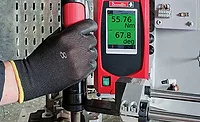
The big advantage of electronic torque wrenches is that they record each measurement. Individual measurements can be matched to specific assemblies for liability protection, while aggregate data can be analyzed for statistical process control. Photo courtesy ASI Datamyte


“Trust but verify” was one of Ronald Reagan’s signature phrases. The president used it whenever he spoke of his negotiations with the Soviets during the Cold War. These days, the phrase is more applicable to the assembly line than arms negotiations. Manufacturing engineers trust power tools to install threaded fasteners quickly and accurately, but one way or another, engineers must verify that the tools truly are performing as specified.

Electronic and mechanical torque wrenches enable engineers to do just that. “Torque wrenches are used to check fasteners that have already been tightened,” says Frank Skog, product manager for ASI Datamyte Inc. (Plymouth, MN), now retired. “They ensure that the fasteners have been tightened correctly and that the joints have not loosened after assembly.”

It’s rarely necessary to check every fastener, in every joint, in every assembly. Rather, engineers check a random sample-perhaps one out of every five assemblies, or one out of 10. The frequency of such checks depends on the importance of the assembly, the softness of the joint, and the tool that installed the fastener. Safety-critical assemblies, such as automotive steering components or tie rods, are checked frequently. Similarly, gasket assemblies and other soft joints are checked often, since they are likely to relax after tightening. Joints fastened with computer-controlled DC electric tools are checked less often than joints fastened by pulse tools, because the pulsing action can interfere with torque transducers.

In the end, says Skog, how a torque audit is conducted is an economic decision. “You want to catch defects when they’re least expensive to fix,” he says. “Once the assembly goes out the door, fixing a problem is really expensive.”
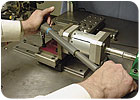


When using a torque wrench, hold the handle perpendicular to the centerline of the fastener. Support the head of the wrench using one hand and prepare to pull with the other. Then, pull on the handle with a smooth, steady motion. Stop pulling either when the desired torque specification is reached or when the fastener breaks loose and begins to rotate. Photo courtesy RS Technologies Ltd.

Mechanical vs. Electronic

Mechanical torque wrenches are available in numerous designs. The three most common are beam, dial and click wrenches.

The beam wrench is the simplest, says Ray Reynertson, president and COO of Sturtevant Richmont (Franklin Park, IL). In this design, a beam connects the head of the tool with the handle. A pointer is connected to the head, parallel with the beam. The pointer extends almost to the handle, but does not connect to it. At the base of the handle is a metal plate with a torque scale. When the wrench is pulled, the beam deflects, but the pointer stays still, indicating the torque on the scale. This design is accurate and very durable, but reading the scale can be difficult.

Dial wrenches are easier to read. In this design, a torsion bar goes from the head of the tool to a rack-and-pinion mechanism. As the bar deflects, the mechanism turns a dial that indicates torque, says Reynertson.

Of all the designs for mechanical torque wrenches, the click, or toggle, wrench is most commonly used on assembly lines. That’s because operators don’t have to read a dial or gauge; they simply pull the wrench until it clicks. In this design, the drive head is connected to a lever that, in turn, is connected to a toggle mechanism and an adjustable compression spring. As a load is applied to the handle of the tool, the lever shifts the toggle, compressing the spring. When enough load is applied, the spring triggers the toggle with an audible click, and the tool becomes rigid, says Reynertson.

Mechanical wrenches are simpler than electronic wrenches, but even they can get high-tech help, says Jennifer Ruth, vice president of Tohnichi America Corp. (Northbrook, IL). For example, Tohnichi offers click wrenches with electronic sensors that detect the release of the toggle mechanism. The sensor communicates each click of the tool to a PLC through a cable or a wireless connection. This enables engineers to error-proof the process. For example, if the operator is supposed to check four bolts on an assembly, but the PLC only records three clicks of the wrench, the assembly cannot be released to the next station.

Another click wrench from Tohnichi takes a visual approach to error-proofing. When a fastener has been tightened to the right torque, the wrench marks both the fastener and the assembly with a quick-drying ink. Thus, the operator or an inspector can tell at a glance if any fasteners were not tightened (they would be unmarked) or if any fasteners have subsequently loosened (the marks on the fastener and the assembly would be misaligned).

Electronic torque wrenches measure torque with a strain gauge. These wrenches are more expensive than their mechanical counterparts, but they’re also more accurate. The big advantage of electronic wrenches is that they record each torque measurement. Individual measurements can be matched to specific assemblies for liability pro-tection, while aggregate data can be analyzed for statistical process control (SPC). Data fluctuations could be an early warning that power tools need service or operators need extra training.

Durability is another advantage of electronic torque wrenches. An electronic torque wrench is four or five times more accurate than a click wrench right out of the box. What's more, the spring in that click wrench will lose some elasticity over time.

Electronic tools can be tethered to a portable controller, or they can communicate wirelessly to a remote unit. Some portable controllers even have displays that show the operator which bolts to check and what sequence to check them in. Like the toggle wrench with the “click detector,” electronic torque wrenches can be set up for error-proofing.


Of all the designs for mechanical torque wrenches, the click wrench is most commonly used on assembly lines. Photo courtesy Project JK

The Right Technique

Whether mechanical or electronic, torque wrenches should not be handled like ordinary hand tools, but rather like the fine measuring instruments they are. The right technique is critical for obtaining accurate torque readings.

First, the operator should hold the handle of the wrench perpendicular to the centerline of the fastener, explains Miller. The operator should support the head of the wrench using one hand and prepare to pull with the other. The operator should then pull on the handle with a smooth, steady motion. The operator should stop pulling either when the desired torque specification is reached or when the fastener breaks loose and begins to rotate. The opera-tor should not jerk the handle abruptly, since this will yield inaccurate or inconsistent readings.

Operator influence is one of the challenges of implementing a torque audit program. Some operators pull that wrench hard and fast, and others are too cautious. In some cases, engineers can look at an SPC chart and identify which operator took each set of measurements.

Fortunately for engineers, technology is making torque wrenches easier to use and less dependent on operator skill. For example, the LightStar electronic torque wrench from ASI Datamyte is equipped with a solid-state gyro with a resolution of 0.04 degree. The gyro enables the instrument to measure torque only when the fastener actu-ally turns. The wrench issues visual and audible signals if the operator fails to pull hard enough or if he pulls too much. The wrench also records how far the fastener turns during the measurement.

“It takes a week to learn how to use a mechanical torque wrench and a month to get good at it,” says Skog. “The LightStar takes 30 minutes to learn and an hour to get good at.”

Like power tools, electronic and mechanical torque wrenches must be calibrated periodically to ensure accurate measurements. The frequency of calibration depends on the importance of the assembly and how much use the tool gets. A high-use tool is typically tested at the start of each shift. If the tool is found to be out of calibration, the testing interval should be shortened, says Reynertson.

Looking for quick answers on assembly and manufacturing topics? Try Ask ASM, our new smart AI search tool. Ask ASM →

Share This Story

Looking for a reprint of this article?
From high-res PDFs to custom plaques, order your copy today!

John has been with ASSEMBLY magazine since February 1997. John was formerly with a national medical news magazine, and has written for Pathology Today and the Green Bay Press-Gazette. John holds a B.A. in journalism from Northwestern University, Medill School of Journalism.

Recommended Content

JOIN TODAY
To unlock your recommendations.

Already have an account? Sign In

  • Made in the U.S.A.

    Consumer Products Manufacturing: Made in the USA

    Supply chain lessons learned during the coronavirus...
    Automated Assembly Systems
    By: Austin Weber
  • Best Practices for Press-Fit Assembly

    Best Practices for Press-Fit Assembly

    In manufacturing, ironclad formulas for success are hard...
    Assembly Presses
    By: Jim Camillo
  • aem0523leader-tesla1.jpg

    Tesla Rethinks the Assembly Line

    Engineers at Tesla Inc. have developed a new process that...
    Electrification
    By: Austin Weber
Manage My Account
  • eMagazine Subscription
  • Assembly Newsletters
  • Online Registration
  • Subscription Customer Service
  • Manage My Preferences

More Videos

Sponsored Content

Sponsored Content is a special paid section where industry companies provide high quality, objective, non-commercial content around topics of interest to the ASSEMBLY audience. All Sponsored Content is supplied by the advertising company and any opinions expressed in this article are those of the author and not necessarily reflect the views of ASSEMBLY or its parent company, BNP Media. Interested in participating in our Sponsored Content section? Contact your local rep!

close
  • ultrasonic welding
    Sponsored bySonobond Ultrasonics

    Engineering Efficiency in High-Performance Assembly: How Ultrasonic Welding Enhances Throughput, Reliability and Quality

  • UV curing system
    Sponsored byDymax

    Why UV Intensity Alone Doesn’t Define Curing Performance

  • wooden pallets
    Sponsored byLEAN Manufacturing Products

    Eliminating Waste on the Shop Floor: Applying Lean Principles to Improve Manufacturing Efficiency

Popular Stories

ASSEMBLY News Now, episode-30: Volvo Redesigns EV Manufacturing

Volvo Redesigns EV Manufacturing

Boeing CEO Kelly Ortberg announces 1 billion investment

Boeing Plans $1 Billion Wichita Investment, Workforce Training Center

automated consumer goods assembly system

Best Practices for Cycle Time Optimization

Watch the latest episode of ANN now!

Events

July 24, 2025

From Shop Floor to CFO: How Manufacturers Are Closing the Loop Between Operations and Finance

On Demand Learn how manufacturers are bridging the gap between the shop floor and ERP systems to gain real-time visibility, streamline operations, and kick-start digital transformation—without waiting years.

Sponsored by:

PicoStratusGreen
July 30, 2025

Buffer Analysis and Design Fundamentals for Manufacturing Excellence

On Demand In this presentation, Dr. Herman Tang shares practical insights from his industry experience and research on buffer management in manufacturing operations.

View All Submit An Event

Poll

Difficult Assembly Processes

Which assembly process gives you the most difficulty?
View Results Poll Archive

Products

Manufacturing Cost Policy Deployment (MCPD) Profitability Scenarios: Systematic and Systemic Improvement of Manufacturing Costs

Manufacturing Cost Policy Deployment (MCPD) Profitability Scenarios: Systematic and Systemic Improvement of Manufacturing Costs

See More Products
Register for webinar - Modernizing Automotive Assembly: Why Upgrading Legacy MES is a Business Imperative

Related Articles

  • Assembly in Action: Torque Tool Builder Locks Calibration

    See More
  • X-Y-Z: Planetary Gearheads Boost Torque, Reduce Speed

    See More
  • How to Determine a Torque Specification

    How to Determine a Torque Specification

    See More

Related Products

See More Products
  • handbook of digital.jpg

    Handbook of Digital Innovation, Transformation, and Sustainable Development in a Post-Pandemic Era

  • strong.jpg

    Strong Supply Chains Through Resilient Operations: Five Principles for Leaders to Win in a Volatile World

  • lean systems.jpg

    Lean Systems Applications and Case Studies in Manufacturing, Service, and Healthcare

See More Products

Related Directories

  • Teledyne TORQUE

    Could your products use precision TORQUE measurement and control capabilities? Teledyne designs and manufactures sensors that integrate into your existing drivetrain. We offer co-development design services and turnkey manufacturing; Metal-foil, platinum-tungsten and semi-conductor strain-gages as required by your application. Sensors are zero-balanced, temperature-compensated and calibrated to industry traceability standards.
  • Team Torque Inc.

×

Never miss the latest news and trends driving the manufacturing industry

Stay in the know on the latest assembly trends.

JOIN TODAY!
  • RESOURCES
    • Advertise
    • Contact Us
    • Directories
    • Manufacturing Division
    • Store
    • Want More?
  • SIGN UP TODAY
    • Create Account
    • eMagazine
    • Newsletters
    • Customer Service
    • Manage Preferences
  • SERVICES
    • Marketing Services
    • Reprints
    • Market Research
    • List Rental
    • Survey/Respondent Access
  • STAY CONNECTED
    • LinkedIn
    • Facebook
    • Instagram
    • YouTube
    • X (Twitter)
  • PRIVACY
    • PRIVACY POLICY
    • TERMS & CONDITIONS
    • DO NOT SELL MY PERSONAL INFORMATION
    • PRIVACY REQUEST
    • ACCESSIBILITY

Copyright ©2026. All Rights Reserved BNP Media, Inc. and BNP Media II, LLC.

Design, CMS, Hosting & Web Development :: ePublishing