Plastic Welding by Numbers
Today’s ultrasonic plastic welders offer unprecedented control over the joining process. But what exactly do all those settings mean?
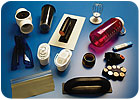
These days, every cell phone has a tiny digital camera. Welding the camera’s clear plastic lens to the case is tricky. There’s not much room for tooling, the seal must be watertight, and the process window is very small. What’s more, a cosmetic appearance is absolutely critical. No marks or particulates can be tolerated.
“Without a high level of control, such as amplitude profiling or welding by distance, that application would be very difficult,” says Jeff Frantz, director of applications and ultrasonic tooling at Branson Ultrasonics Corp. (Danbury, CT).
With feedback from load cells, encoders and other sensors, today’s microprocessor-controlled ultrasonic plastic welders offer extraordinary command over every aspect of the joining process. Depending on the machine, engineers can monitor and control ram force, ram speed, amplitude, power, energy, weld distance, weld time and hold time. These parameters can be measured individually or in combination to produce a good weld every cycle, regardless of the size, shape or composition of the parts.
The ability to fine-tune such variables as force and amplitude enables engineers to use ultrasonic welders to assemble delicate parts and challenging materials. To learn more, we asked three ultrasonic welding experts to share thoughts on the major parameters of the process.
Frequency
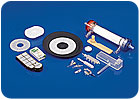
The first variable engineers need to think about is actually one they can’t change much-the operating frequency. The frequency is determined by the ultrasonic stack, and it can’t be changed significantly without changing the stack. The most common frequency is 20 kilohertz, though 15-, 30-, 35-, 40- and even 50-kilohertz models are also available. High-frequency welders are best for small, delicate parts. Low-frequency machines are best for large parts.“There’s an inverse relationship between frequency and amplitude,” explains Vasko Naumovski, product manager for plastics at Herrmann Ultrasonics (Bartlett, IL). “As you go up in frequency, you go down in amplitude.”
The frequency is analogous to a hammer. A 15-kilohertz machine is like a sledgehammer. A 50-kilohertz machine is like a finishing hammer. “You wouldn’t drive railroad spikes with a finishing hammer, and you wouldn’t hang a picture with a sledgehammer,” says Naumovski. “You choose the frequency based on the size of the part that you’re welding.”
Another consideration is the shape of the part. Higher frequency sonotrodes cannot tolerate multiple steps or contours as easily as lower frequency sonotrodes.
Amplitude
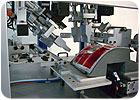
Of all the parameters in ultrasonic welding, the most important is amplitude, the peak-to-peak motion of the horn at its face. “If you don’t have the right amount of amplitude at the horn face, you’re not going to weld the part,” says Frantz.Amplitude is analogous to heat. Plastics with low melting temperatures need less amplitude than plastics with high melting temperatures. Semicrystalline materials require more amplitude; amorphous resins need less.
The newest ultrasonic welders provide closed-loop control over amplitude, which enables engineers to weld parts using a technique called amplitude profiling.
Frantz compares the process to boiling eggs. “When you first put the pot on the stove, you turn the heat on high to get the water boiling as quickly as possible,” he says. “Once you put the eggs in, you don’t need that much heat. If fact, if you keep it too hot, the eggs will crack.
“Ultrasonic welding is the same. It takes a lot of energy to heat the plastic to its melting point. But, once it’s there, you can lose control of the process if you keep the amplitude at a high level. The plastic can melt too quickly, and you’ll get a thin bond line or a weak weld. With amplitude profiling, you can set a high level of amplitude to generate heat, but then ramp it down to maintain the melt without losing control.”
Force
Because ultrasonic welding relies on friction to generate heat, another key variable is the force at which one part is pushed against the other. The amount of force depends on the size, shape and composition of the part, as well as on how much amplitude can be safely applied to the joint.“Plastics like ABS and polystyrene melt rather easily, so you don’t need a lot of force to get them to seal,” says Steve Woida, applications engineer with Forward Technology (Cokato, MN). “With a more difficult material, like nylon, you have to apply more pressure to get it to weld. The process window is very narrow.”
Force is also important because it determines the “joining velocity,” or how quickly the parts are pushed together once melting starts. For optimal welds, the joining velocity should be linear. If it’s too fast, molten plastic will be squeezed out of the bond area. If it’s too slow, the weld will be like a cold solder joint-the plastic won’t flow and bond well.
The latest ultrasonic welders can monitor and control the force to ensure a linear joining velocity. “When the energy director first starts melting, there’s not much resistance, because it’s a point with a small surface area,” says Naumovski. “As you melt more of the energy director, you get more resistance from the part, and the speed at which the two parts are pushed together slows down. We have the ability to profile the force and add more, if necessary, so the joining velocity remains linear throughout the process.”
Time
The last major variable to establish is how long to apply ultrasonic vibrations during the welding process. This can be controlled by time, energy, power and distance.Time is the simplest. The horn contacts the parts, vibrations are applied for a set amount of time, and then the vibrations are turned off. This is often where suppliers start when determining the parameters for a new application.
Welding by distance enables engineers to overcome slight variations in the parts. Assemblers can weld by collapse distance or absolute distance. In the former, a linear encoder resets when the horn contacts the parts. Then, ultrasonic vibrations are applied until the parts have collapsed a predetermined distance. “If the energy director is 0.01 inch tall, we can tell the welder to apply vibrations until the encoder registers 0.01 inch of movement,” says Naumovski. “Sometimes that might take 0.5 second. Other times it might take 480 milliseconds or 520 milliseconds. That’s because parts from different mold cavities or different lots might vary in density or size.”
Welding by absolute distance is similar, except that vibrations are applied until the face of the horn reaches a predetermined set point. In other words, it doesn’t matter where the welder starts; it only matters where it stops.
Just as the welder can be activated by distance, so too can it be turned on and off by how much power, in watts, or energy, in joules, is applied to the joint.
“Power and energy modes are typically used for parts that are not injection-molded or do not have an energy director,” says Naumovski. “These parts may be extruded, thermoformed or rotomolded. These modes are also used for less traditional uses of ultrasonic welding equipment, such as swaging, staking and spot welding.”
Most welders will provide feedback on all these variables, so engineers can establish quality thresholds or obtain baseline data for tweaking the process, says Woida. For example, if the machine welds by time, it will report how much energy it used. If it welds by distance, it will report how much time the process took.
Control in Perspective
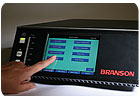
Despite advancements in monitoring and control, ultrasonic welders can’t set the ideal process parameters on their own. For that, engineers must rely on their own experience and their suppliers. Rules of thumb provide starting points, but a certain amount of trial welds will be necessary. Pull testing, pressure testing or leak testing of prototype assemblies can confirm that visibly good welds meet performance specifications.Of course, a high level of process control comes with a price, and assemblers should carefully consider whether their application justifies the additional cost of computer-controlled equipment. A wide range of ultrasonic welding equipment is available. The most basic machines allow engineers to set time digitally and adjust force manually through a pressure regulator. The most sophisticated allow engineers to set all parameters digitally. Some can monitor and control multiple variables simultaneously.
“The more control and feedback you require, the more the machine is going to cost,” concedes Woida.
Which end of the spectrum you require depends on your production volume and product mix; the size, shape, composition and quality of the parts; the strength and cosmetic requirements of the weld; and the criticality of the assembly. Medical devices require much greater control over the welding process than, say, blister packaging or tchotchkes.
Because of the interplay between variables, more control also gives engineers greater flexibility in developing just the right parameters for their application. “If you have high amplitude and high force, you’ll have a short weld time,” says Frantz. “If the part can’t tolerate high force, you might have to increase the weld time.”
Looking for a reprint of this article?
From high-res PDFs to custom plaques, order your copy today!