To help healthcare personnel mix and dispense these thick materials accurately and economically, TAH Industries Inc. (Robbinsville, NJ) recently introduced a single-use, 1-milliliter package called the u-TAH Nano. The product’s success hinges on the ability of TAH to assemble it at an attractive price while maintaining acceptable margins. Automation was the best-indeed, the only-way to achieve those goals.
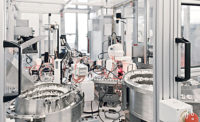
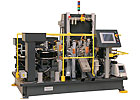
TAH turned to systems integrator Dial-X Automated Equipment Inc. (Albion, IN) for help. Working closely with TAH’s internal automation team, Dial-X designed a 16-station, fully automatic rotary indexing system. The system was installed at TAH’s facility in January. In this profile, Curt Bonar, president of Dial-X, describes the system.
For more information on parts feeders and automated assembly systems, call Dial-X at 260-636-7588 or visitwww.dial-x.com.
For more information on dispensing equipment for medical as well as industrial adhesives and polymers, call TAH at 800-257-5238 or visitwww.tah.com.
What are the dimensions of the finished assembly?0.375 inch in diameter and 2 inches long.
How many parts are assembled to complete the product?Five plastic parts.
What equipment feeds the parts?The parts are fed with five vibratory feeder bowls, which we built ourselves in-house. Storage hoppers keep the bowls supplied with parts. Vibratory in-line feeders take singulated and oriented parts out from the bowls. Pick-and-place units take them from there.
What methods are used to assemble the product?The components are rotated to the correct orientation and then pressed together.
What checks or inspections are included in the assembly process?Various sensors and proximity switches ensure that parts are present and correctly oriented. A leak tester checks the final assembly.
What is the production rate?One part every 3.5 seconds.
Did you help the customer design the product for efficient automated assembly?Yes, a few modifications were made to the product so the parts could be easily fed from the feeder bowls.
Can the system accommodate product variants?Yes, to a certain extent. The bowls and in-line tracks have adjustable tooling.
What was the most challenging aspect of designing and building the assembly system?Coming up with a method to feed and assemble the small delicate parts without damaging them. With 37 years of experience in engineering and feeder bowl assembly, we designed precision tooling and feeders to handle the job.
Editor’s note: Whether you’re a systems integrator or the in-house automation team of an OEM, if you’ve designed a system that you’re particularly proud of, tell us about it. Send an e-mail to John Sprovieri, editor of ASSEMBLY, at sprovierij@bnpmedia.com, or call 630-694-4012.