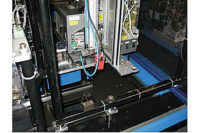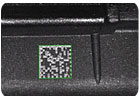
A 2D Data Matrix code, etched into the plastic housing of the actuator,
enables an automotive supplier to document that that each assembly operation
was successfully completed. Photo courtesy Cognex Corp.
The supplier needed Innovative Automation (IA) to design and build an assembly line for a new actuator. The line had to include a part traceability system to document that each operation was successfully completed.
To meet this challenge, IA laser-etched a 2D Data Matrix code into the plastic housing of the actuator at the first assembly station of the system. The code is marked prior to the start of assembly operations. Each code consists of a series of dots and spaces that are configured in rows and columns in an arrangement that gives each pattern a unique identity.
At the first assembly station, an In-Sight 5110 vision system verifies whether the Data Matrix code quality is sufficient to be readable at subsequent stations. At each assembly station, the code is read by a DataMan 100 Industrial ID Reader, which sends a signal to the PLC database to indicate that the operation has been completed.
Tests are also performed at many stations using sensors or vision systems, and the results are also added to the PLC database. If all previous operations have been successfully completed, the part status is considered valid for the station, and the assembly or test operation is allowed to proceed. If a part is rejected and subsequently repaired, its status will be updated in the PLC database, and the part will be accepted at subsequent stations.
Besides code verification, assembly station one is where an operator presses a seal, a bearing and a stud into the lower housing. A sensor measures the force used to press the parts into the housing, and this information is saved in the PLC database. If the operator tries to push an oversized bearing into the pocket on the housing, the sensor will record an excessive force value, and the part is removed at this station or will be rejected at the next station.
At the second station, an operator loads an output gear and shaft onto the assembly. At the third station, the operator attaches a small electric motor with a pinion gear that engages the gear loaded in the previous station. At the fourth station, the assembly is loaded onto a four-station rotary-indexing dial machine and a cover is installed.
The dial machine then indexes the part to its second station were a leak tester checks the housing at a pressure of 20 psi to ensure it is airtight. Grease is automatically injected into the pinion gear at the third station of the dial machine. At the fourth station, a second operator loads the cover with five clips and presses it into the lower housing.
The part then indexes back to the first station of the dial machine, where a vision camera verifies the presence of the clips. The same operator that loaded the part onto the dial machine unloads it to station five of the assembly system. A function tester at this station powers up the part and runs it through a series of operations. The test results are stored in the PLC database. The operator then passes the part back to station one, where the same laser that put on the original 2D Data Matrix code applies another code, which includes the serial number and date code for the accepted part.
Originally, the customer bought a single machine with the Data Matrix tracking system, but now uses it on all of its assembly lines.
For more information on data code readers, call 508-650-4141 or visit www.cognex.com.