Medical Device Assembly: Lasers Make Marks in Medical
Lasers are used extensively by medical professionals to surgically remove tumors or repair skin, eyes and hair. Interestingly, these types of lasers are also being used by medical device manufacturers to mark codes directly on their products as a way to improve traceability.

Lasers are used extensively by medical professionals to surgically remove tumors or repair skin, eyes and hair. The types of lasers most commonly used for these procedures are carbon dioxide (CO2) and neodymium-doped yttrium aluminum garnet (Nd: YAG).
Interestingly, these and other types of lasers are also being used by medical device manufacturers to mark codes directly on their products as a way to improve traceability. This trend will increase over the next few years as the FDA implements its new Unique Device Identification (UDI) system, which requires every medical device to bear a unique, globally recognized identifier so it can be tracked from the point of manufacture, through distribution, to final use.
Boston Scientific Neuromodulation Corp., for example, laser marks several of the medical devices it manufactures, including the Precision Plus Spinal Cord Stimulator (SCS) system. The system consists of a small, rechargeable implant; two or more flexible leads that connect to the implant; and the external devices necessary to control therapy and charge the implant (a charger and a cordless remote).
During surgery, the leads from the implant are inserted along each side of the spine. After surgery, the patient uses the charger to power the implant, and the remote to control how much electrical stimulation is sent to the spine for pain relief.
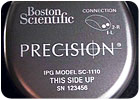
Human-readable information is laser marked on the implant (which has a metal outer case), charger and cordless remote, which is polycarbonate.
Greg Bates, senior process engineer for Boston Scientific, says the marked information includes model, serial and lot numbers, along with general company contact information. The marking area on each component is a bit more than 0.5-inch square.
Precision Plus SCS has been laser-marked for the past six years. It is assembled in the company’s Valencia, CA, facility at a rate of 50 to 100 units per day and distributed to hospitals worldwide.
“We are familiar with UDI and already comply with it,” says Gino Mercurio, manufacturing support engineer for Boston Scientific. “Laser marking helps us meet our high traceability requirements. If there’s ever a problem with any device out in the field, even after many years, we can trace it back and retrieve all its pertinent information such as exactly when it was made and with what materials.”

Manufacturers currently use lasers to mark a wide range of medical products, from pacemakers to catheter hubs and steel prostheses. Lasers are also used to mark steel medical instruments, transfusion bags, biofluid storage containers and oral medicines.
Another reason manufacturers like laser-made marks is that they are environmentally friendly, very clean and do not require any chemicals. In addition, laser marking offers users a fixed cost of operation because it uses no consumables.
Finally, laser marking ensures the safety of implantable devices. For example, products marked using the dot-peen method can contain traces of debris, while those with RFID tags may, over time, expose patients to higher-than-normal levels of radio waves.
A laser marks plastic and metal surfaces differently. On plastic surfaces, the laser creates marks through carbonization, foaming, ablation or bleaching. Carbonization produces dark marks, while foaming produces light ones. During ablation, a covering layer evaporates to produce high-contrast marks. Bleaching modifies surface pigments, resulting in a surface color change.
On metal surfaces, marks are created through engraving, annealing or surface removal. Laser engraving vaporizes the surface material. Annealing is done to create a contrasting mark. The surface removal process is used on multilayer materials such as anodized aluminum.
Any character or image that can be created or imported into CAD-based or graphics software programs like Illustrator and Corel Draw can be marked with a laser.
YVO4 and Nd: YAG lasers have a wavelength of 1,064 nanometers, while the ytterbium fiber laser has a slightly higher wavelength of 1,070 nanometers. The wavelengths of the other lasers are as follows: green (532 nanometers), UV (355 nanometers) and CO2 (10,640 nanometers).
Although introduced a little more than a decade ago, the Yb: fiber has become one of the most popular lasers for high-quality contrasting marks on plastic and metal devices. With a minimum focused spot size of 20 microns, high-resolution marks are also possible. This laser has a power range from 10 to 50 watts and can be used in various low- and high-power applications. It also offers low operating costs.
“This laser produces high-contrast marks for many of the materials used in the medical device industry,” says Geoff Shannon, laser technology manager for Miyachi Unitek. “The fiber laser has the high mark flexibility and control necessary to provide precise marking and negligible heat input.”
Miyachi Unitek’s range of LMF fiber lasers can be used for many applications on metal or plastics-from large-area marking to marking characters less than 30 microns wide. LMF lasers provide pulse frequencies from 2 to 500 kilohertz, selectable pulse widths, and excellent beam quality and mark times. In particular, the LMF 2000-SM single-mode laser features an increased depth of focus and marking area.
Another type of laser used for high-resolution fine marking, especially on plastics, is the YVO4. This laser has a beam spot size from 15 to 150 microns, depending upon the lens used to focus the laser and the marking application. YVO4 lasers produce intense, short pulses of light that last less than 20 nanoseconds at peak powers as high as 100 kilowatts.
“YVO4 lasers provide excellent absorption in plastics and metal surfaces such as stainless steel and titanium,” says James Jewell, senior technical marketing specialist for Keyence Corp. “In addition, the lasers can be fine-tuned to create consistent-color markings on plastic. Depending on the specific type of plastic and laser frequency, the laser can produce brown, black or white markings.”
The MD-V9900A from Keyence is a three-axis YVO4 laser that can perform marking on the X, Y and Z axes within a 42-millimeter variable focal length. This laser provides pulse recurrence at frequencies up to 400 kilohertz and features a dual-end pumping cavity that reduces energy consumption.
 The Nd: YAG laser can be used for low- and high-power applications (10 to 100 watts) involving deep engraving on metal and plastic surfaces. This laser has a beam spot size of 30 microns or wider. Although the beam is high-powered, it produces limited thermal distortion.
Technifor makes the TD 412 diode-pumped Nd: YAG laser, which comes with T700W marking software. Andrew Wellons, laser market manager for Technifor, says the TD 412 can be used on thin plastics and reflective metallics such as stainless steel and titanium.
The T700 software supports marking of text, logos, photos, 1D and 2D barcodes and unique identifier symbols. The TD 412 can be linked to a PC, PLC or barcode reader, or operated independently.
Green and UV lasers are specialty Nd: YAG lasers that produce higher-contrast markings with greater control of heat input. The green laser is created through a process called frequency doubling, in which the photons from an Nd: YAG laser are combined with those of a nonlinear crystal to form new photons that have twice the energy and frequency, but have a wavelength of 532 nanometers. This laser is most often used on highly reflective metals and plastics without pigmentation.
The UV laser is created through frequency tripling, in which the ND: YAG laser is combined with a nonlinear crystal twice to form new photons that have triple the energy and frequency, but one-third the wavelength (355 nanometers). The UV laser produces extremely high-resolution markings on all types of plastic and is used for corrosion-resistant marking on stainless steel.
Finally, there is the CO2 laser, which is an older technology still preferred by many manufacturers because it is low cost and has low maintenance requirements. A CO2 laser operates at various power levels (10 to 50 watts) and has a large beam spot size (50 to 200 microns), yet it absorbs well into non-metallic materials. As a result, this laser is used mostly on plastics, especially packaging materials. It can also be used on anodized aluminum.
Synrad makes the 48-1 CO2 laser, which has a beam diameter of 3.5 millimeters and beam mode quality near 1.0. Justin Conroy, laser applications engineer for Synrad, says a mode quality number near 1.0 means users can focus the laser beam down to a spot size of 50 to 100 microns.
The 48-1 has a working life of greater than 45,000 hours but can be refilled with gas as needed. Available in air- and water-cooled versions, the 48-1 is used with the company’s UC-2000 universal laser controller.
Lasers are used extensively by medical professionals to surgically remove tumors or repair skin, eyes and hair. The types of lasers most commonly used for these procedures are carbon dioxide (CO2) and neodymium-doped yttrium aluminum garnet (Nd: YAG).
Interestingly, these and other types of lasers are also being used by medical device manufacturers to mark codes directly on their products as a way to improve traceability. This trend will increase over the next few years as the FDA implements its new Unique Device Identification (UDI) system, which requires every medical device to bear a unique, globally recognized identifier so it can be tracked from the point of manufacture, through distribution, to final use.
Boston Scientific Neuromodulation Corp., for example, laser marks several of the medical devices it manufactures, including the Precision Plus Spinal Cord Stimulator (SCS) system. The system consists of a small, rechargeable implant; two or more flexible leads that connect to the implant; and the external devices necessary to control therapy and charge the implant (a charger and a cordless remote).
During surgery, the leads from the implant are inserted along each side of the spine. After surgery, the patient uses the charger to power the implant, and the remote to control how much electrical stimulation is sent to the spine for pain relief.
Human-readable information is laser marked on the implant (which has a metal outer case), charger and cordless remote, which is polycarbonate.
Greg Bates, senior process engineer for Boston Scientific, says the marked information includes model, serial and lot numbers, along with general company contact information. The marking area on each component is a bit more than 0.5-inch square.
Precision Plus SCS has been laser-marked for the past six years. It is assembled in the company’s Valencia, CA, facility at a rate of 50 to 100 units per day and distributed to hospitals worldwide.
“We are familiar with UDI and already comply with it,” says Gino Mercurio, manufacturing support engineer for Boston Scientific. “Laser marking helps us meet our high traceability requirements. If there’s ever a problem with any device out in the field, even after many years, we can trace it back and retrieve all its pertinent information such as exactly when it was made and with what materials.”
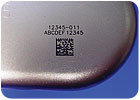
Nd: YAG lasers provide deep marking of 2D Data Matrix codes on metal surfaces. Photo courtesy Technifor
The Preferred Marking Method
Laser marking continues to grow in popularity among medical device manufactures because it creates a permanent mark that is high quality and high contrast, unlike other methods such as ink-jetting, labels, pad printing, dot-peening and radio frequency identification (RFID) tags.Manufacturers currently use lasers to mark a wide range of medical products, from pacemakers to catheter hubs and steel prostheses. Lasers are also used to mark steel medical instruments, transfusion bags, biofluid storage containers and oral medicines.
Another reason manufacturers like laser-made marks is that they are environmentally friendly, very clean and do not require any chemicals. In addition, laser marking offers users a fixed cost of operation because it uses no consumables.
Finally, laser marking ensures the safety of implantable devices. For example, products marked using the dot-peen method can contain traces of debris, while those with RFID tags may, over time, expose patients to higher-than-normal levels of radio waves.
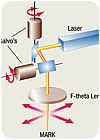
A laser beam is created when a lasing medium is excited by an energy source, or pump, and amplified between fully and partially reflecting mirrors (mounted on Galvo motors). Laser markers use two computer-controlled scanning mirrors to steer the laser beam through a focusing optic (F-theta lens), which concentrates the laser energy into a small spot that forms characters on plastic or metal. Graphic courtesy Miyachi Unitek
How Lasers Mark Surfaces
A laser beam is created when a lasing medium, such as carbon dioxide, is excited by an energy source, or pump, and amplified between fully and partially reflecting mirrors. Laser markers use two computer-controlled scanning mirrors to steer the laser beam through a focusing optic, which concentrates the laser energy into a small spot that forms characters on plastic or metal.A laser marks plastic and metal surfaces differently. On plastic surfaces, the laser creates marks through carbonization, foaming, ablation or bleaching. Carbonization produces dark marks, while foaming produces light ones. During ablation, a covering layer evaporates to produce high-contrast marks. Bleaching modifies surface pigments, resulting in a surface color change.
On metal surfaces, marks are created through engraving, annealing or surface removal. Laser engraving vaporizes the surface material. Annealing is done to create a contrasting mark. The surface removal process is used on multilayer materials such as anodized aluminum.
Any character or image that can be created or imported into CAD-based or graphics software programs like Illustrator and Corel Draw can be marked with a laser.
Human-readable information is laser marked on the Precision Plus SCS system implant, which has a metal outer case. Image provided courtesy of Boston Scientific. (C)2011 Boston Scientific Corp. or its affiliates. All rights reserved.
Several Technologies to Choose From
Lasers are named according to the mediums they use and categorized by their wavelength. Types of lasers include ytterbium fiber (Yb: fiber), neodymium-doped yttrium orthovanadate (YVO4), Nd: YAG, green, ultraviolet (UV) and CO2.YVO4 and Nd: YAG lasers have a wavelength of 1,064 nanometers, while the ytterbium fiber laser has a slightly higher wavelength of 1,070 nanometers. The wavelengths of the other lasers are as follows: green (532 nanometers), UV (355 nanometers) and CO2 (10,640 nanometers).
Although introduced a little more than a decade ago, the Yb: fiber has become one of the most popular lasers for high-quality contrasting marks on plastic and metal devices. With a minimum focused spot size of 20 microns, high-resolution marks are also possible. This laser has a power range from 10 to 50 watts and can be used in various low- and high-power applications. It also offers low operating costs.
“This laser produces high-contrast marks for many of the materials used in the medical device industry,” says Geoff Shannon, laser technology manager for Miyachi Unitek. “The fiber laser has the high mark flexibility and control necessary to provide precise marking and negligible heat input.”
Miyachi Unitek’s range of LMF fiber lasers can be used for many applications on metal or plastics-from large-area marking to marking characters less than 30 microns wide. LMF lasers provide pulse frequencies from 2 to 500 kilohertz, selectable pulse widths, and excellent beam quality and mark times. In particular, the LMF 2000-SM single-mode laser features an increased depth of focus and marking area.
Another type of laser used for high-resolution fine marking, especially on plastics, is the YVO4. This laser has a beam spot size from 15 to 150 microns, depending upon the lens used to focus the laser and the marking application. YVO4 lasers produce intense, short pulses of light that last less than 20 nanoseconds at peak powers as high as 100 kilowatts.
“YVO4 lasers provide excellent absorption in plastics and metal surfaces such as stainless steel and titanium,” says James Jewell, senior technical marketing specialist for Keyence Corp. “In addition, the lasers can be fine-tuned to create consistent-color markings on plastic. Depending on the specific type of plastic and laser frequency, the laser can produce brown, black or white markings.”
The MD-V9900A from Keyence is a three-axis YVO4 laser that can perform marking on the X, Y and Z axes within a 42-millimeter variable focal length. This laser provides pulse recurrence at frequencies up to 400 kilohertz and features a dual-end pumping cavity that reduces energy consumption.
Lasers mark metal surfaces through engraving, annealing or surface removal. Annealing is done to create a contrasting mark. Photo courtesy Miyachi Unitek
Technifor makes the TD 412 diode-pumped Nd: YAG laser, which comes with T700W marking software. Andrew Wellons, laser market manager for Technifor, says the TD 412 can be used on thin plastics and reflective metallics such as stainless steel and titanium.
The T700 software supports marking of text, logos, photos, 1D and 2D barcodes and unique identifier symbols. The TD 412 can be linked to a PC, PLC or barcode reader, or operated independently.
Green and UV lasers are specialty Nd: YAG lasers that produce higher-contrast markings with greater control of heat input. The green laser is created through a process called frequency doubling, in which the photons from an Nd: YAG laser are combined with those of a nonlinear crystal to form new photons that have twice the energy and frequency, but have a wavelength of 532 nanometers. This laser is most often used on highly reflective metals and plastics without pigmentation.
The UV laser is created through frequency tripling, in which the ND: YAG laser is combined with a nonlinear crystal twice to form new photons that have triple the energy and frequency, but one-third the wavelength (355 nanometers). The UV laser produces extremely high-resolution markings on all types of plastic and is used for corrosion-resistant marking on stainless steel.
Finally, there is the CO2 laser, which is an older technology still preferred by many manufacturers because it is low cost and has low maintenance requirements. A CO2 laser operates at various power levels (10 to 50 watts) and has a large beam spot size (50 to 200 microns), yet it absorbs well into non-metallic materials. As a result, this laser is used mostly on plastics, especially packaging materials. It can also be used on anodized aluminum.
Synrad makes the 48-1 CO2 laser, which has a beam diameter of 3.5 millimeters and beam mode quality near 1.0. Justin Conroy, laser applications engineer for Synrad, says a mode quality number near 1.0 means users can focus the laser beam down to a spot size of 50 to 100 microns.
The 48-1 has a working life of greater than 45,000 hours but can be refilled with gas as needed. Available in air- and water-cooled versions, the 48-1 is used with the company’s UC-2000 universal laser controller.
Looking for a reprint of this article?
From high-res PDFs to custom plaques, order your copy today!