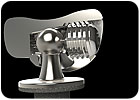
Skeletal Dynamics recently developed the Align Radial Head System, which features an artificial elbow joint designed to restore the natural function of the native radial head. Photo courtesy Spiralock Corp.
As a result, some medical device companies are developing implants to withstand up to 1 million load cycles without loosening or backing out. For example, Skeletal Dynamics recently developed the Align Radial Head System, which features an artificial elbow joint designed to restore the natural function of the native radial head.
Previously, prosthetic radial heads featured one of two designs, both of which had drawbacks. The traditional fixed monoblock design offered stability, but could not be aligned to the patient’s anatomy and tended to wear away natural tissue such as cartilage. The bi-polar radial head did align with the patient’s native anatomy by rotating in a polyethylene sheath, but would not remain in the correct position because it would not lock.
“We aimed to provide the ability to orient the joint to its natural position during surgery, and then lock it in place for the rest of the patient’s life,” says Tom Norman, vice president of engineering at Skeletal Dynamics. “We considered traditional fastener thread forms, but lacked confidence that they would stay in place for the up to a million load cycles an active patient could subject them to in their lifetime.”
Skeletal Dynamics next considered using a fastener called Spiralock but was concerned about the manufacturability of the fastener’s self-locking thread. Spiralock features a 30-degree wedge ramp cut at the root of the female thread, whereas traditional fasteners use a 60-degree thread.
Under clamp load, the crests of the threads on any standard male bolt are drawn tightly against the wedge ramp. This eliminates sideways motion that causes vibrational loosening and distributes the threaded joint’s load throughout all engaged threads.
The load percentage on the first engaged thread is very low, reducing the chance of bolt failure and improving product performance.
To counter Skeletal Dynamics’ concerns, Spiralock Corp. manufactured prototype tooling, customized tools to cut the thread form and worked closely with their contract manufacturer to increase production. Skeletal decided to use Spiralock with the Align system.
When the Align system is surgically installed in a patient, proprietary instrumentation allows alignment of the radial head as it would be in the patient’s native anatomy. Once the device is oriented in this natural position, the surgeon locks the device in place by tightening the Spiralock setscrew (made of cobalt chrome) against a long titanium stem for three-point fixation.
“Third-party testing showed that the fastener successfully survived load and fatigue testing to one million cycles without loosening or backing out,” says Norman. “That gave us the design confidence we needed, and helped with our FDA approval. Going right to the fastener potentially saved us millions of dollars and years of development time.”
For more information on self-locking fasteners, call 800-521-2688 or visit www.spiralock.com.