That, at least, has been the experience of engineers at Medtronic Sofamor Danek, a manufacturer of tools and implants for spinal surgery. Surgeons from across the country visit Sofamor’s assembly plant and development lab in Memphis, TN, to have their ideas for new surgical instruments turned into functional prototypes. One of the lab’s most important machines is the Fortus fused-deposition modeling (FDM) system from Stratasys Inc.
“We often see one or two VIP surgeons per day,” says Sofamor design engineer Richard Franks. “They come with a problem to solve in the morning. They explain their need to an engineer. The engineer will model a solution on ProEngineer [CAD software] and then make a prototype. Often by the next morning, we’ll have a prototype in their hands. Sometimes we even deliver the same day. Having the FDM machine in-house really makes it easy for us to design products.”
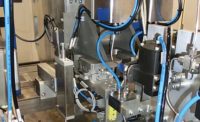
The Fortus machine produces accurate, durable prototypes and production-grade parts from high-performance thermoplastic. The machine works much like an inkjet printer, but instead of ink, it deposits thin layers of plastic, such as ABS, polycarbonate or polyphenylsulfonen. The smallest Fortus machine can produce a prototype as large as 10 by 10 by 12 inches. The largest model can make a prototype as big as 36 by 24 by 36 inches.
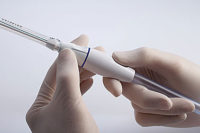
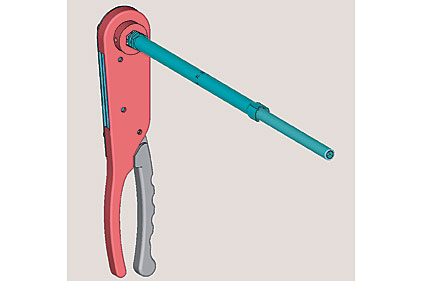
Sofamor engineers recently designed a ratcheting instrument for fastening setscrews to a corrective vertebral implant. After the screws are fixed in place, the tool shears off the screw heads at a preset torque. The current method of driving the screws required surgeons to use two separate tools, working in opposing directions, using both hands. The result was often a violent impulse that occurred at the moment when the screw head sheared off. The surgeons wanted to eliminate that.
“The tool we developed combines the two existing tools into a single unit,” says Franks. “As the surgeon squeezes two handles together, the ratchet tightens the screws.”
The engineers produced a working polycarbonate ratchet strong enough to withstand testing on stainless steel setscrews and durable enough to survive an autoclave. “Surgeons are really rough on these prototypes while trying them out, so we’ve got to have tough material,” adds senior engineering manager Troy McDonald. “FDM gave us the strength and durability we needed.”
The ability to produce prototypes that can actually be used as intended is vital for tweaking designs, says McDonald. For example, after sending the ratchet out to three hospitals, Sofamor learned that the design could be improved by rotating its handle 90 degrees—information it might not have learned without working prototypes.
Having FDM technology in the prototype lab also yields some financial advantages. “Now we can refine our designs more before we start cutting metal, which is where the dollars start going up exponentially,” says McDonald.
He predicts that the savings will continue as more prototypes are made in-house. “We have several divisions and each one has its own dedicated engineering staff that comes to our lab with modeling requests,” says McDonald. “Except for display items, almost everything that comes off the FDM machine is for functional evaluation. That saves the company a lot of money. The cost of sending out work vs. doing it in-house is easy to capture, and we can justify owning the FDM system by reducing that cost alone. But the intangibles like timing issues, communication and value-added services are where we see the greatest benefits.”
For more information on rapid prototyping equipment, call Stratasys at 800-937-3010 or visit www.stratasys.com.