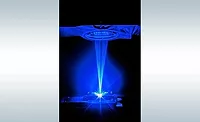
Diode Lasers for Welding Aluminum
Audi, Volkswagen and other OEMs are successfully using diode lasers for structural welds.
The latest Corporate Average Fuel Economy standard requires automotive OEMs to meet an average fleet gas mileage of 54.5 mpg by 2025. This will require radical improvements in engine technology as well as drastically lighter vehicles.
Using aluminum instead of steel can decrease the weight of a car body up to 50 percent. For example, the latest Audi A8, with its aluminum chassis, is a whopping 527 pounds lighter than the original 1994 model, which had a steel chassis.
Initially, joining aluminum represented quite a challenge. Now, however, automakers have numerous options, including riveting, MIG welding and laser welding.
|
Diode Laser Suppliers
Coherent Inc.
DILAS Diode Laser Inc.
Laserline Inc.
TeraDiode Inc. |
Many laser technologies can be used for metal welding, including CO2, Nd:YAG and fiber lasers, but one technology that is gaining attention for welding aluminum is high-power diode lasers.
A diode laser is a semiconductor device that directly converts electrical energy into laser light. High-power diode lasers emit light in the near-infrared spectrum, 800 to 940 nanometers.
A single diode laser emitter might produce a few watts of output power. However, numerous emitters can be fabricated on a single, monolithic semiconductor substrate or bar with a total output as high as 100 watts. These bars can, in turn, be combined in horizontal or vertical stacks to produce lasers with a total output measured in kilowatts. (Diode lasers should not be confused with optically pumped solid-state lasers, which are powered, or “pumped,” by a lamp or a laser diode.)
A key advantage of diode lasers is their efficiency. A high-power diode laser is approximately 40 percent efficient in converting electrical energy into light. In comparison, a CO2 laser is about 20 percent efficient. That makes diode lasers less expensive to operate.
Another cost-saving advantage of diode lasers is their long life. A diode laser can provide more than 30,000 operating hours. In comparison, a lamp-pumped Nd:YAG laser requires a lamp change every 1,000 operating hours.
Another advantage of diode lasers is their compact size, which makes them easy to integrate with robots or other assembly equipment. It also makes them easier to keep cool.
Welding With Diode Lasers
High-power diode lasers can be used for both conduction welding and keyhole welding.
In keyhole welding, the laser is focused to achieve a high power density on the workpiece. Once the metal starts to melt, it can absorb much more heat from the laser. This raises the metal’s temperature above the boiling point, generating metal vapor. The pressure of this vapor opens a channel around the laser beam, forming the so-called keyhole. The keyhole traps almost all of the laser power and converts it into heat, allowing the laser to produce welds that are deep and narrow.
A 1-kilowatt, fiber-coupled diode laser can keyhole-weld 304 stainless and mild steel up to 0.125 inch thick at a rate of 72 inches per minute.
In conduction welding, the laser energy is absorbed mostly at the surface of the metal, and heat transfer into the bulk material occurs by conduction. Conduction welds are shallow with a bowl-shaped profile, and they tend to be wider than they are deep. The heat-affected zone is large, and the transition from the fusion zone to the base metal is smooth and gradual. Welds made with a diode laser do not require as much surface preparation as those made with CO2 or Nd:YAG lasers.
With conduction welding, diode lasers can be used for:
- seam welding thin sheets.
- welding parts with differing thicknesses.
- welding materials prone to cracking.
- welding parts with complex, 3D joining faces.
Diode lasers are good for conduction welding medium- and high-carbon steels, which tend to form an undesirable martensitic fusion zone when subjected to high temperatures and fast temperature cycles. Galvanized steels can also be conduction welded with diode lasers. The low-temperature process creates a fusion zone with a uniform dilution of zinc and steel with no porosity.
Stainless steel is another candidate for conduction welding with diode lasers. Stainless absorbs near-infrared wavelengths better than longer wavelengths. And, because conduction welding is a lower-temperature process, it doesn’t remove volatile alloying elements from the fusion zone, preserving the material’s corrosion resistance.
Diode lasers offer a distinct advantage for welding aluminum. The wavelength of diode lasers is closer to the absorption peak of aluminum than the 1,030-nanometer wavelength of disk lasers or the 1,080-nanometer wavelength of fiber lasers.
Several car manufacturers are using diode lasers to weld structural components and outer skin joints.
In general, welding 6000 series aluminum, which is commonly used in car bodies, requires an aluminum-silicon filler wire to prevent hot cracking of the weld.
The filler wire is applied during the weld with the aid of optical seam-tracking technology.
Audi uses a 4-kilowatt diode laser guided with a 400-micron optical fiber to weld the aluminum tailgates of several vehicle models. The finish of the tailgate welds meet the highest specifications for visible joint quality and does not require further processing.
Kuka Systems Corp. North America has successfully welded aluminum with both 4-kilowatt and 6-kilowatt fiber-coupled diode lasers. Typical weld speeds are 3 to 4 meters per minute. One application was to weld structural reinforcements under truck beds. This was achieved with a low-brightness diode laser guided by a 1-micron fiber. It yielded an edge-lap weld with good strength yet little or nothing showing on the back side.
Beyond Car Bodies
Hybrid and electric vehicles require a lot of lithium-ion batteries. The battery cans are mostly made from aluminum and require a hermetic seal where the cap is attached. The weld process cannot damage any of the components inside the can.
Conduction welding with a diode laser solves the problem. For example, a diode laser was used to weld a housing made from 3000 series aluminum 1 millimeter thick. The laser enabled the manufacturer to tightly control weld depth to between 0.3 and 0.6 millimeter. Better still, the metal did not need to be cleaned prior to welding. The beam spot was 0.6 millimeter in diameter, and the weld speed was 4.5 meters per minute.
Diode lasers can even be used for micro-welding thin stainless steel foils. In the electronics industry, parts such as pressure sensors with diaphragms are made by welding thin metal sheets together. A 2-kilowatt fiber-coupled diode laser can weld metal sheets ranging in thickness from 150 microns to 3 millimeters.
Without an optical fiber, a 500-watt diode laser can weld foils less than 100 microns thick. (Without the fiber, the shape of the beam is elliptical rather than circular, making for a narrower weld.)
Besides metal welding, diode lasers can be used for a host of other joining applications. For example, diode lasers can be used for noncontact selective soldering of sensors and other heat-sensitive electronic components. The advantages of laser soldering are limited heat load and a highly defined, localized energy input. In the photovoltaic industry, diode lasers solder the conductive ribbons connecting individual solar cells in a panel.
Similarly, diode lasers can be used for brazing. Compared with spot welding, laser brazing produces a more aesthetic joint. At the Volkswagen assembly plant in Wolfsburg, Germany, a 6-kilowatt diode laser and a silicon bronze filler metal are used to braze the zinc-coated steel roof of the Touran minivan. The joint is brazed at a rate 4.4 meters per minute.
Diode lasers can also weld thermoplastics, as long as at least one of the parts is transparent to the laser.
Looking for quick answers on assembly and manufacturing topics? Try Ask ASM, our new smart AI search tool. Ask ASM
Looking for a reprint of this article?
From high-res PDFs to custom plaques, order your copy today!