Assembly Blog


Welding, Dispensing, Machine Tending...and Milking?

June 29, 2010
Robots are used for myriad applications, including welding, painting, palletizing and assembly. Now, dairy farmers are using them milk cows.

Agriculture-one of only three ways to create real wealth-has always been challenging, and dairy farming is arguably the most challenging, at least in terms of never-ending commitment. Row crops can be planted, protected from insects and disease, and even harvested with some flexibility in scheduling. Similarly, feeding meat animals to market weight has some flexibility in scheduling. But in dairy farming, cows must be milked on a regular schedule, several times a day, 365 days a year. The life of a dairy farmer has always been one of unbending adherence to a schedule.

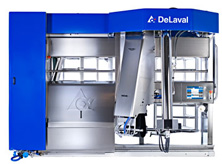
Enter-stage left-automation in the form of robotic milking. Milking machines have been in use for years, of course, but they still require numerous manual operations to get the job done. And, generally speaking, milking must still be done on a rigid schedule. Not so at the Russell Buchholz farm in Malta, IL. As reported recently in Point of View, the DeKalb County (IL) Farm Bureau’s newspaper, Buchholz’s dairy cows are now on their own schedule with the help of two Voluntary Milking Systems (VMS) from DeLaval. The firm has been making these robotic milkers for 10 years. While robotic technology has been used extensively in Europe, the Buchholz installation is the first in Illinois.

Each of the 116 cows is fitted with an electronic collar that identifies that cow to the computer controlling the system. When a cow decides to be milked, she enters an entry lock where she is identified. If a sufficient amount of time has elapsed since her last milking, the cow is allowed to enter and given a dietary concentrate. A multipurpose robotic arm then extends underneath the cow and, guided by laser and photo sensors, cleans and dries each teat before attaching vacuum milking cups.

Milk flow, quantity and milking time are monitored individually for each of the cow’s four teats, and compared with historical values. After milking, the vacuum cup lines are retracted, and the robotic arm sprays the cow’s underside with a disinfectant. The gate then opens, releasing the cow to the feeding area, and the VMS system cleans itself before allowing the next cow to enter.

Although automation and robotics have progressed to an extent unimaginable 50 years ago, there are still areas where the “you can’t automate that” mindset impedes their application. Dairy farming was one such area not many years ago. But people like the Buchholz family will expand the automation envelope into new areas in the years ahead.

Robotic Milking

Brian Huse
June 30, 2010 3:50 PM
Robots were invented specifically for dirty, dangerous and droll work in the factory. From the beginning robots were made to work in a dirty environment (fumes, dust, etc.); for a dangerous task (heavy lifting or repeated motions if not worse); and often for work that is just boring or repetitive. They are rugged and reliable because they were bred for use in harsh factory environments. It is no wonder robots now are finding a niche in settings outside the factory that are equally difficult (like a barn). Sensors and end-effectors have been designed for almost every immaginable task, but it is still jarring to realize how easily this transfers to new tasks like cow milking. Are agricultural robots poised for big gains? A lot of research has gone into it. Don't be surprised if farmers all over the world find competitive advantages with robots. Thank you auto industry. You are a demanding task master and that is why robots can go 80,000 to 100,000 hours between failure in even the harshest conditions (automotive or not). Fixed automation just doesn't have the same mix of reliability, flexibility and affordability.


about welding

Welding Machines
August 27, 2010 4:41 AM
I found informative as well as useful Blog here. As an industrial analyst, I would like to share about welder. They provide welding machines, welding helmets, mig/tig welding, equipments tools & accessories etc... http://welder.net.au


You must register or login in order to post comments.

Multimedia

Videos

Image Galleries

Wire Harness

AssemTech Inc. is a busy and growing harness assembly shop in West Chicago, IL. The company has a 12,000-square-foot assembly area and employs 20 full-time harness assemblers - far cry from its early days back in 1986, when founder Chuck Hall and various family members assembled harnesses in his garage.

Podcasts

Lighting and 3D: Their Impact on Vision Inspection
Cognex Corp. makes vision inspection systems for manufacturers worldwide. Recently, John Stamos, sales engineer for Cognex, spoke with Jim Camillo, a senior editor of Assembly magazine, about the impact of lighting and 3D technologies on current and future vision inspection systems. The interview was conducted after a small-group presentation by Stamos in Chicagoland.
More Podcasts

THE MAGAZINE

Assembly Magazine

February 2012 issue cover

2012 February

Assembly's new issue is now available. Check it out!

TABLE OF CONTENTS SUBSCRIBE

U.S. manufacturers

What are your plans for 2012?
See Poll Results Poll Archive

THE ASSEMBLY MAGAZINE STORE

welding.gif
Welding: Principles & Practices

This text introduces students to a solid background in the basic principles and practices of welding.

More Products

Clear Seas Research

Clear Seas ResearchWith access to over one million professionals and more than 60 industry-specific publications,Clear Seas Research offers relevant insights from those who know your industry best. Let us customize a market research solution that exceeds your marketing goals.

Assembly Showrooms

ASSEMBLY Showrooms

STAY CONNECTED

Facebook Twitter  LinkedIn