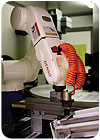
Surefire LLC (Fountain Valley, CA) manufactures professional-grade, high-intensity flashlights used by people like hikers and police officers. Although it has long employed both automated and semiautomated processes on its assembly lines, the company recently began replacing its hard automation equipment with articulated robots to further streamline its manufacturing operations.
Among other things, company engineers wanted to reduce labor costs, while at the same time improving quality and reducing scrap rates and rework. The company also wanted to improve flexibility and the rate of return on investment on its automated equipment.
With this in mind, Surefire now has two robots from DENSO Robotics (Long Beach, CA) in operation with three more robots on order. In the first of its two existing workcells, a VS Series six-axis articulated robot picks up flashlight parts from a conveyor and then presents them to a laser, which engraves them with serial numbers and other information. After engraving, the robot places the parts onto an outgoing conveyor.
This system replaces a fixtured indexing table that required an operator to load and unload the parts, sometimes more than once in the event multiple sides needed to be engraved. Thanks to its articulated “wrist,” the robot can turn the parts as many times as necessary to complete the required engraving. With less manual part handling and a more constant output flow, one operator can now run multiple machines. Cycle times are also faster, with the engraving operations requiring approximately 24 seconds, compared to 48 seconds in the past.
In the second cell, another six-axis articulated robot, equipped with a three-function gripper, assembles flashlight tail-cap units. Each tail cap assembly consists of a tail cap, a retainer ring, a spring holder, a spring and drive stud.
To begin the assembly sequence, the robot picks up a drive stud from a dispenser and places it into a spring holder. The robot then picks up a tail cap and presents it to an adhesive dispenser, which places adhesive onto the interior threads of the cap.
Next, the robot inserts a retainer ring into the cap and positions the cap under a screwdriving machine, which tightens the retainer ring into the cap. The robot then inserts the drive stud, spring holder and spring into the cap assembly, and presents the assembly to a press, which fits the spring into the spring holder. Finally, the robot removes the completed assembly from the press and places it into a parts box on the outgoing parts shuttle.
The new cell takes up much less floor space than the multiple semiautomated stations previously used, and can be run by a single operator-the same one operating the laser-marking cell. Cycle times have been cut in half, from 76 seconds to 38 seconds.
Up to now, all systems integration has been done in-house, with most parts fabricated in the company’s own machine shop. “In-house integration isn’t for everyone, of course, but for us it had a lot of advantages,” says Surefire vice president of assembly operations Daniel Fischer. “The robots themselves were easy to set up and program, especially using DENSO’s 3D offline simulation software. And naturally we saved a considerable amount of money by designing and building our own cells…. ROI is pretty fast this way. Running two shifts, it’s been only a little over a year.”
For more on robotic assembly, visitwww.densorobotics.comor call 888-952-7502.