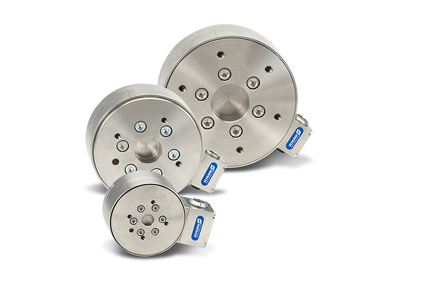
The efficiency and reliability of an industrial robot largely depend on its end-of-arm tooling (EOAT). However, we often forget that the interface between the end-effector and the robot arm also plays a critical role. Devices, such as tool changers, compensation units, and force and torque sensors, have a great influence on the robot’s performance, flexibility and fields of application.
Tool changers lend speed and flexibility to a robotic assembly line.Even an experienced operator requires 10 to 30 minutes to manually change the EOAT on a robot. With a tool changer, the same operation takes less than 10 to 30 seconds.
A tool changer consists of two components: a quick-change head, which is mounted on the robot arm, and a quick-change adapter, which is connected to the tool. The tool changer provides feed-throughs for electric, pneumatic and hydraulic connections between the arm and the EOAT. During a tool change, both components are automatically or manually coupled. When selecting a tool changer, engineers should look for a device with a low weight-to-force ratio, short change times, and precision-made energy-transfer points.
Integrating micro valves into a quick-change system can replace a complete valve terminal. At every cycle, the cylinder of the actuator will fill with compressed air, which saves a lot of time. If you are using a feeding hose that’s 3 meters long and 4 millimeters in diameter, micro valves will reduce air consumption by 90 percent. Instead of cable and wire bundles, just one pneumatic line for compressed air and power supply is required. Both lines can usually be fed through a center bore with a diameter of 12 millimeters, and they can be integrated into the arm of a SCARA robot.
To avoid problems during robotic insertion operations, compensation units provide some compliance between the end-effector and the robot arm. This prevents damage to the assembly or the EAOT and increases the reliability of the process. The latest compensation devices work without pneumatics. Compliance in two directions is adjusted via springs with adjustment screws. Compliance in three directions is adjusted via elastomeric elements. Because the units work without pneumatics, they are flat and particularly suitable for use in confined areas. Smooth-running roller guides compensate for smaller forces without stick-slip effects.
The latest trend in robotics is to equip the robot with force and torque sensors. Such sensors give the robot the ability to precisely adjust its path based on feedback. This is critical for obtaining consistent results in robotic grinding and finishing applications, for example.
The FTNet from SCHUNK is an intelligent force and torque sensor that measures forces and moments in all six degrees of freedom. This sensor is equipped with an interface to the robot control unit, which simplifies connection. The sensor has a high-speed data output of up to 7,000 hertz for highly dynamic control. For remote monitoring, the sensor can simply be connected to a local area network. The system settings can be configured, displayed and adjusted via a Web interface.
What’s been your experience with tool-changers, compliance devices, and force and torque sensors? How will these accessories impact future robotic applications?
Editor’s note: “SCHUNK on Automation” is part of a series of guest spots by industry experts that will appear regularly on ASSEMBLY’s blog page. Check back frequently to read more commentaries from SCHUNK, as well as contributions on product testing, ergonomics, electronics assembly and robotics. For more information about automation components, visit www.schunk.com or e-mail info@us.schunk.com.

Recent Comments
Helpful for Trainees
Cable Assembly Manufacturers
Huawei for manufacturing?
should have a scanner and then 3D print the repair
IPC-A-610 and IPC-j-std-001