Columns / We Fed It

We Fed It: System Feeds, Assembles Springs

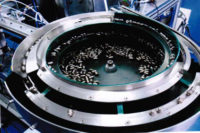
Centricity Corp. has developed a machine that feeds and assembles springs and other tubular parts.

Springs are tough to feed. They’re flexible, and they tangle easily. Centricity Corp. has developed a machine, called the Versa-Stack, that overcomes the challenges of feeding and assembling springs and other tubular parts.

Recently, the machine was put to the test. It had to stack three cylindrical parts-a ring formed from steel wire, a metal tube, and a small or large coil spring-and place the stack into a larger assembly. The OD of each part was approximately 0.15 inch; the ID was 0.1 inch.

The Versa-Stack consists of a vertically oriented servo-driven rotary indexer fitted with a custom dial plate. Mounted radially around the edge of the plate are 35 replaceable pins. Above the plate are two vibratory bowl feeders and two spring feeders fitted with Centricity’s Feedscape systems.

The Feedscape is designed to feed parts with a high diameter-to-length ratio, such as washers, retaining rings, wave washers, Belleville springs, seals and bearings. Instead of handling parts by their outer surfaces, it handles parts by their inside surfaces. The parts are threaded onto a rod and secured by a series of alternating jaws. Parts are free to travel down the rod as the jaws open and close. This maintains control of the part at all times. There is no chance for parts to flip, shingle or fall off. The Feedscape does not require a vibratory in-line track, and tooling is inexpensive and flexible.

As the dial indexes clockwise to the 11:00 position, a ring is fed from the bowl to a Feedscape, which drops it onto a pin. The dial then indexes to the next position, where the tube is dropped onto the same pin. Next, the dial indexes to the final position, where the small spring is dropped onto the pin. If the assembly requires the large spring, the first spring feeder is bypassed and the second feeder is activated.

The stacks are held in place by an integrated retaining system until they reach the 6:00 position. At that point, the stack is threaded onto another Feedscape mechanism, which passes it off to a robot at a rate of 15 per minute.

For more information, call 330-545-5624 or visit www.centricity.net.

Editor’s note: “We Fed It” is a regular series profiling parts feeders for automated assembly. Whether it’s a vibratory bowl, a tray feeder or a flexible robotic system, if you’ve solved a parts-feeding challenge, we’d like to hear about it. Send an e-mail to John Sprovieri, editor of ASSEMBLY, at sprovierij@bnpmedia.com, or call 630-694-4012.


Did you enjoy this article? Click here to subscribe to Assembly Magazine.

John-sprovieri
John has been with ASSEMBLY magazine since February 1997. John was formerly with a national medical news magazine, and has written for Pathology Today and the Green Bay Press-Gazette. John holds a B.A. in journalism from Northwestern University, Medill School of Journalism.

Recent Articles by John Sprovieri

You must login or register in order to post a comment.

Multimedia

Videos

Image Galleries

eCards

eCards including Assembly Lubricant, Metric Components and Part Manufacture and Power/Hand Tools and Accessories!

Podcasts

John Sprovieri was featured on Manufacturing Revival Radio, speaking about best practices and techniques, emerging trends in manufacturing, and the impact that the new Baxter Robot will have on manufacturers, as well as the capital spending outlook for 2013 and 2014.

More Podcasts

THE MAGAZINE

Assembly Magazine

ASM May 2013 cover

2013 May

The 2013 May Assembly includes a cover story about considerations for selecting vision systems and articles about leak testing, optimizing parts bin layout, and what's new with assembly presses. Check it out today!

Table Of Contents Subscribe

Additive Manufacturing Processes

Has your company ever used an additive manufacturing process, such as fused deposition modeling or direct metal laser sintering?
View Results Poll Archive

THE ASSEMBLY MAGAZINE STORE

welding.gif
Welding: Principles & Practices

This text introduces students to a solid background in the basic principles and practices of welding.

More Products

Clear Seas Research

Clear Seas ResearchWith access to over one million professionals and more than 60 industry-specific publications,Clear Seas Research offers relevant insights from those who know your industry best. Let us customize a market research solution that exceeds your marketing goals.

Assembly Showrooms

ASSEMBLY Showrooms

STAY CONNECTED

facebook_40px twitter_40px  youtube_40pxlinkedin_40px