Magnetic Pulse Welding Joins Parts Without Heat
Nuclear energy has a dark side and a bright side. The dark side includes 52,000 tons of stored radioactive waste that poses a potential environmental threat as well as a terrorist target. The bright side is an abundant power source with a minimal amount of atmospheric emissions.
Just like the space program in the 1960s, widespread nuclear energy programs in the 1970s spawned spinoff technology that has been applied to various manufacturing processes. Magnetic pulse welding is one result of such technology transfer.
The welding process was developed in the late 1960s and early 1970s for nuclear energy applications. Russian scientists at the Kurchatov Institute of Nuclear Physics invented a technique for pulsed magnetic welding of end closures of nuclear fuel rods.
Maxwell Laboratories Inc. (San Diego) licensed the technology and built welding equipment for Westinghouse Hanford Co., which operated a nuclear fuel manufacturing facility in Hanford, WA, for the U.S. Department of Energy. Other companies involved in the early development of magnetic pulse welding in the United States included Douglas United Nuclear Inc. (Richland, WA) and General Atomic Technologies Corp. (San Diego). A U.S. patent (#4,150,274) for the technology was issued to three Russians in 1979.
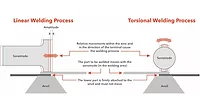
The cold welding process uses a magnetic field to rapidly collapse one component onto another forming a metallurgical bond. The welding cycle is extremely short—typically less than 1 second. The technology is well-suited for joining dissimilar metals and cylindrical components, such as air conditioning tubing and tubular space frames.
Numerous Benefits
Magnetic pulse welding offers numerous benefits to assemblers, such as no heat input, fast cycle , ability to join dissimilar materials, and base metal strength in most materials. The weld produced is a true solid-state bond. Magnetic pulse welding is a good alternative to brazing because it offers greater repeatability.
"The process is fast, clean, very energy efficient and creates no heat affected zone to change the physical properties of either part," claims Michael Plum, chairman and CEO of Magneform Corp. (San Diego). "Additionally, it creates a solid-state weld between either similar or dissimilar metals. Unlike some types of welding, no filler is needed."
Looking for quick answers on assembly and manufacturing topics? Try Ask ASM, our new smart AI search tool. Ask ASM
Plum says magnetic pulse welding is being used for more and more high volume applications. For example, the technology appeals to auto part manufacturers because of its ability to join dissimilar materials, such as aluminum to steel, within very short cycle.
A typical magnetic pulse welding system includes a power supply, which contains a bank of capacitors, a high-speed switching system and a coil. The parts to be joined are inserted into the coil, the capacitor bank is charged and the high-speed switch is activated. As current is applied to the coil, a magnetic field is created, and the outer component is collapsed over the inner component.
How It Works
The magnetic pulse welding process works by dumping stored energy from a capacitor bank into a coil designed to transform the electrical energy into magnetic energy due to the rapid change in current in a short period of time. This creates a magnetic field that creates eddy currents in the part. The higher the conductivity of the material, the more efficient the system.
The eddy currents oppose the magnetic field in the coil and a repulsive force is created. "This drives the materials together at an extremely high rate of speed and creates an ‘explosive or impact’ type of weld," says Dave Workman, an applications engineer at the Edison Welding Institute (EWI, Columbus, OH). "If the part is not a closed section, then the eddy currents cannot circulate and create the opposing magnetic field.
"The coil must withstand the force or impulse used to drive the materials together so the coil and tooling design is critical," adds Workman. "Everything must be electrically isolated. The fields generated by the conductors and coil can interact with adjacent tooling. Work is underway to create a coil for doing this on flat sheets, but the challenge is significant."
When an aluminum tube is subjected to the magnetic field, it collapses inward with sufficient force to weld itself onto a stationary component, such as a steel or aluminum end fitting. The process produces a solid-state weld that requires no heat. The machine tooling controls the component orientation.
Bonding occurs at a significantly lower temperature than with traditional welding. The process also works from the inside out, with the coil in the inner tube and the magnetic field forcing the inner tube into the outer tube to create a weld.
The process behind magnetic pulse welding is similar to what happens if you try to hold two permanent magnets together. "When like poles are pushed together they repel each other," explains Plum. "That is the same basic principal of pulsed magnetic welding.
"Typically, the parts to be welded are oriented coaxially with the outer piece being a good electrical conductor," adds Plum. "Both parts are placed into a coil. An electrical current is discharged into the coil creating two magnetic fields, one in the coil; a current induced in the outer conductor to be welded creates a second field."
According to Plum, the stronger of the two magnetic fields created by the coil expands, cannot penetrate the second field, and therefore creates a pressure that puts the part into motion. That’s the same phenomenon as occurs when holding two permanent magnets together, except the strength of the magnetic field is much greater. The outer workpiece is accelerated at a speed greater than 300 meters per second.
"It is very much like a bat hitting a baseball," explains Plum. "The bat is the larger field and the ball is the workpiece. The bat hits the ball and sends it flying. When the workpiece hits the inner piece at sufficient speed and all other conditions are right, a solid-state weld is created. All of the work takes place in microseconds."
Assembly Applications
Pulsed magnetic welding has traditionally been used to seal metal canisters and nuclear fuel pins. However, it is on the verge of becoming a high-volume production process. Typically, any round part such as a tube-to-tube joint, a tube-to-end joint or a wire crimp joint would be an ideal candidate for magnetic pulse welding.
Workman claims that magnetic pulse welding is ideal for electrical, automotive and aerospace applications. "The special interest is the ability to join materials that are metallurgically incompatible or sensitive to heat input, as this welding process does not create a fusion zone," he points out.
Material conductivity, ductility and strength are important criteria. According to Workman, magnetic pulse welding works best for conductive alloys such as copper and aluminum. "I have not seen it used for welding plastic to plastic, but steel to plastic mechanical joints are possible," he says.
Magnetic pulse welding can join most metals that explosive bonding can, provided the sections can be accelerated. It is identical to explosive bonding in the formation of the bond. But, instead of chemical explosive energy, it uses magnetic fields to drive the materials together.
Workman claims that weld with magnetic pulse technology are shorter by several orders of magnitude. "Weld are a single pulse of energy ranging from 10 to 50 microseconds roughly with a voltage in the thousands of volts range and currents between 30 kiloamperes to more than 850 kiloamperes."
"A great deal of experimentation has been and is being done using pulsed magnetics to weld aluminum parts to steel, aluminum to aluminum, copper to steel, and stainless steel to stainless steel," says Plum.
"Projected uses include torque tubes of various kinds with aluminum tubes welded to steel yokes, space frame sections, sealing of pressure vessels and various aerospace components," notes Plum. "However, I am not aware of any high production facility that has actually installed pulsed magnetic welding equipment and is using it in serial production."
Potential automotive applications for magnetic pulse welding include air conditioning tubing, fuel lines, tubular space frames, struts, shocks, fuel filters, tubular seat components, driveshafts and electrical connections.
Dana Corp. (Toledo, OH) has been experimenting with magnetic pulse welding for several years. It uses the technology to join ferrous and nonferrous materials that produce lighter, more efficient driveshafts.
"Our magnetic pulse welding process allows us to join steel and aluminum components to create a wide variety of innovative driveshaft designs," says Jim Duggan, chief engineer of advanced design for Dana’s Spicer Driveshaft Group. "The result is a connection that outperforms conventional MIG welding and other metallurgical attachment processes."
Magnetic pulse welding may also be ideal for joining the dissimilar materials used in aerospace applications, such as nickel to titanium. Aerospace manufacturers traditionally use brazing or gas tungsten arc welding (GTAW) to produce tubular components, such as fuel lines.
Compared with GTAW, magnetic pulse welding could reduce the cost of inspection and rework for tubular components. Some of those components are subjected to dye penetrant inspection while others undergo X-ray inspection. According to EWI, it is not uncommon to experience up to 30 percent rework for those components that are inspected by dye penetrant and 60 to 70 percent rework for those that are inspected by X-ray.
Other potential advantages of using magnetic pulse welding over GTAW for aerospace applications include the ability to eliminate the chemical-cleaning step prior to welding. The technology also has fewer process variables and can be easily automated.
Joint Design
Magnetic pulse welding requires a lap joint configuration. Lap joints are required since the outer member must impact the inner to create the weld.
Magneform’s Plum says the part being accelerated also must be a good electrical conductor. The higher the conductivity, the easier it is to move. Materials that have an electrical resistivity of 15 micro-ohm centimeters or less lend themselves to direct welding. That includes aluminum, copper, low carbon steels and most precious metals.
"To weld materials with a high electrical resistivity, a ‘driver’ of a more conductive material must be placed outside of and in intimate contact with the outer part," says Plum. "For example, an aluminum ring over a stainless steel tube. Only the outer part must be highly conductive."
With magnetic pulse welding, all work takes place in microseconds. Therefore, time is not an issue, except for loading and unloading. "Electrically, shape doesn’t matter as long as the part is a good conductor and has a path for a current to flow," explains Plum. "There are geometric considerations that make some shapes very difficult, such as a rectangle. The sides are much easier to move than the corners."
Development is underway to refine the magnetic pulse welding process to allow for the joining of noncylindrical components. And nonclosed coils are being developed to allow the coil to be opened to increase part accessibility.
"Theoretically, there are no size limitations," says Plum. "Welding requiring a large amount of energy will require a large machine. Cost is somewhat linear with stored energy. The smallest fuel rods are less than 0.25-inch in diameter. Typical parts under development range up to 10 inches in diameter."
"We have welded parts in excess of 3-inch diameter and as small as 0.15-inch in diameter," adds EWI’s Workman. "If it is too small, then the magnetic field may interact with itself. If it is too large, then the machine may become expensive. Economics play an important role here."
Disadvantages
Although there are many advantages to magnetic pulse welding, there are some potential drawbacks to the technology. For instance, while speed is an advantage to assemblers, it can also be a limitation. The process is so fast that it does not lend itself to deep drawing of material since the material does not have time to stretch.
"The outer member to be welded must be accelerated at a speed greater than 300 meters per second," says Plum. "When a body moving that fast meets another, it will try to displace it. This is what causes the weld. The movable body meets an immovable body.
"The drawback is that the interior part must have sufficient structural strength to withstand the impact," adds Plum. "Therefore, it is not possible to pulse magnetic weld a thin-walled tube on another thin-walled tube unless there is a mandrel backing up the inner part."
Pulsed magnetic welding machines can be cycled every several seconds. "The minimum is six," notes Plum. "Typically, loading and unloading presents the major time constraint."
Coaxial positioning of the parts to be welded is also critical, as is the angle of impact. "Typically, a coil of a given diameter can be used for many diameter parts," says Plum. "Field shapers, or flux concentrators, that couple the workpiece to the coil electrically are part specific."
According to Workman, magnetic pulse welding is more expensive initially than other types of welding technologies. "But, once up and running, it has a much lower cost than most other processes," he points out.
"Capital cost will vary greatly depending upon the amount of stored energy required," adds Plum. He says small machines begin around $100,000.
Another disadvantage of pulsed magnetic welding is that materials being joined need to be conductive. Only material with low electrical resistivity can be easily used, such as aluminum, copper and low carbon steel.
Looking for a reprint of this article?
From high-res PDFs to custom plaques, order your copy today!