Last month, Congress opened hearings into the fungal meningitis outbreak that has killed 32 people so far and sickened 438 others. Food and Drug Administration officials believe the outbreak is linked to tainted steroids produced at a Massachusetts compounding pharmacy.
In October, FDA investigators who toured the facility found a foreign, “greenish-black” material in some vials of the steroid suspected as the cause of the illnesses, federal health officials said. The contaminated product was one of a host of potential violations discovered during the inspection. At an affiliate of the pharmacy, inspectors found bugs, a flying bird and other unsterile conditions.
If any good can be said to have come from the tragedy, it’s that the outbreak has re-emphasized the need to maintain sterile conditions in pharmaceutical and medical device manufacturing facilities. Assembly equipment for clean rooms should be selected carefully. In some cases, equipment can be used in clean rooms with little or no modifications. In others, it requires special materials and adaptations.
Two robotics suppliers have recently introduced compact, six-axis robots designed for use in aseptic environments.
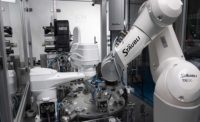
The C3-V six-axis robot from EPSON Robots resists vaporized hydrogen peroxide (VHP) gas, an aggressive chemical used in aseptic manufacturing environments.
“C3-V robots are used in barrier isolator systems for aseptic manufacturing processes predominantly in medical device, pharmaceutical and life sciences industries, where a variety of transportation tasks are followed by aggressive VHP cleaning and sterilization,” says Michael Ferrara, director of EPSON Robots. “Many of the processes currently [performed] in isolator systems are entirely manual, requiring the use of glove ports where human operators risk repetitive motion injuries and exposure to harmful toxic drugs...during processes such as syringe-filling operations. C3-V robots...allow many of these processes to become fully automated.”
The slim body and compact wrist of the robot enable it to be installed in sealed environments, such as inside an isolator. IP67-grade water- and dust-proofing allow the robot to be cleaned and sterilized with aggressive chemical solutions or high-temperature VHP and steam. Because it withstands sterilization, the robot can be used as a handling device for presenting fixtures and components for cleaning to VHP misting areas from many angles. This ensures there are no neglected areas during sterilization.
The robot is available with either EPSON’s True PC-Based RC620+ controller or its Micro PowerDrive RC180 controller. Both offer options such as vision guidance, .Net support, Profibus, DeviceNet and EtherNet/IP.
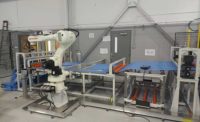
DENSO Robotics has introduced a Class 1 clean room version of its VS-Series six-axis articulated robot, adding to its previously released Class 100 version. The robot can perform a standard pick-and-place move in 0.33 to 0.37 second with a repeatability from ±0.02 to ±0.03 millimeter. Models are available with a maximum reach of 500 to 900 millimeters and payload capacities from 4 to 7 kilograms.
This compact robot has a slim arm to facilitate integration and a new optional bottom-side cable connection that saves valuable floor space. The robot can be mounted on the floor, ceiling or wall without any special hardware.
A new internal wiring option allows connection of Gigabit Ethernet devices and servo grippers directly to the robot flange. This prevents cables from becoming tangled or interfering with peripheral equipment. ANSI and CE safety compliance allows the robot to be deployed anywhere in the world.
For more information on DENSO robots, call 310-952-7955 or visit http://densorobotics.com/products-vs-6axis-new.php.
For more information on EPSON robots, call 562-290-5910 or visit www.epsonrobots.com.
Clean Room Robots Assemble Medical Devices

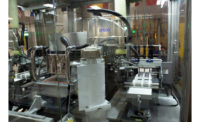
These compact, six-axis robots are designed for use in aseptic environments. Photos courtesy EPSON Robots and DENSO Robotics.

These compact, six-axis robots are designed for use in aseptic environments. Photos courtesy EPSON Robots and DENSO Robotics.