
Sponsored Content
How One Pump Manufacturer Saved $1 Million by Replacing a Hydraulic Press with a Promess EMAP
Why Servo Presses Outperform Hydraulic Presses in Real-World Manufacturing
It’s a common assumption in manufacturing: hydraulic presses cost less than servo presses. And while the up-front price of a hydraulic press is usually lower, many manufacturers are discovering the hidden truth, hydraulic systems often cost far more in scrap, rework, downtime, and warranty claims over time.
 One major pump manufacturer learned this lesson the hard way. Their hydraulic press was unknowingly causing premature pump failures, shrinking product lifespan by 95% and resulting in a staggering 10–20% return rate. What seemed like the "cheaper" choice was quietly draining profitability.
The Challenge: Uncontrolled Force = Hidden Product Failures
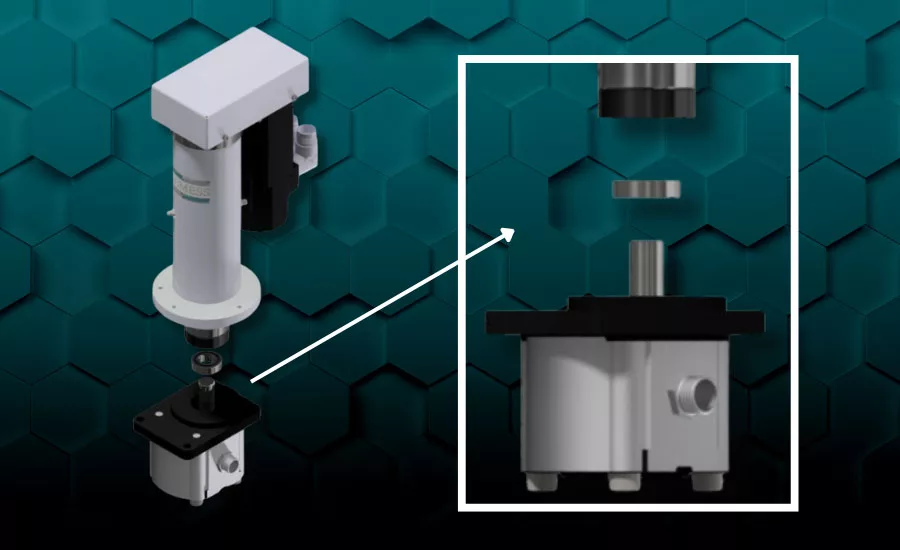
The manufacturer used a hydraulic press to insert bearings into pump housings. As with most hydraulic systems, the press went to full pressure every cycle, regardless of part variation. That meant some bearings were being over-pressed, damaging them in a way that wasn't detectable during internal testing.
The consequences were significant:
- Excessive force caused internal component damage
- Pumps passed inspection but failed prematurely in the field
- Warranty costs skyrocketed
- No force monitoring meant no way to identify out-of-spec assemblies
They needed a solution that could adapt to part-to-part variation while providing full process control and traceability.
The Solution: Intelligent Force Control with the Promess EMAP
Promess introduced a 20kN Electro-Mechanical Assembly Press (EMAP) paired with a Promess motion controller. This integrated solution is built to deliver precision, repeatability, and real-time feedback.
How the EMAP Solved the Problem
1. Adaptive Force Control
Instead of slamming to full pressure every cycle, the EMAP:
- Began pressing to a defined point
- Switched to a relative force mode, applying only the exact force needed
- Prevented over-pressing and eliminated hidden component damage
Each bearing was pressed to the proper seating force.
2. Complete Process Monitoring
Every cycle generated a force vs. distance curve, capturing real-time performance data. This allowed engineers to:
- Verify every press cycle
- Detect anomalies
- Compare results against tolerance bands
- Improve overall process control
3. Full Traceability
The system stored process signatures and cycle details such as:
- Date and time
- Pressed part serial number
- Force/distance curves
- Pass/fail results
This meant every pump had a complete historical record, which is a requirement for many quality-driven industries.
The Results: Zero Failures and $1,000,000 Saved in One Year
Once the EMAP was implemented, the pump failure problem disappeared entirely. With controlled force and complete process visibility, the manufacturer eliminated field failures caused by the assembly operation.
The results were remarkable:
✔ 100% Elimination of Press-Related Failures
No more over-pressing, no more hidden defects.
✔ $1,000,000 Saved in Warranty Costs—In the First Year Alone
The ROI on the EMAP was immediate and undeniable.
✔ Increased Product Lifespan & Reliability
Pumps performed exactly as engineered, with no early-life breakdowns.
✔ Long-Term Cost Savings
Reduced scrap, fewer returns, less downtime, and dramatically higher quality.
Why Servo Presses Are Worth the Investment
This case makes one thing clear: hydraulic presses often cost far more in the long run. Servo presses like the Promess EMAP deliver:
- Precise force control
- Repeatable accuracy
- Lower energy consumption
- Data-driven quality assurance
- Traceability for every part
When product quality and reliability matter—and when warranty claims can reach millions—servo technology isn’t a luxury. It’s the smarter, more cost-effective choice.
Looking for a reprint of this article?
From high-res PDFs to custom plaques, order your copy today!


