
Sponsored Content
Combining Linear and Rotational Precision in One System
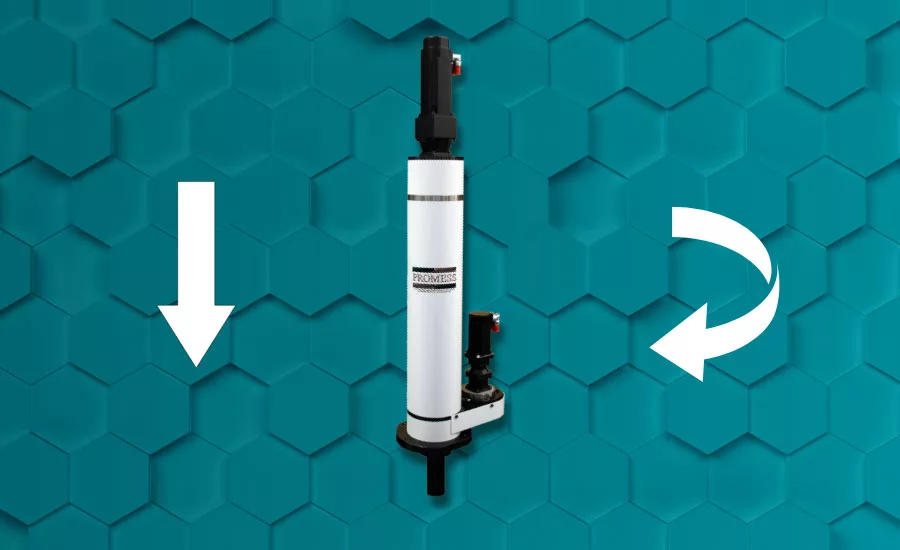
As precision assembly continues to evolve, manufacturers are being challenged to combine multiple motion requirements within a single, tightly controlled process. Many assemblies now rely on both linear and rotational movement, which traditionally requires complex, multi‑component systems with custom controls and mechanical integration. These setups add cost, increase engineering time, and introduce additional points of failure.
 The Promess REMAP (Rotational Electric Modular Actuator Package) offers a modern alternative by providing fully programmable, independent control of both linear and rotational motion in one complete unit. For manufacturers focused on accuracy, repeatability, and simplified machine design, REMAP represents a significant advancement in the evolution of precision assembly and test systems.
Unlike traditional dual‑motion systems that rely on multiple actuators, drives, and external control schemes, the REMAP is delivered as a compact, ready‑to‑run package. This reduces integration time and eliminates the need for complex mechanical coordination between independent systems. Whether added to a new automated cell or retrofitted into an existing station, the REMAP’s flexible footprint makes it easy to adapt to a wide range of applications.
At the heart of REMAP’s capability are its integrated force and torque sensors, which provide real‑time feedback throughout both linear and rotational motion. This allows manufacturers to monitor and control critical process variables with a high degree of accuracy. The system can be programmed to control to force, torque, position, angle, or a combination of inputs, offering exceptional flexibility for complex assemblies.
One of the REMAP’s most powerful capabilities is the ability to clone an assembly process across multiple production lines or locations. Once a process is developed and optimized, its parameters can be duplicated precisely across any REMAP‑equipped workstation. This ensures consistency in production quality, reduces variation, and simplifies scalability for manufacturers managing multiple programs.
The REMAP also supports stringent quality requirements by generating a fault condition whenever an assembly falls outside its programmed parameters. This helps ensure that questionable or nonconforming components never move forward in production, eliminating downstream issues and improving first‑pass yield. This approach aligns closely with modern no‑fault‑forward manufacturing strategies, where every part must be verified before advancing to the next stage.
Beyond performance, the REMAP is designed for practical integration. Its compact size allows for installation in tight workcells, and its self‑contained configuration reduces engineering complexity. Because both linear and rotational functions are built into a single system, manufacturers gain streamlined wiring, reduced hardware, and easier long‑term maintenance.
In an industry where assembly processes are becoming more intricate and precision requirements continue to tighten, the Promess REMAP provides a unified solution that brings accuracy, repeatability, and control under one platform. For companies looking to modernize their precision assembly and test systems, REMAP offers a straightforward path to improved performance and consistent, scalable production.
Looking for a reprint of this article?
From high-res PDFs to custom plaques, order your copy today!


