
Sponsored Content
Precision Universal Joint Assembly Using Dual Electro-Mechanical Assembly Presses
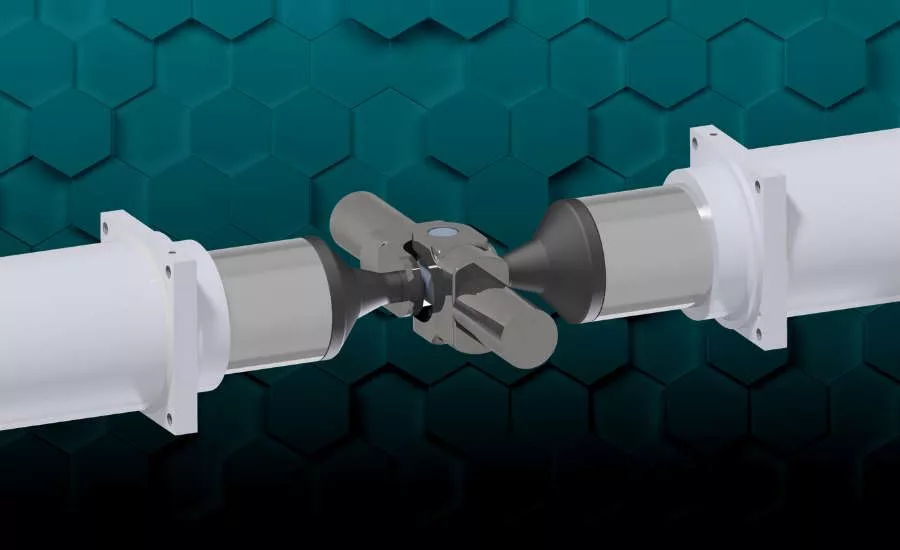
In automotive manufacturing, precision and repeatability are essential to producing reliable drivetrain components. Universal joints play a critical role in transmitting torque from the driveshaft to the differential while accommodating changes in angle during vehicle operation. Because these joints operate under constant load and motion, even minor assembly inaccuracies can lead to vibration, premature wear, or failure. One of the most difficult challenges in universal joint assembly is maintaining precise alignment of the floating spider while bearing cups are inserted and staked.
 During assembly, the spider is free to shift as force is applied, making it difficult to keep perfectly centered. Any movement during bearing cup installation can result in misalignment, uneven load distribution, and reduced joint life. Traditional single‑press assembly methods often struggle to control this movement, especially during staking operations where force imbalance can easily push the spider out of position. To address this issue, a manufacturer adopted an advanced assembly strategy using dual Electro‑Mechanical Assembly Presses from Promess.
The solution centered on redesigning the bearing cup insertion and staking process to apply force evenly and simultaneously from both sides of the universal joint. Two Promess Electro‑Mechanical Assembly Presses were configured to operate in a synchronized manner, allowing bearing cups to be pressed into place at the same time. By applying equal and opposing forces, the system prevented the floating spider from shifting during insertion and ensured that it remained precisely centered throughout the process.
To further enhance accuracy, the assembly system incorporated external feedback sensors that continuously monitored the spider’s position. These sensors provided real‑time data to verify centering and allowed the presses to maintain alignment control as force was applied. Both EMAPs operated at the same speed and delivered uniform force, creating a fully coordinated pressing and staking sequence. This level of synchronization ensured that when staking occurred, the spider was already locked into its correct position within the joint.
The results of implementing dual electro‑mechanical assembly presses were substantial. Precise spider alignment was maintained consistently, eliminating a common source of assembly variation and reducing defect rates. The combination of synchronized motion control and real‑time feedback delivered highly repeatable results, improving overall universal joint quality and reliability. With fewer alignment issues, the manufacturer experienced reduced rework, less scrap, and improved throughput.
Beyond quality improvements, the streamlined dual‑press approach increased production efficiency. By eliminating manual adjustments and minimizing variability, the assembly process became faster and more predictable. Accurate centering also translated into improved universal joint performance in the field, contributing to longer service life and greater vehicle reliability.
The use of dual Promess Electro‑Mechanical Assembly Presses represents a significant advancement in precision universal joint assembly. By ensuring the floating spider remains perfectly centered during bearing cup insertion and staking, manufacturers can achieve higher quality, improved durability, and greater production consistency. For automotive manufacturers facing similar alignment challenges, advanced EMAP solutions provide a proven path to improving both product performance and manufacturing efficiency.
Looking for a reprint of this article?
From high-res PDFs to custom plaques, order your copy today!


