Assembly Magazine logo
search
Ask ASSEMBLY AI
cart
facebook twitter linkedin youtube
  • Sign In
  • Create Account
  • Sign Out
  • My Account
Assembly Magazine logo
  • TRENDS
    • Ask ASSEMBLY AI
    • Trends
    • News
    • New Products
  • INDUSTRIES
    • Aerospace
    • Appliance
    • DFMA Assembly
    • Medical Devices
    • Green Manufacturing
    • Lean Manufacturing
    • Machinery Assembly
    • Electronics Assembly
    • Automotive
  • TECHNOLOGIES
    • Adhesives & Dispensing
    • Assembly Presses
    • Automated Assembly Systems
    • Manufacturing Management
    • Manufacturing Software
    • Motion Control
    • Screwdriving & Riveting
    • Robotics
    • Test & Inspection
    • Plastics & Metal Welding
    • Wire Processing
    • Workstations
  • AUTONOMOUS & ELECTRIC MOBILITY
    • AEM Magazine Archives
    • Autonomy
    • Electrification
    • Mobility Services
    • Assembly & Testing
    • AV/EM News
  • MEDIA
    • Ask ASSEMBLY AI
    • Podcasts
    • Assembly News Now
    • Assembly TV
    • Webinars
    • eBooks
  • EVENTS
    • Calendar
    • The ASSEMBLY Show
  • MORE
    • Exclusives >
      • Plant of the Year
      • Capital Spending
    • Buyers Guide >
      • Supplier Insights
    • Classifieds
    • Featured Products
    • Newsletters
    • Store
    • White Papers
    • Columns
    • Sponsor Insights
  • INFOCENTER
    • Assembly & Test Solutions
  • EMAGAZINE
    • eMagazine
    • Archive Issues
    • Advertise
    • Contact Us
    • Sign Up
Automotive AssemblyAutomated Assembly Systems

Ford and Toyota Celebrate Historic Milestones

Ford Motor Co. and Toyota Motor Corp., the two companies that pioneered mass production and lean manufacturing, are each celebrating important milestones this year.
By Austin Weber
March 1, 2013

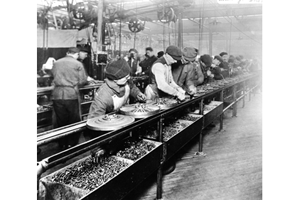
Ford Motor Co. and Toyota Motor Corp., the two companies that pioneered mass production and lean manufacturing, are each celebrating important milestonesFirst moving assembly line this year. Ford is marking the 150th anniversary of the birth of Henry Ford and the 100th anniversary of the assembly line. Meanwhile, Toyota is celebrating its 75th anniversary and the 100th anniversary of the birth of Eiji Toyoda, the former president and chairman of the automaker who spearheaded its global expansion efforts in the 1970s and 1980s.

In their early days, both Ford and Toyota used innovation to achieve production breakthroughs that quickly propelled them to success—the moving assembly line and just-in-time manufacturing.

Henry Ford was born on July 30, 1863, on a farm in Dearborn, MI. As most people know, Ford’s big contribution was the moving assembly line (contrary to popular belief, he did not invent it—Ford merely assembled a team of engineers who collaborated on the project).

The first moving assembly line for a large-scale manufacturing application began to operate on April 1, 1913, at Ford’s Highland Park, MI, plant, which was producing the Model T. The manually operated assembly line was used to produce flywheel magnetos (a key component of the Model T’s electrical system).

A group of 29 operators pushed flywheels down a waist-high table constructed out of metal pipe frame and angle iron. As each flywheel was pushed from right to left, the assemblers attached and tightened various components. They reached into bins positioned underneath the line and grabbed V-shaped magnets, screws, nuts, washers, bolts and other parts. Fasteners were tightened with power-driven socket wrenches.

The new assembly process dramatically increased productivity. For instance, production time per flywheel was reduced from 20 minutes to 13 minutes. Soon after the manual line proved to be successful, Ford engineers developed a motorized version to increase throughput rates. Within a year, 14 assemblers were producing a flywheel every 5 minutes.

Four months later, Ford engineers created a crude assembly line in which a chassis was pulled 250 feet by rope and a hand-cranked windlass. Over the next four months, they experimented with the line and made numerous changes in speed, workstation positions and the number of assemblers. On Jan. 14, 1914, the assembly line became power-driven when Sorensen added an “endless chain” powered by a motor.

I have written several articles about this historical event in the past (see “The Man Behind the Moving Assembly Line” and “The Model T Turns 100”). And, we will be publishing a new article on the origins of Ford’s assembly line in the October issue of ASSEMBLY.

The innovation that transformed Toyota was just-in-time production—one of the core elements of the Toyota Production System. Kiichiro Toyoda, the founder of Toyota Motor Corp., proposed the concept when production of the Model AA sedan ramped up at the company’s first assembly plant in Koromo, Japan (today’s Toyota City) in 1938.

“I believe that the most important thing is to ensure that there is neither shortage nor excess,” said Toyoda, who had experimented with Ford’s concept of using chain-driven conveyors a decade earlier while serving as chief engineer and managing director of the Toyoda Automatic Loom Works. “That is, to ensure that there is no excess labor and time for the designated production. There is no waste and there is no excess. It means not having to wait for parts to be circulated around. It is important that each part be ready just in time. This is the first principle of increasing efficiency.”

“What Kiichiro had in mind was to produce the needed quantity of the required parts each day,” recalled Eiji Toyoda (Kiichiro’s cousin) in 1988. “To make this a reality, every single step of the operation, like it or not, had to be converted over to his flow production system. Kiichiro referred to this as the just-in-time concept. By this he meant ‘just make what is needed in time, but don't make too much.’”

However, the just-in-time concept was not fully realized at Toyota until 1954, when the supermarket supply method—the idea of having subsequent processes take what they need from the earlier processes—was developed. The kanban system was created as a tool for carrying this out. After a decade of development in other Toyota plants, company-wide adoption of the kanban system occurred in 1963.

Which innovation has had a bigger impact on the auto industry—the moving assembly line or just-in-time production?

Looking for quick answers on assembly and manufacturing topics? Try Ask ASM, our new smart AI search tool. Ask ASM →

KEYWORDS: conveyors Ford Motor Co. manufacturing history Toyota Motor Co.

Share This Story

Austinweber headshot
Austin has been senior editor for ASSEMBLY Magazine since September 1999. He has more than 21 years of b-to-b publishing experience and has written about a wide variety of manufacturing and engineering topics. Austin is a graduate of the University of Michigan.

Blog Topics

Austin Weber

Assembly Automation

Ergo Corner

Hoffmann on Testing

Jim Camillo

Jim Smith

John Sprovieri

Recent Comments

Helpful for Trainees

Cable Assembly Manufacturers

Huawei for manufacturing?

should have a scanner and then 3D print the repair

IPC-A-610 and IPC-j-std-001

Manage My Account
  • eMagazine Subscription
  • Assembly Newsletters
  • Online Registration
  • Subscription Customer Service
  • Manage My Preferences

More Videos

Sponsored Content

Sponsored Content is a special paid section where industry companies provide high quality, objective, non-commercial content around topics of interest to the ASSEMBLY audience. All Sponsored Content is supplied by the advertising company and any opinions expressed in this article are those of the author and not necessarily reflect the views of ASSEMBLY or its parent company, BNP Media. Interested in participating in our Sponsored Content section? Contact your local rep!

close
  • ultrasonic welding
    Sponsored bySonobond Ultrasonics

    Engineering Efficiency in High-Performance Assembly: How Ultrasonic Welding Enhances Throughput, Reliability and Quality

  • UV curing system
    Sponsored byDymax

    Why UV Intensity Alone Doesn’t Define Curing Performance

  • wooden pallets
    Sponsored byLEAN Manufacturing Products

    Eliminating Waste on the Shop Floor: Applying Lean Principles to Improve Manufacturing Efficiency

Popular Stories

ASSEMBLY News Now, episode-30: Volvo Redesigns EV Manufacturing

Volvo Redesigns EV Manufacturing

Boeing CEO Kelly Ortberg announces 1 billion investment

Boeing Plans $1 Billion Wichita Investment, Workforce Training Center

automated consumer goods assembly system

Best Practices for Cycle Time Optimization

Watch the latest episode of ANN now!

Events

July 24, 2025

From Shop Floor to CFO: How Manufacturers Are Closing the Loop Between Operations and Finance

On Demand Learn how manufacturers are bridging the gap between the shop floor and ERP systems to gain real-time visibility, streamline operations, and kick-start digital transformation—without waiting years.

Sponsored by:

PicoStratusGreen
July 30, 2025

Buffer Analysis and Design Fundamentals for Manufacturing Excellence

On Demand In this presentation, Dr. Herman Tang shares practical insights from his industry experience and research on buffer management in manufacturing operations.

View All Submit An Event

Poll

Difficult Assembly Processes

Which assembly process gives you the most difficulty?
View Results Poll Archive

Products

Manufacturing Cost Policy Deployment (MCPD) Profitability Scenarios: Systematic and Systemic Improvement of Manufacturing Costs

Manufacturing Cost Policy Deployment (MCPD) Profitability Scenarios: Systematic and Systemic Improvement of Manufacturing Costs

See More Products
Register for webinar - Modernizing Automotive Assembly: Why Upgrading Legacy MES is a Business Imperative
×

Never miss the latest news and trends driving the manufacturing industry

Stay in the know on the latest assembly trends.

JOIN TODAY!
  • RESOURCES
    • Advertise
    • Contact Us
    • Directories
    • Manufacturing Division
    • Store
    • Want More?
  • SIGN UP TODAY
    • Create Account
    • eMagazine
    • Newsletters
    • Customer Service
    • Manage Preferences
  • SERVICES
    • Marketing Services
    • Reprints
    • Market Research
    • List Rental
    • Survey/Respondent Access
  • STAY CONNECTED
    • LinkedIn
    • Facebook
    • Instagram
    • YouTube
    • X (Twitter)
  • PRIVACY
    • PRIVACY POLICY
    • TERMS & CONDITIONS
    • DO NOT SELL MY PERSONAL INFORMATION
    • PRIVACY REQUEST
    • ACCESSIBILITY

Copyright ©2026. All Rights Reserved BNP Media, Inc. and BNP Media II, LLC.

Design, CMS, Hosting & Web Development :: ePublishing