
Founded in 1960, Sonobond Ultrasonics is a pioneering leader in ultrasonic bonding and welding technology. The company manufactures ultrasonic assembly equipment used by companies across a broad range of industries.


Engineering Efficiency in High-Performance Assembly: How Ultrasonic Welding Enhances Throughput, Reliability and Quality
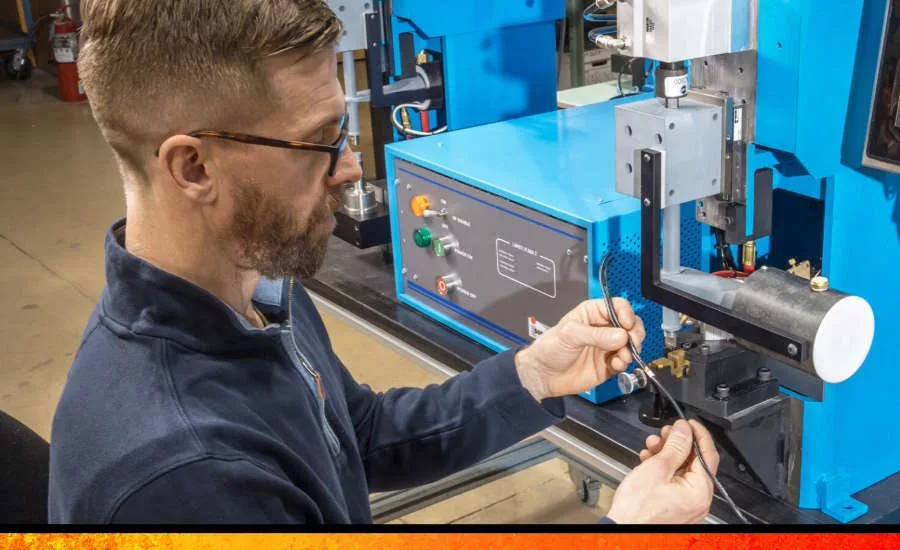
Manufacturers across the automotive, aerospace, medical device, appliance, and electronics sectors face a common challenge: increasing production throughput while maintaining strict quality requirements. As product designs and assemblies become more complex —especially in wire processing and electrical interconnects—traditional joining methods can introduce variability, inefficiencies and long-term reliability risks.
Ultrasonic metal welding offers a proven, production-ready solution to these challenges. By delivering precise, repeatable, solid-state bonds, it enables manufacturers to improve cycle times, reduce defects, and maintain consistent performance across high-volume assembly environments.
Understanding Ultrasonic Welding
Ultrasonic welding is a solid-state joining process that uses high-frequency mechanical vibrations under pressure to bond metals at the molecular level. Unlike thermal processes, it does not melt the material, preserving the base metal’s properties, which means that there is:
- No heat-affected zone (HAZ): conductivity and strength are maintained
- No filler materials: variability from solder or adhesives is eliminated
- No mechanical deformation: more durable than crimp-only connections
Ultrasonic welding produces clean, metallurgical bonds ideal for high-reliability applications and has distinct advantages over thermal processes. Soldering processes can degrade or lose conductivity. Crimping processes can loosen under vibration or thermal cycling. Resistance welding processes can distort.
Driving Throughput in High-Volume Production
Faster Cycle Times
Ultrasonic welds are typically completed in seconds, eliminating heat-up time, cooling cycles and secondary handling steps. Because the process does not rely on bulk heat transfer or extended cooling periods, cycle times are significantly shorter than those associated with conventional joining techniques. For wire harness manufacturing and electrical assemblies, this translates directly into higher units per hour, more consistent connections and reduced bottlenecks in assembly lines.
Reduced Downtime and Easier Tool Changes
Manufacturing efficiency is also improved through reduced downtime associated with setup and changeovers. Ultrasonic welding systems are designed to allow fast tooling changes with minimal recalibration. Because the weld process parameters are tightly controlled and repeatable, operators spend less time adjusting equipment and more time producing finished assemblies.
Seamless Integration with Automation
Ultrasonic welding systems are well suited for automated manufacturing such as robotic cells, inline automation and custom assembly equipment because they produce precise and repeatable results. Microprocessor-controlled ultrasonic welders store predetermined weld parameters and apply them consistently during operation, reducing the likelihood of operator error.
Ensuring Quality in Critical Electrical and Mechanical Connections
Consistent, High-Integrity Welds
Ultrasonic welding produces strong, reliable welds that maintain excellent mechanical integrity and electrical performance. Because these systems produce solid-state welds through mechanical vibration and pressure rather than melting, the joint forms from metal-to-metal contact. This is especially valuable in This is especially valuable in wire-to-wire splices, wire-to-terminal connections and busbar and battery tab assemblies.
Minimal Thermal Impact
Because the process is solid-state, heat is localized and controlled, and no bulk material heating occurs. Benefits include:
- No insulation damage in wire processing
- No distortion of precision components
- Preservation of metallurgical properties
These benefits are critical for applications including medical devices and other sensitive materials, aerospace components with tight tolerances, electronics and joining thin foils and delicate structures.
Reduced Rework and Defects
Reliable first-pass welds lead to higher yield rates, fewer rejected assemblies and less rework and scrap. For assemblers, this means fewer rejects, less rework and improved overall product quality, resulting in fewer disruptions to production.
Supporting Lean Manufacturing and Cost Efficiencies
Elimination of Consumables
Ultrasonic welding process removes the need for adhesives, fluxes, solder or other joining materials to form a bond. This absence of extra materials reduces material costs and simplifies supply chain management.
Lower Energy Consumption
Because energy is applied directly at the joint, not across the entire part, overall energy use is comparatively low, lowering operating costs.
Improved Labor Efficiency
With fast cycles and minimal manual intervention, operators can manage higher output, fewer process steps are required and labor cost per unit decreases.
Safer and More Sustainable Production
Ultrasonic welding aligns with modern manufacturing goals by eliminating fumes and emissions from thermal processes, reducing chemical waste (no flux or adhesives), and supporting cleaner production environments. This is particularly important for regulated industries such as medical and aerospace, and facilities focused on ESG and sustainability goals.
Applications Across Key Manufacturing Sectors
Wire Harness Manufacturing
In wire harness assembly, ultrasonic welding enables high-speed splicing of stranded wires, reliable terminal connections and consistent conductivity across production.
Battery Assembly
Ultrasonic metal welding is ideal for joining foil, tabs and terminal connections in lithium-ion and other rechargeable battery types. Dual-head ultrasonic metal spot welders, for example, can weld multiple layers of thin foils to battery tabs in a single pulse, supporting high electrical performance and structural integrity in energy storage applications.
Automotive, Aerospace and Electronics
Ultrasonic welding supports the production high-volume, high-reliability assemblies that must meet precise quality standards. These include bus bars, sensor connectors, ignition modules and other electromechanical parts.
Conclusion
For manufacturers focused on wire processing and complex assemblies, ultrasonic welding provides clear advantages including:
- Higher throughput
- Improved product reliability
- Lower operating costs
- Greater process consistency
As industries continue to demand lighter, more efficient, and more reliable electrical systems, ultrasonic welding is increasingly becoming a standard for high-performance assembly environments—replacing traditional joining methods that can no longer meet modern production and quality requirements.
Looking for a reprint of this article?
From high-res PDFs to custom plaques, order your copy today!


