Choosing Adhesives for Medical Devices
A major problem in selecting an adhesive for any assembly application is the presence of so many candidates. The number of adhesive varieties can be overwhelming. Adhesives are available with such a broad range of mechanical and handling properties that finding the best one for your application can seem like finding a needle in a haystack.
Adhesives for any application should be chosen carefully, but adhesives for bonding medical devices should be chosen with the utmost care. "Manufacturers of medical devices are more conscientious about using the best material for the job," says Jere Donohue, CEO of Integrated Dispensing Solutions (Woodland Hills, CA). "They are more willing to take the time to look around at adhesives. We do a lot of quotes for people who request samples for various tests.
"It might have to do with what they’re building. If you’re making a telephone and it fails, the worst thing that could happen is that you don’t get to talk to the person that you were talking to. It is kind of different for a lot of medical device applications."
Medical-Grade Adhesives
"With the inroads that have been made with many adhesive types, the range of medical devices that are suitable for adhesive bonding has broadened. Just about any apparatus or diagnostic device may have applications for medical-grade adhesives," says Jim Golebiewski, vice president of marketing and sales for Dymax Corp.’s (Torrington, CT) medical program.Disposable devices, such as syringes, and reusable devices, such as surgical instruments, are most often assembled with medical-grade adhesives. Implantable devices, such as pacemakers, are less likely to use adhesives. According to Christine Salerni, market manager for general industrial OEM at Henkel Loctite Corp. (Rocky Hill, CT), few companies supply adhesives for permanent implantation devices. Stringent requirements must be met before a material can be introduced to the body for an extended period of time.
Light-curing materials are the most commonly used adhesives in the medical industry. These can be acrylics, silicones or cyanoacrylates.
For the light-cure materials to work, the joint must be accessible to light. So light-cure adhesives are generally used on devices made with clear plastics, such as polycarbonate or acrylic. Light-cure adhesives cure in less than 30 seconds, and they adhere well to metals, glass and plastic. These adhesives also perform well with automatic dispensing equipment.
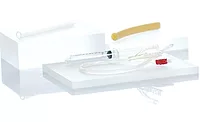
The most common devices assembled with light-cure adhesives are fluid monitoring and collection devices, needle assemblies, anesthesia masks and tube sets.
The second-most popular adhesive for disposable devices is moisture-curing cyanoacrylate. Also known as "CA" or "super glue," cyanoacrylate is a high-performance material. The product provides good bond strength and short cure Arial, without light, at room temperature. It cures by reacting with moisture on the substrates. It works well with automatic dispensers, and it can bond polyolefins and other hard-to-bond substrates. It is a single-component material and ranges in viscosity from a thin fluid to a thick gel.
Looking for quick answers on assembly and manufacturing topics? Try Ask ASM, our new smart AI search tool. Ask ASM
Cyanoacrylates have some limitations. They are brittle by nature, and moisture can cause bond delamination and degradation. Cyanoacrylates can be used to assemble the same types of devices as light-cure adhesives. They are commonly used for catheter assembly.
Some epoxies and polyurethanes are also used to assemble medical devices. Both types are available in one- and two-part formulas.
Many epoxies are used for needle bonding. They are also used for potting applications where a larger volume of material is required. Epoxies offer chemical and thermal stability, adhesion to metals, and unlimited depth of cure.
They have some limitations in terms of dispensing. Many are two-part adhesives, so they require meter-mix systems. They also might need heat to shorten the curing time. Rapid-curing epoxies do exist, but they require more intense heat.
Polyurethanes are tough, flexible and durable at low temperatures. They also have unlimited depth of cure, with excellent adhesion to plastics.
Medical vs. Industrial
Medical-grade adhesives are similar in chemistry to industrial adhesives. However, they differ in a major way. Medical-grade adhesives are solvent-free and nontoxic once they are cured. "In the liquid state, all adhesives are toxic," says Golebiewski.And, unlike industrial adhesives, medical-grade adhesives must be tested for biocompatibility. This testing can differ extensively from supplier to supplier. "It is very important for device manufacturers who are looking for a biocompatible product to ensure that they understand what tests the adhesive supplier has screened its products through," says Salerni.
For biocompatibility testing, most suppliers have moved from the United States Pharmacopoeia (USP) Class VI standard to ISO-10993. The two standards specify slightly different tests and follow different test methods. For example, USP testing requires a physicochemical test not normally included in ISO testing. Moreover, establishing a USP Class VI rating has little bearing on whether the product will win approval from the Food and Drug Administration (FDA). The Class VI rating merely states that the product exhibits a low level of toxicity under the test conditions.
ISO-10993 biocompatibility testing can include:
- Intracutaneous injection tests to evaluate the irritation potential of the material.
- Acute systemic injection tests to evaluate the material for potential toxic effects as a result of single-dose systemic injection.
- Cytotoxicity tests to determine the biological reactivity of monolayer cell cultures to the material.
- Hemocompatibility tests to evaluate the hemolytic potential of the material with rabbit blood. In vitro hemocompatibility tests ensure that the test material extract does not adversely affect the cellular components of blood.
Before placing a product on the market, medical device manufacturers go through an extensive process of evaluating the various materials that will make up the device. This is done to determine if the materials are safe. Afterward, the Food and Drug Administration still has to have its say. After all is said and done, a great amount of time, effort and money will be expended to get the product to market. The last thing that a medical device manufacturer needs is to have its adhesive formulation changed. A dramatic change, such as a new raw material or new process for making it, might mean that the manufacturer has to resubmit the product for approval.
To keep that from happening, adhesive suppliers guarantee that their adhesive formulations will not change without notification, a practice called "lock-down." Like biocompatibility testing, lock-down policies vary from supplier to supplier. If formulations do change, customers should be notified, so that they can take the appropriate action to ensure that the material continues to meet their needs.
Fortunately, most medical-grade adhesives remain the same over the life of the product. New and improved versions might be introduced, but most likely, they will be introduced as new materials with new names.
Adhesives and Sterilization
Another important factor when choosing an adhesive for medical device assembly is its resistance to sterilization. Most disposable and reusable medical devices go through some type of sterilization process prior to use. A unique factor to consider when choosing an adhesive is how well it survives the various sterilization methods.Two of the most common sterilization methods for disposable devices are ethylene oxide and gamma irradiation. Most adhesives do very well following limited exposure to these sterilization processes.
However, new bulk sterilization methods are emerging, such as hydrogen peroxide and electron beam. Adhesive suppliers and the people selecting adhesives need to know how well adhesives will survive these methods.
Autoclaves are even more of a concern. Hospitals and healthcare facilitieswhere reusable devices, such as endoscopes, are usedtypically do not use ethylene oxide or gamma irradiation. Instead, they use autoclaves or liquid sterilants.
When designing products for use in an autoclave, engineers must consider not only the adhesive, but the substrates as well. Autoclaves sterilize devices with high-pressure steam. Temperatures inside the sterilization chamber typically hover around 130 C. Many substrates and adhesives won’t survive well in that environmentespecially after multiple cycles.
Epoxies perform the best under multiple autoclave exposures. However, on certain substrates, the light-cure acrylics and cyanoacrylates will also perform fairly well. Success depends on the adhesive and the substrate. Engineers are well-advised to consult their suppliers of adhesives and materials.
Looking for a reprint of this article?
From high-res PDFs to custom plaques, order your copy today!