Welding With Digital Controls
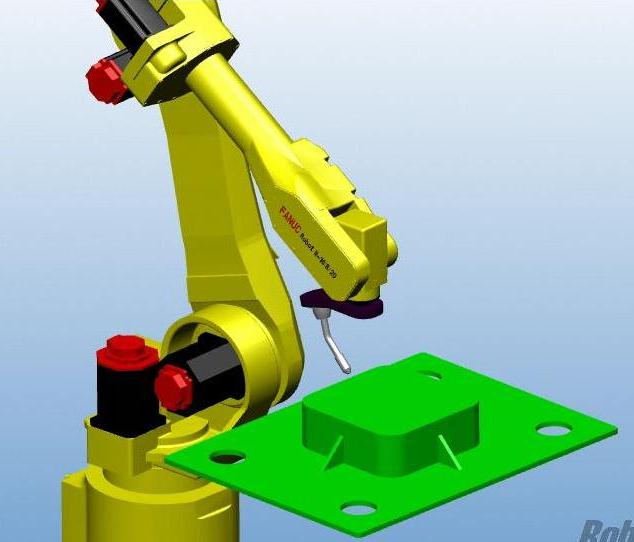
Digital technology has transformed the way that end users program and interact with everything from printing presses to slot cars. Traditionally, analog controls are mechanically adjusted by physically turning a knob or adjusting a dial.
Digital controls use microchips and sensors to transmit signals via a keypad or a touch-screen. Data and functions are managed precisely at very fast speeds. Data-carrying signals are electronic or optical pulses. The amplitude of each signal represents a logical 1 (pulse present and/or high) or a logical 0 (pulse absent and/or low).
More welding equipment is now equipped with digital power supplies, microprocessors and servocontrollers that monitor all joining process variables and parameters. As a result, assemblers have more opportunities than ever to join plastic parts with much higher quality, tighter tolerances and fewer problems.
Whether it’s hot-plate welding, spin welding or ultrasonic welding, digital controls allow more precise plastic assembly, with consistent performance. All output signals can be digitally adjusted and are no longer affected by the manufacturing tolerances of built-in components.
The biggest advantage of using digital controls for plastic welding applications is speed and accuracy. Timing accuracy provides more repeatable weld cycles and, therefore, more accurate parts assembly.
“Data output and data management are improved [over analog control],” says Janet Devine, president of Sonobond Ultrasonics (West Chester, PA). “Digital entry gives you repeatability, speed and accuracy in parameter entry, potential access to more parameters and storage. It can give you better remote control and monitoring.”
With one digital controller, end users can set many different parameters, such as weld time, hold time, delay time, after-burst time, distance energy, trigger force, pressure, distance, pre-trigger, converter amplitude and quality windows. They can also save and recall multiple jobs, set alarms and display all of these functions after the weld is completed.
“Graphing weld distance and power during the weld cycle is another benefit of using a digital microprocessor controller,” notes Robert Soloff, president of Sonics & Materials Inc. (Newtown, CT). “Many of these parameters would be difficult, if not impossible, to achieve with analog controls.
“In addition, you get outputs that can be fed into a computer for statistical analysis and maintaining a history of the weld parameters during a job run,” adds Soloff. “The display screen can be used as a dynamic power output meter and a parts counter.”
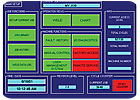
Today's digitally controlled welders include advanced touchscreen displays for the user interface.
Analog vs. Digital
Analog controls are usually very simple, but often are not repeatable. For example, if you need to set a weld timer to say 5.23 seconds, it would be difficult to repeat that setting. Some equipment now uses digital readouts to achieve such accuracy. With digital controls, operators can directly input the desired setting by simply entering 5.23.“Digital controls enable new modes of welding, communication, improved operator interfaces and advanced process control,” explains Sylvio Mainolfi, worldwide director of product marketing at Branson Ultrasonics Corp. (Danbury, CT). “The benefit to the customer includes higher quality of welded parts as a result of repeatability, accuracy and advanced process control; process tracking by way of data communication; and ease of use with an improved operator interface.”
With digital controls, there also is a very desirable technology-to-size ratio. “Digital controls can provide high levels of technology in small packages compared to simple analog controls in much larger ones,” says Brian Gourley, manager of the technical services group at Sonics & Materials. The company recently unveiled a digital ultrasonic power supply unit that is more than 30 percent smaller than its analog predecessors. “This is good news for typical assembly operations, where space and weld integrity are critical considerations,” Gourley points out.
Traditional analog vibration welder controls use a large variable frequency drive to power a set of voice coils, which cause the welding head to vibrate at a programmed amplitude. One of the problems with the analog system is that there are only two voice coils and three phases of power coming from the variable frequency drive, resulting in significant inefficiencies.
Another problem is that the resonant frequency of the system must first be established for any tool being run in the machine. “This is commonly called auto tuning and it is done in a nonwelding state,” explains Andrew Tapper, engineering manager at Forward Technology (Cokato, MN). “The resulting frequency from the auto tuning procedure is then locked in for that tool.
“The inefficiency comes from the extra time it takes to do this auto tuning procedure, and having to remember to do it,” explains Tapper. “Also, that resonant frequency is an extremely precise phenomena that can be shifted by small variations in the system. The further your running frequency is from the actual resonant frequency, the greater the inefficiency of power transfer. If the running frequency is off by more than 0.5 hertz, the system probably won’t run at all.”
Tapper and his colleagues developed a digital linear vibration welder that uses two digital DC amplifiers and a servo controller to precisely control the signals going to each voice coil, based on the current position of the welding head and the required amplitude. “This results in a machine with better welding output power using approximately half the incoming power,” he points out.
“This system also eliminates the need for auto tuning,” adds Tapper. “In fact, frequency becomes a byproduct instead of a control parameter. The machine is either running at resonant frequency or is not running at all–truly digital.”
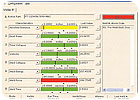
A visual quality screen allows end users to set limits and see at a glance if all parameters are within those limits.
Complexity Concerns
The first digitally controlled welders replaced analog knobs and dials with digital displays and tactile buttons. This allowed end users to input and display precise weld times, hold times, energy levels and process limits.
“Today’s digitally controlled welders include advanced touch-screen displays for the user interface and distributed microprocessors that are tasked to do specific functions,” says Mainolfi. “The welding systems include advanced functionality that is driven mainly by software.”
Digitally controlled welders are inherently more complex than traditional equipment. This is driven by the increased functionality that requires microprocessor-based control systems and software. As a result, digital controls generally cost more than traditional controls.
“Digital controls are more complex in their design,” warns Soloff. “However, they are very simple to use. In fact, the world is going digital in its use of computers, video games and various machine tools.
“Our kids are being brought up on this technology,” adds Soloff. “I wonder how many youngsters would know how to use a dial telephone [today]? How would they text message?”
Because of that complexity, digital controls can be more expensive than analog alternatives. According to Soloff, there is a higher cost in the initial development, but once digital controls are implemented, the overall costs to manufacture the welder are usually less.
An analog system requires things like switches, meters, potentiometers, knobs, indicating lights and other components. “These are usually very costly discrete devices,” claims Soloff. “The labor costs involved in wiring these elements together is also quite high.”
“The processor and digital components will cost more than the analog components to provide the same end result,” adds Bill Simon, director of research and development at Sonics & Materials. “However, value is added once converted to the digital world by the additional functions that can be provided by digital circuits.
“Once the design is complete, functions and features can be changed with program modifications and may not require additional circuit modifications, depending on the requested changes,” explains Simon. “Except for very simple timing changes, analog circuits would require major circuit board modifications in order to add new functional blocks to an existing design.”
Most experts believe that once you go digital, there’s no going back to the analog age. “Digital technology is always changing and will only get better,” predicts Gourley. “[The possibilities are] limited only to one’s imagination.”
“Today’s digitally controlled welders include advanced touch-screen displays for the user interface and distributed microprocessors that are tasked to do specific functions,” says Mainolfi. “The welding systems include advanced functionality that is driven mainly by software.”
Digitally controlled welders are inherently more complex than traditional equipment. This is driven by the increased functionality that requires microprocessor-based control systems and software. As a result, digital controls generally cost more than traditional controls.
“Digital controls are more complex in their design,” warns Soloff. “However, they are very simple to use. In fact, the world is going digital in its use of computers, video games and various machine tools.
“Our kids are being brought up on this technology,” adds Soloff. “I wonder how many youngsters would know how to use a dial telephone [today]? How would they text message?”
Because of that complexity, digital controls can be more expensive than analog alternatives. According to Soloff, there is a higher cost in the initial development, but once digital controls are implemented, the overall costs to manufacture the welder are usually less.
An analog system requires things like switches, meters, potentiometers, knobs, indicating lights and other components. “These are usually very costly discrete devices,” claims Soloff. “The labor costs involved in wiring these elements together is also quite high.”
“The processor and digital components will cost more than the analog components to provide the same end result,” adds Bill Simon, director of research and development at Sonics & Materials. “However, value is added once converted to the digital world by the additional functions that can be provided by digital circuits.
“Once the design is complete, functions and features can be changed with program modifications and may not require additional circuit modifications, depending on the requested changes,” explains Simon. “Except for very simple timing changes, analog circuits would require major circuit board modifications in order to add new functional blocks to an existing design.”
Most experts believe that once you go digital, there’s no going back to the analog age. “Digital technology is always changing and will only get better,” predicts Gourley. “[The possibilities are] limited only to one’s imagination.”
Click "Web Extra" to learn more about digital welding controls.
Looking for a reprint of this article?
From high-res PDFs to custom plaques, order your copy today!