Welding Beads: Welding Rods and Wires
Resistance and other solid-state welding processes are ideal for joining metal wire or rod to form rigid structures.
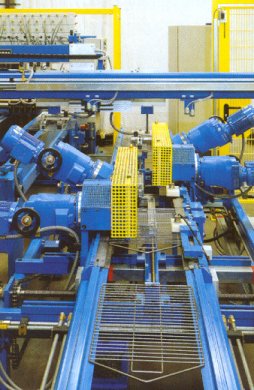 Metal rod and wire are very broadly used in myriad engineering applications. Rods and wires offer extreme flexibility in component design, and provide excellent strength-to-weight ratios in structural components. Welding holds the key to using these versatile materials successfully for any structural purpose.
The ubiquitous shopping cart is a common example of wire welding. In this application, individual wires are joined to form a rigid mesh strong enough to handle the weight of the family groceries. Each joint consists of two wires placed against each other at some non-zero angle and welded with force and current. This results in a strong solid-state bond with a minimum of weld flash.
While this is a relatively large-scale example of wire joining, the different methods available can bond gauges from the microscopic to 1-inch diameter and greater. Similarly, lap welding is often used for joining stranded wires. The ends of the bare wires are overlapped and welded. The tooling used should prevent the wires from spreading during the weld and eliminate shunting to produce consistent results.
Other methods for joining wires include mash, butt and percussion welding. These processes are best used on solid wires and rods. Mash welding is a resistance welding process similar to lap welding. In this process, the wire ends are overlapped to a controlled distance, generally on the order of one wire diameter, and resistance forge welded with electrodes oriented perpendicular to the wire axis. This results in a weld with a cross-sectional area close to that of the wire.
Butt welding is also a resistance joining method. In this process the wires are held in clamps with a consistent amount of stick out. The ends of the wires are brought together under load and current is passed through them. As the wires are heated they soften and the ends are forged together. This results in a ring of flash around the weld that is usually removed in a secondary operation. Butt welding works well for large diameter wires that can handle the high compressive forces associated with the process.
Mash and butt welding are solid-state processes that weld wire or rod together by applying heat and pressure to effectively forge two wires or two rods together, forming a solid-state joint. Wire welding can also be done with a number of fusion related processes. Percussion welding uses a power supply to draw an arc between the two wires. This arc melts a thin layer on the surface of each wire, which are welded by bringing the molten ends together. The process is similar to capacitor discharge welding, which is used in stud joining. Power supplies used for gas tungsten arc welding (GTAW, commonly called Tig welding) or lasers are also suitable for fusion welding. The choice depends on the application and manufacturing requirements.
It is common to work with dissimilar metals in wire joining. Two examples are copper wire welded to Nichrome to form a resistance heating element, and copper wire welded to constantan to form a thermocouple. Depending on the type of welding being done, different problems can arise. A primary concern is simple heat balance associated with the differing geometries, electrical resistivities and thermal conductivities of the two different metals. Appropriate electrode material, cooling and setup will usually compensate for heat balance concerns.
Joining combinations of dissimilar metals often leads to the formation of deleterious secondary phases. These secondary phases can often be hard and brittle, compromising the integrity of the joint. The formation of such phases can often be managed through the implied thermal cycle of the welding process. Generally a fast, low heat-input process can limit the formation of such secondary phases. Avoiding the formation of secondary phases is often the major determining factor in selecting the appropriate process for joining wires of dissimilar metals.
Wire welding is omnipresent in today’s manufacturing world. The approaches described here are by no means an exhaustive list of the available welding processes or the problems associated with them. The issues involved with welding rod or wire are as varied as the applications in which these versatile materials are used. There are no one-size-fits-all solutions. Rather, the best approaches will be specific to the application of interest.
The ubiquitous shopping cart is a common example of wire welding. In this application, individual wires are joined to form a rigid mesh strong enough to handle the weight of the family groceries. Each joint consists of two wires placed against each other at some non-zero angle and welded with force and current. This results in a strong solid-state bond with a minimum of weld flash.
While this is a relatively large-scale example of wire joining, the different methods available can bond gauges from the microscopic to 1-inch diameter and greater. Similarly, lap welding is often used for joining stranded wires. The ends of the bare wires are overlapped and welded. The tooling used should prevent the wires from spreading during the weld and eliminate shunting to produce consistent results.
Other methods for joining wires include mash, butt and percussion welding. These processes are best used on solid wires and rods. Mash welding is a resistance welding process similar to lap welding. In this process, the wire ends are overlapped to a controlled distance, generally on the order of one wire diameter, and resistance forge welded with electrodes oriented perpendicular to the wire axis. This results in a weld with a cross-sectional area close to that of the wire.
Butt welding is also a resistance joining method. In this process the wires are held in clamps with a consistent amount of stick out. The ends of the wires are brought together under load and current is passed through them. As the wires are heated they soften and the ends are forged together. This results in a ring of flash around the weld that is usually removed in a secondary operation. Butt welding works well for large diameter wires that can handle the high compressive forces associated with the process.
Mash and butt welding are solid-state processes that weld wire or rod together by applying heat and pressure to effectively forge two wires or two rods together, forming a solid-state joint. Wire welding can also be done with a number of fusion related processes. Percussion welding uses a power supply to draw an arc between the two wires. This arc melts a thin layer on the surface of each wire, which are welded by bringing the molten ends together. The process is similar to capacitor discharge welding, which is used in stud joining. Power supplies used for gas tungsten arc welding (GTAW, commonly called Tig welding) or lasers are also suitable for fusion welding. The choice depends on the application and manufacturing requirements.
It is common to work with dissimilar metals in wire joining. Two examples are copper wire welded to Nichrome to form a resistance heating element, and copper wire welded to constantan to form a thermocouple. Depending on the type of welding being done, different problems can arise. A primary concern is simple heat balance associated with the differing geometries, electrical resistivities and thermal conductivities of the two different metals. Appropriate electrode material, cooling and setup will usually compensate for heat balance concerns.
Joining combinations of dissimilar metals often leads to the formation of deleterious secondary phases. These secondary phases can often be hard and brittle, compromising the integrity of the joint. The formation of such phases can often be managed through the implied thermal cycle of the welding process. Generally a fast, low heat-input process can limit the formation of such secondary phases. Avoiding the formation of secondary phases is often the major determining factor in selecting the appropriate process for joining wires of dissimilar metals.
Wire welding is omnipresent in today’s manufacturing world. The approaches described here are by no means an exhaustive list of the available welding processes or the problems associated with them. The issues involved with welding rod or wire are as varied as the applications in which these versatile materials are used. There are no one-size-fits-all solutions. Rather, the best approaches will be specific to the application of interest.
Looking for a reprint of this article?
From high-res PDFs to custom plaques, order your copy today!


