Assembly in Action: Panel PCs Handle Heavy-Duty Lifting Chores
When designing a new heavy-duty transporter, engineers at TDS Automation didn't have much room for the controller. A tablet PC solved the problem.
Manufacturers in the power, energy, chemical and construction fields have to manage and efficiently move continually larger products to remain competitive. When it’s time to move and lift extremely heavy loads, many companies turn to Wheelift transporters, which can handle more than 1 million pounds. The devices are commonly used to maneuver transformers, turbine generators, mining machinery, nuclear processors, ship propellers and other bulky items.
Wheelift wheeled transporters routinely tackle payloads of 50 to 500 tons. Operators position the device beneath a load, raise the deck to lift it, transport it wherever it needs to go and set it down. The heavy-duty devices are manufactured by the TDS Automation division of Doerfer Cos. in Waverly, IA.
Wheelift transporters are custom-designed to meet individual applications. “It is a self-contained system with an on-board engine powering a 480-volt, three-phase generator which supplies power for the entire system,” says Ron Howell, an electrical engineer at Doerfer. “A three-phase power-monitoring module gathers a wealth of electrical information, including phase angles, voltages, watts, current and hertz. Knowing power consumption at all times helps prevent potential problems before they arise.”
During the initial engineering phase of its newest heavy transporters, Howell and his colleagues reviewed PLC-based products to meet their demanding requirements. However, they were limited by large housing dimensions and few available options. Traditional PLCs were quickly ruled out.
A critical requirement of the new controls platform was its ability to handle the updated hydraulic system. The new system required enhancements, such as greater reliability and increased accuracy and resolution for the tightly integrated hydraulic and electrical servo systems.
“Fortunately, Beckhoff Automation provided an ideal alternative-a very small, but powerful industrial PC system,” says Mark Lavallee, controls design manager. “This platform easily fit our new Wheelift requirements for compact-size controls paired with speed, performance and reliability improvements.”
The Wheelift team also needed a universally accepted IEC 61131-3 programming environment to handle complex steering control software. “Beckhoff’s TwinCAT PLC software gave us that foundation,” says Howell. “We use many of the languages defined by PLC-open, and we favor Structured Text for this application, because it is fully supported by TwinCAT along with many other programming languages.”
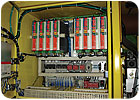
The compact nature of the equipment was critical for the new transporters. Engineers were challenged by the amount of cabinet space available, due to the low profile requirements for heavy transporters. The streamlined way the controls fit together helped them design a system that is as compact as possible.
“We decided to use the Beckhoff CP6201-0001 as a compact, all-in-one control and display solution,” explains Howell. “This helped to greatly reduce the space taken up by the control system. We also recognized a cost savings by having a powerful processor included in the display. The CP6201-0001 features a 12.1-inch screen and a built-in Intel Celeron M 1.0 gigahertz processor.
“Depending on the Wheelift transporter, eight to 24 servo axes are individually controlled using a single Beckhoff CP6201,” claims Howell. “Synchronous, coordinated motion would have been very difficult to accomplish on this scale using traditional PLC systems.”
For more on PC-based controls, call 952-890-0000 or visit www.beckhoffautomation.com.
Looking for a reprint of this article?
From high-res PDFs to custom plaques, order your copy today!