Robots Make Victor a Champion
Victor Plastics Inc. supplies injection-molded plastic parts to a wide range of industries, including automotive and appliance manufacturers. By using robots and vision to automate secondary operations, the fast-growing company has improved productivity, quality and safety.

Victor Plastics Inc. (VPI) supplies injection-molded plastic parts to a wide range of industries, including automotive and appliance manufacturers. The fast-growing company opened its doors in 1983 with six injection-molding machines and 25 employees, and it had $2 million in sales its first year.
Today, the company has plants in Victor, IA, North Liberty, IA, Kalona, IA, and Flora, MS. The four plants represent some 475,000 square feet of manufacturing space and contain a total of 130 injection-molding presses ranging in size from 30 tons to 3,000 tons. The company processes more than 40 million pounds of plastic each year. Its annual sales exceed $100 million, and the company now employs more than 700 people.
VPI has invested heavily in technology and automation. Nearly all of its injection-molding presses are tended by Cartesian robots on linear slides. The robots pick parts out of the presses from above. In addition, all of the company’s facilities use Motoman articulated robots to perform secondary operations, such as degating, sprue removal, assembly and inspection. This allows VPI to provide consistent, high-quality parts at a low cost.
The plants operate 24 hours per day, 7 days per week, with two 12-hour shifts per day. “Productivity improvement is our primary goal for adding robots to our operations,” says Sean Kenneally, production manager at VPI’s North Liberty plant, which now has four robot cells for various secondary operations. “We also consider other key factors, such as quality and repeatability, safety, manpower cost, and the skilled labor shortage. Generally speaking, the robot systems pay for themselves in less than a year.”
“By adding the robots, we’ve been able to cut our manufacturing cost and, in turn, we’ve been able to pass that cost reduction on to our customers,” adds Casey Scholl, a process engineer at the North Liberty plant. “For example, on one part we make for an appliance customer, we were able to lower the price by over 50 cents a part-more than 16 percent.”
Despite round-the-clock operation, the robots have been reliable. Regular maintenance is scheduled into VPI’s production schedule, and the robots are equipped with software to facilitate maintenance and troubleshooting.
Completed in January 2003, the Weight Ring Assembly Cell produces load balancers for washing machines. The parts are large, hollow rings filled with liquid calcium chloride. Each ring weighs approximately 12 pounds.
An operator loads unfilled parts for pickup by a six-axis UP130 robot with a 2,650-millimeter reach and a repeatability of ±0.2 millimeter. The robot moves the part to a camera station, where a DVT 530 vision system from Cognex Corp. (Natick, MA) verifies that the part has a Class 1 surface. (That is, the surface is visually free of defects.) The robot then moves the part to a fill station, where calcium chloride is automatically added to the ring. Next, the robot removes the filled part to a scale to ensure that the ring falls within upper and lower weight limits. The robot places good parts onto a conveyor, which transfers them out of the cell to an operator for packing. If a bad part is detected anywhere in the process, the robot removes it to a separate conveyor for rejects.
Direct labor savings, productivity improvement and safety were the primary reasons for automating this operation. “The robot reduced our direct labor cost by several hundred thousand dollars a year, as the number of operators required was reduced by 80 percent,” Kenneally says. “Although the cycle time is roughly the same, the robot improved productivity and also generally increased safety because…we’re dealing with calcium chloride, a substance that is very irritating to skin, particularly if the person has any cuts or scrapes. It can also cause skin to dry out.”
Completed in June 2003, the weight ring work-in-process cell includes two six-axis UP130 robots arranged back-to-back in a mirror-image layout. The two robots run continuously, loading and unloading parts to and from shared machines. I/O communications and safety zones keep the robots from colliding.
Each robot unloads a part directly from an injection-molding machine and drops the subgate, or runner system, into a grinder. Next, the robot presents the part to a clipping station to degate the lid. The robot then moves the part to a spin welder. This machine spin-welds the lid of the weight ring onto the base. Components produced in this cell go to the weight ring assembly cell.
“The robots reduced cycle time required for these operations by 20 percent-from 65 seconds down to 49 seconds. They also reduced direct labor required from one operator to one-third of an operator,” Kenneally says.
“Spin welding formerly was done later in the process in a secondary cell that finishes the part, but using the robot gave us the ability to perform this…operation sooner in the process,” Scholl adds.
Completed in August 2004, the Donaldson inspection line uses a five-axis SV035 robot to perform a series of 28 critical quality inspections on air filter assemblies for GM. The robot has a 3-kilogram payload, a 650-millimeter reach, and a repeatability of ±0.1 millimeter.
“We drop-ship these parts to GM, so they have to be perfect. We can’t have any failure,” Kenneally says.
An operator assembles the air filter assembly manually, then places the part on a linear servo table that takes it to the robot. The robot moves around the part, checking each inspection point using a combination of laser and proximity switch sensors. If anything fails, the robot places the part in a locked area, and a supervisor is paged. The supervisor takes the part out and sends it for rework. After it is reworked, the part goes back through the inspection process.
“Even though this is a slightly older model robot, this is one of our newer cells,” Kenneally says. “There are no before-and-after figures on this one, because it was never done manually. We put the robot in at the very beginning in order to meet GM specs.”
Completed in May 2005, the blower housing assembly line uses a pair of robots to assemble blower housings for clothes dryers. Similar to a fan, the blower housing removes warm, moist air from the dryer.
A two-axis robot from Yushin America Inc. (Cranston, RI) removes the blower housing base from an injection-molding machine and hands it off to a six-axis Motoman UP165 robot, which places it in a fixture. The six-axis robot then assembles the blower wheel and cover into the base and loads the assembly into a heat-staking machine, which joins the components together. A post in the base part passes through a hole in the cover, and the heat-staker melts the end of this projection to secure the assembly. From there, the robot removes the still-warm assembly to a conveyor, which transfers it to an operator for shipping.
Equipped with a vacuum gripper and an air bladder, the six-axis robot has a 165-kilogram payload, a 2,650-millimeter reach, and a repeatability of ±0.2 millimeter. An XRC2001 robot controller directs all cell operations; no PLC is used.
“We use vacuum grippers and air bladders, so we don’t have any problem deforming the plastic parts,” Kenneally explains.
Direct labor savings and safety were the primary reasons for automating the blower assembly operation. “The robot reduced our direct labor cost significantly. The number of operators required has been reduced by 50 percent,” Scholl says.
“This was a very difficult part to assemble manually,” Kenneally adds. “Using the robot to assemble it has helped reduce repetitive motion injuries. The cost of safety is priceless.”
“We’re basically a just-in-time production facility,” says Brian Jones, systems and maintenance manager at the plant. “When a customer places an order, we build to that order. They don’t order more than they can run, and we usually have about a week or so to fill the order.”
Since June 2005, the plant has been using a small, six-axis K3 robot equipped with an MRC controller and a zip cutter or router to deflash parts and remove gates and sprue. The robot is mounted to a portable table so it can be moved from station to station, as needed.
“Before we started using the robot, the gates were not being clipped close enough on some parts to suit the customer,” Jones says. “Using the robot reduces the chance of injury to operators and improves the quality and consistency of our parts.”
The gates on some parts are so large that trimming using a handheld power clipper presents a safety issue, adds plant manager Brad Webb. “Any time you hand a power hand trimmer to an employee, you’re asking for trouble on the quality side or safety side. Using the robot helps avoid a potentially dangerous situation while also improving quality,” he says.
Besides degating, the robot is also used to machine plastic parts. For example, the robot drills holes in a plastic part for a coffee maker. The robot is used because precision and cosmetics are critical aspects of the part.
“The robot runs 24 hours a day until we’re done with the job,” Jones says. “Then we manually change over the part-holding fixtures and select a new program on the robot controller.”
Eventually, the plant hopes to install at least one more robot. “Since the table is portable, we have the flexibility to do multiple jobs using one robot,” Jones says. “However, sometimes we may be running two jobs, and we could be utilizing two robots. Because we only have the one robot, not all jobs are being automated. Some are still being done manually. Other jobs are put in a box and reworked later, which ends up costing us more because we have to handle the parts twice.”
For more information on assembly robots, call Motoman at 937-847-6200 or visit www.motoman.com. For more information on press-tending robots, call Yushin America at 888-707-6288 or visit www.yushinamerica.com. For more information on vision systems, call Cognex at 877-264-6391 or visit www.cognex.com.
Victor Plastics Inc. (VPI) supplies injection-molded plastic parts to a wide range of industries, including automotive and appliance manufacturers. The fast-growing company opened its doors in 1983 with six injection-molding machines and 25 employees, and it had $2 million in sales its first year.
Today, the company has plants in Victor, IA, North Liberty, IA, Kalona, IA, and Flora, MS. The four plants represent some 475,000 square feet of manufacturing space and contain a total of 130 injection-molding presses ranging in size from 30 tons to 3,000 tons. The company processes more than 40 million pounds of plastic each year. Its annual sales exceed $100 million, and the company now employs more than 700 people.
VPI has invested heavily in technology and automation. Nearly all of its injection-molding presses are tended by Cartesian robots on linear slides. The robots pick parts out of the presses from above. In addition, all of the company’s facilities use Motoman articulated robots to perform secondary operations, such as degating, sprue removal, assembly and inspection. This allows VPI to provide consistent, high-quality parts at a low cost.
The plants operate 24 hours per day, 7 days per week, with two 12-hour shifts per day. “Productivity improvement is our primary goal for adding robots to our operations,” says Sean Kenneally, production manager at VPI’s North Liberty plant, which now has four robot cells for various secondary operations. “We also consider other key factors, such as quality and repeatability, safety, manpower cost, and the skilled labor shortage. Generally speaking, the robot systems pay for themselves in less than a year.”
“By adding the robots, we’ve been able to cut our manufacturing cost and, in turn, we’ve been able to pass that cost reduction on to our customers,” adds Casey Scholl, a process engineer at the North Liberty plant. “For example, on one part we make for an appliance customer, we were able to lower the price by over 50 cents a part-more than 16 percent.”
Despite round-the-clock operation, the robots have been reliable. Regular maintenance is scheduled into VPI’s production schedule, and the robots are equipped with software to facilitate maintenance and troubleshooting.
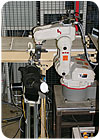
This five-axis robot performs a series of quality inspections on automotive air filters.
North Liberty Plant
The North Liberty plant produces parts for major appliance manufacturers. It’s also a Tier 2 supplier to General Motors Corp. (GM, Detroit). The plant’s four robot cells are dedicated to particular lines, so little changeover is required.Completed in January 2003, the Weight Ring Assembly Cell produces load balancers for washing machines. The parts are large, hollow rings filled with liquid calcium chloride. Each ring weighs approximately 12 pounds.
An operator loads unfilled parts for pickup by a six-axis UP130 robot with a 2,650-millimeter reach and a repeatability of ±0.2 millimeter. The robot moves the part to a camera station, where a DVT 530 vision system from Cognex Corp. (Natick, MA) verifies that the part has a Class 1 surface. (That is, the surface is visually free of defects.) The robot then moves the part to a fill station, where calcium chloride is automatically added to the ring. Next, the robot removes the filled part to a scale to ensure that the ring falls within upper and lower weight limits. The robot places good parts onto a conveyor, which transfers them out of the cell to an operator for packing. If a bad part is detected anywhere in the process, the robot removes it to a separate conveyor for rejects.
Direct labor savings, productivity improvement and safety were the primary reasons for automating this operation. “The robot reduced our direct labor cost by several hundred thousand dollars a year, as the number of operators required was reduced by 80 percent,” Kenneally says. “Although the cycle time is roughly the same, the robot improved productivity and also generally increased safety because…we’re dealing with calcium chloride, a substance that is very irritating to skin, particularly if the person has any cuts or scrapes. It can also cause skin to dry out.”
Completed in June 2003, the weight ring work-in-process cell includes two six-axis UP130 robots arranged back-to-back in a mirror-image layout. The two robots run continuously, loading and unloading parts to and from shared machines. I/O communications and safety zones keep the robots from colliding.
Each robot unloads a part directly from an injection-molding machine and drops the subgate, or runner system, into a grinder. Next, the robot presents the part to a clipping station to degate the lid. The robot then moves the part to a spin welder. This machine spin-welds the lid of the weight ring onto the base. Components produced in this cell go to the weight ring assembly cell.
“The robots reduced cycle time required for these operations by 20 percent-from 65 seconds down to 49 seconds. They also reduced direct labor required from one operator to one-third of an operator,” Kenneally says.
“Spin welding formerly was done later in the process in a secondary cell that finishes the part, but using the robot gave us the ability to perform this…operation sooner in the process,” Scholl adds.
Completed in August 2004, the Donaldson inspection line uses a five-axis SV035 robot to perform a series of 28 critical quality inspections on air filter assemblies for GM. The robot has a 3-kilogram payload, a 650-millimeter reach, and a repeatability of ±0.1 millimeter.
“We drop-ship these parts to GM, so they have to be perfect. We can’t have any failure,” Kenneally says.
An operator assembles the air filter assembly manually, then places the part on a linear servo table that takes it to the robot. The robot moves around the part, checking each inspection point using a combination of laser and proximity switch sensors. If anything fails, the robot places the part in a locked area, and a supervisor is paged. The supervisor takes the part out and sends it for rework. After it is reworked, the part goes back through the inspection process.
“Even though this is a slightly older model robot, this is one of our newer cells,” Kenneally says. “There are no before-and-after figures on this one, because it was never done manually. We put the robot in at the very beginning in order to meet GM specs.”
Completed in May 2005, the blower housing assembly line uses a pair of robots to assemble blower housings for clothes dryers. Similar to a fan, the blower housing removes warm, moist air from the dryer.
A two-axis robot from Yushin America Inc. (Cranston, RI) removes the blower housing base from an injection-molding machine and hands it off to a six-axis Motoman UP165 robot, which places it in a fixture. The six-axis robot then assembles the blower wheel and cover into the base and loads the assembly into a heat-staking machine, which joins the components together. A post in the base part passes through a hole in the cover, and the heat-staker melts the end of this projection to secure the assembly. From there, the robot removes the still-warm assembly to a conveyor, which transfers it to an operator for shipping.
Equipped with a vacuum gripper and an air bladder, the six-axis robot has a 165-kilogram payload, a 2,650-millimeter reach, and a repeatability of ±0.2 millimeter. An XRC2001 robot controller directs all cell operations; no PLC is used.
“We use vacuum grippers and air bladders, so we don’t have any problem deforming the plastic parts,” Kenneally explains.
Direct labor savings and safety were the primary reasons for automating the blower assembly operation. “The robot reduced our direct labor cost significantly. The number of operators required has been reduced by 50 percent,” Scholl says.
“This was a very difficult part to assemble manually,” Kenneally adds. “Using the robot to assemble it has helped reduce repetitive motion injuries. The cost of safety is priceless.”
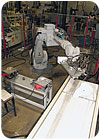
This six-axis robot assembles blower housings for a clothes dryer. Here, the robot retrieves freshly molded parts from a conveyor.
Kalona Plant
PI’s Kalona plant makes polycarbonate, polypropylene and polystyrene parts that are used in everything from coffee makers to filter housings for trucks.“We’re basically a just-in-time production facility,” says Brian Jones, systems and maintenance manager at the plant. “When a customer places an order, we build to that order. They don’t order more than they can run, and we usually have about a week or so to fill the order.”
Since June 2005, the plant has been using a small, six-axis K3 robot equipped with an MRC controller and a zip cutter or router to deflash parts and remove gates and sprue. The robot is mounted to a portable table so it can be moved from station to station, as needed.
“Before we started using the robot, the gates were not being clipped close enough on some parts to suit the customer,” Jones says. “Using the robot reduces the chance of injury to operators and improves the quality and consistency of our parts.”
The gates on some parts are so large that trimming using a handheld power clipper presents a safety issue, adds plant manager Brad Webb. “Any time you hand a power hand trimmer to an employee, you’re asking for trouble on the quality side or safety side. Using the robot helps avoid a potentially dangerous situation while also improving quality,” he says.
Besides degating, the robot is also used to machine plastic parts. For example, the robot drills holes in a plastic part for a coffee maker. The robot is used because precision and cosmetics are critical aspects of the part.
“The robot runs 24 hours a day until we’re done with the job,” Jones says. “Then we manually change over the part-holding fixtures and select a new program on the robot controller.”
Eventually, the plant hopes to install at least one more robot. “Since the table is portable, we have the flexibility to do multiple jobs using one robot,” Jones says. “However, sometimes we may be running two jobs, and we could be utilizing two robots. Because we only have the one robot, not all jobs are being automated. Some are still being done manually. Other jobs are put in a box and reworked later, which ends up costing us more because we have to handle the parts twice.”
For more information on assembly robots, call Motoman at 937-847-6200 or visit www.motoman.com. For more information on press-tending robots, call Yushin America at 888-707-6288 or visit www.yushinamerica.com. For more information on vision systems, call Cognex at 877-264-6391 or visit www.cognex.com.
Looking for a reprint of this article?
From high-res PDFs to custom plaques, order your copy today!