Assembly Magazine logo
search
Ask ASSEMBLY AI
cart
facebook twitter linkedin youtube
  • Sign In
  • Create Account
  • Sign Out
  • My Account
Assembly Magazine logo
  • TRENDS
    • Ask ASSEMBLY AI
    • Trends
    • News
    • New Products
  • INDUSTRIES
    • Aerospace
    • Appliance
    • DFMA Assembly
    • Medical Devices
    • Green Manufacturing
    • Lean Manufacturing
    • Machinery Assembly
    • Electronics Assembly
    • Automotive
  • TECHNOLOGIES
    • Adhesives & Dispensing
    • Assembly Presses
    • Automated Assembly Systems
    • Manufacturing Management
    • Manufacturing Software
    • Motion Control
    • Screwdriving & Riveting
    • Robotics
    • Test & Inspection
    • Plastics & Metal Welding
    • Wire Processing
    • Workstations
  • AUTONOMOUS & ELECTRIC MOBILITY
    • AEM Magazine Archives
    • Autonomy
    • Electrification
    • Mobility Services
    • Assembly & Testing
    • AV/EM News
  • MEDIA
    • Ask ASSEMBLY AI
    • Podcasts
    • Assembly News Now
    • Assembly TV
    • Webinars
    • eBooks
  • EVENTS
    • Calendar
    • The ASSEMBLY Show
  • MORE
    • Exclusives >
      • Plant of the Year
      • Capital Spending
    • Buyers Guide >
      • Supplier Insights
    • Classifieds
    • Featured Products
    • Newsletters
    • Store
    • White Papers
    • Columns
    • Sponsor Insights
  • INFOCENTER
    • Assembly & Test Solutions
  • EMAGAZINE
    • eMagazine
    • Archive Issues
    • Advertise
    • Contact Us
    • Sign Up

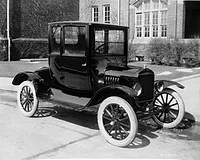
How the Model T Was Assembled

By Austin Weber
September 2, 2008


There were 45 operations involved in producing a Model T chassis on the first moving assembly line, which debuted at Ford’s Highland Park, MI, plant in early 1914. Vehicles moved 327 feet down the assembly line (from South to North) on the ground floor of the four-story factory. By mid-1914, three parallel chain-driven assembly lines were in operation. Here’s a brief look at how many assemblers were involved in the process and what the steps were:

1. Three men (one press man and two chassis frame handlers). Fix four mud guard brackets, two on each side, to the chassis frame; 600 in 8 hours.

2. Six men. On moving line, fix rear spring to chassis frame; 600 in 8 hours. Operations 1 and 2 are on a side line, work moving from north to south, and this line turns out 600 chassis frames with four mud guard brackets and rear springs in place in 8 hours, enough to supply two lines of automobile assemblers, work moving from south to north, each line turning out 300 automobile assemblies in 8 hours.

3. Three men. Two men place and fix the rear axle, connecting the rear axle spring shackles; one man working simultaneously with the other two places and fixes the front axle assembly under the chassis frame.

4. Two men. One completes the fixing of front axle, places the two combined lamp brackets and front mud guards, and catches nuts on, while the other man places and fixes the mud guard bracket truss rods.

5. Two men. Place nuts on truss rods. Place and fix control lever rock shaft.

6. One man. Fixes front spring, tightens nuts, and puts in four split pins.

7. Two men. Complete fixing of combined front fender irons and lamp brackets.

8. Two men. Place gasoline tank and fix same, also place gasoline feed pipe. The tank receives 1 gallon of gasoline before leaving the gasoline tank bridge.

9. One man. With hard grease syringe injects 4 pounds of heavy grease into the bevel gear and differential housing. Also places 1 pound heavy grease in universal joint globe housing.

10. Two men. Place motor and connect the universal joint of propeller shaft to the change-gear shaft.

11. Two men. Line up mud-guard brackets. Tighten rear-spring perch nuts and place the cotter pins in same.

12. One man. Places spark plugs. Fixes same.

13. One man. Seats and caps motor front-support and wires 2 cap screws.

14. Two men. Fix globe housing to end of transmission case, place 2 bolts and 2 cap screws.

15. One man. Puts cotter pins in the nuts placed in operation 14 and wires the cap-screw heads placed in the same operation.

16. Two men. Place and fix the 2 rear crankcase bracket bolts and 2 bolts with split pins.

17. One man. Places 4 grease cups, 2 in universal-joint casings and 2 in rear-axle gear housings.

18. Two men. Place dash assembly. Place 4 bolts.

19. One man. Places muffler and fixes exhaust pipe, also replaces rear-axle bevel-gear housing grease-plug, after first making certain that grease has been properly supplied.

20. One man. Nails name plate on dashboard.

21. One man. Adjusts pedals travel.

22. One man. Fixes steering column end to chassis frame.

23. One man. Places and fixes commutator.

24. One man. Places acetylene gas pipe and its supporting bracket inside chassis frame.

25. Two men. Place split pins in fender and lamp-bracket bolt nuts; also put split pins in 4 dashboard bottom holding-bolt nuts.

26. Two men. Place and fix motor-hood clips and hood “blocks” (wood strips) and connect the spark plug wires.

27. One man. Places radiator support and spring studs and nuts, and places split pins in nuts.

28. One man. Tightens and pins muffler-fixing bolt nuts.

29. One man. Secures gasoline feed-pipe to carburetor; also connects brake rod.

30. Two men. Places motor pans, one on each side, under chassis frame, and pan-holding bolts and nuts.

31. Four men. Tighten motor-pan-bolt nuts and place split pins in same.

32. One man. Pins steering-gear bracket nut and adjusts spark time.

33. Two men. Put on wheels, place wheel nuts.

34. One man. Connects carburetor “pull rod” (gives more or less gasoline) and adjusts the carburetor, and turns on the gasoline.

35. Three men (one head checker and two checkers, one on each side, also act as inspectors). Record chassis numbers and car numbers, fill blank records in record sheets. The third man is record inspector, and filler of his own number record book; superior to the two checkers.

36. One man. Caps steering connecting-rod globe end, places 2 cap bolts, places nuts and pins them.

37. One man. Connects magneto wire, and paints bolts and nuts on right side of chassis.

38. One man. Places radiator and its water connection and top stay-rod, and places carburetor priming rod.

39. One man. Tightens radiator water connection.

40. One man. Places nuts and split pins, radiator-support studs.

41. One man. In pit, caps front-axle radius-rod globe, and puts on two stud nuts and wires same.

42. One man. Paints bolts and nuts on left side of chassis and radiator.

43. One man. Final inspector, tags defects.

44. Two men. Fill radiator with water, handle starting weight lever on rear axle, and lift rear wheels off starting friction-wheels and attach exhaust hose.

45. One man. Drives car onto John R St. body line.

Finished chassis were driven outside and lined up under a chute, where bodies were slid down from the second floor of the factory.

Source: Ford Methods and the Ford Shops, by Horace Arnold and Fay Faurote, published in 1915 (The Engineering Magazine Co., New York).
KEYWORDS: Ford Motor Co. manufacturing history Model T

Share This Story

Looking for a reprint of this article?
From high-res PDFs to custom plaques, order your copy today!

Austinweber headshot
Austin has been senior editor for ASSEMBLY Magazine since September 1999. He has more than 21 years of b-to-b publishing experience and has written about a wide variety of manufacturing and engineering topics. Austin is a graduate of the University of Michigan.

Recommended Content

JOIN TODAY
To unlock your recommendations.

Already have an account? Sign In

  • Made in the U.S.A.

    Consumer Products Manufacturing: Made in the USA

    Supply chain lessons learned during the coronavirus...
    Automated Assembly Systems
    By: Austin Weber
  • Best Practices for Press-Fit Assembly

    Best Practices for Press-Fit Assembly

    In manufacturing, ironclad formulas for success are hard...
    Assembly Presses
    By: Jim Camillo
  • aem0523leader-tesla1.jpg

    Tesla Rethinks the Assembly Line

    Engineers at Tesla Inc. have developed a new process that...
    Electrification
    By: Austin Weber
Manage My Account
  • eMagazine Subscription
  • Assembly Newsletters
  • Online Registration
  • Subscription Customer Service
  • Manage My Preferences

More Videos

Sponsored Content

Sponsored Content is a special paid section where industry companies provide high quality, objective, non-commercial content around topics of interest to the ASSEMBLY audience. All Sponsored Content is supplied by the advertising company and any opinions expressed in this article are those of the author and not necessarily reflect the views of ASSEMBLY or its parent company, BNP Media. Interested in participating in our Sponsored Content section? Contact your local rep!

close
  • ultrasonic welding
    Sponsored bySonobond Ultrasonics

    Engineering Efficiency in High-Performance Assembly: How Ultrasonic Welding Enhances Throughput, Reliability and Quality

  • UV curing system
    Sponsored byDymax

    Why UV Intensity Alone Doesn’t Define Curing Performance

  • wooden pallets
    Sponsored byLEAN Manufacturing Products

    Eliminating Waste on the Shop Floor: Applying Lean Principles to Improve Manufacturing Efficiency

Popular Stories

ASSEMBLY News Now, episode-30: Volvo Redesigns EV Manufacturing

Volvo Redesigns EV Manufacturing

Boeing CEO Kelly Ortberg announces 1 billion investment

Boeing Plans $1 Billion Wichita Investment, Workforce Training Center

automated consumer goods assembly system

Best Practices for Cycle Time Optimization

Watch the latest episode of ANN now!

Events

July 24, 2025

From Shop Floor to CFO: How Manufacturers Are Closing the Loop Between Operations and Finance

On Demand Learn how manufacturers are bridging the gap between the shop floor and ERP systems to gain real-time visibility, streamline operations, and kick-start digital transformation—without waiting years.

Sponsored by:

PicoStratusGreen
July 30, 2025

Buffer Analysis and Design Fundamentals for Manufacturing Excellence

On Demand In this presentation, Dr. Herman Tang shares practical insights from his industry experience and research on buffer management in manufacturing operations.

View All Submit An Event

Poll

Difficult Assembly Processes

Which assembly process gives you the most difficulty?
View Results Poll Archive

Products

Manufacturing Cost Policy Deployment (MCPD) Profitability Scenarios: Systematic and Systemic Improvement of Manufacturing Costs

Manufacturing Cost Policy Deployment (MCPD) Profitability Scenarios: Systematic and Systemic Improvement of Manufacturing Costs

See More Products
Register for webinar - Modernizing Automotive Assembly: Why Upgrading Legacy MES is a Business Imperative

Related Articles

  • access-1921_ford_model_t_coupe_neg_31830.jpg

    How the Model T Was Assembled in Chicago

    See More
  • The Model T Turns 100

    See More

Related Products

See More Products
  • leaner

    Leaner Manufacturing: How to Make the Lean Production Process Easier, Faster, and More Cost-Effective

  • pocket.jpg

    How To Implement Lean Manufacturing, Second Edition

  • The First Snap-Fit Handbook 2e: Creating and Managing Attachments for Plastics Parts

See More Products

Related Directories

  • HowToRobot

×

Never miss the latest news and trends driving the manufacturing industry

Stay in the know on the latest assembly trends.

JOIN TODAY!
  • RESOURCES
    • Advertise
    • Contact Us
    • Directories
    • Manufacturing Division
    • Store
    • Want More?
  • SIGN UP TODAY
    • Create Account
    • eMagazine
    • Newsletters
    • Customer Service
    • Manage Preferences
  • SERVICES
    • Marketing Services
    • Reprints
    • Market Research
    • List Rental
    • Survey/Respondent Access
  • STAY CONNECTED
    • LinkedIn
    • Facebook
    • Instagram
    • YouTube
    • X (Twitter)
  • PRIVACY
    • PRIVACY POLICY
    • TERMS & CONDITIONS
    • DO NOT SELL MY PERSONAL INFORMATION
    • PRIVACY REQUEST
    • ACCESSIBILITY

Copyright ©2026. All Rights Reserved BNP Media, Inc. and BNP Media II, LLC.

Design, CMS, Hosting & Web Development :: ePublishing