Assembly Magazine logo
search
Ask ASSEMBLY AI
cart
facebook twitter linkedin youtube
  • Sign In
  • Create Account
  • Sign Out
  • My Account
Assembly Magazine logo
  • TRENDS
    • Ask ASSEMBLY AI
    • Trends
    • News
    • New Products
  • INDUSTRIES
    • Aerospace
    • Appliance
    • DFMA Assembly
    • Medical Devices
    • Green Manufacturing
    • Lean Manufacturing
    • Machinery Assembly
    • Electronics Assembly
    • Automotive
  • TECHNOLOGIES
    • Adhesives & Dispensing
    • Assembly Presses
    • Automated Assembly Systems
    • Manufacturing Management
    • Manufacturing Software
    • Motion Control
    • Screwdriving & Riveting
    • Robotics
    • Test & Inspection
    • Plastics & Metal Welding
    • Wire Processing
    • Workstations
  • AUTONOMOUS & ELECTRIC MOBILITY
    • AEM Magazine Archives
    • Autonomy
    • Electrification
    • Mobility Services
    • Assembly & Testing
    • AV/EM News
  • MEDIA
    • Ask ASSEMBLY AI
    • Podcasts
    • Assembly News Now
    • Assembly TV
    • Webinars
    • eBooks
  • EVENTS
    • Calendar
    • The ASSEMBLY Show
  • MORE
    • Exclusives >
      • Plant of the Year
      • Capital Spending
    • Buyers Guide >
      • Supplier Insights
    • Classifieds
    • Featured Products
    • Newsletters
    • Store
    • White Papers
    • Columns
    • Sponsor Insights
  • INFOCENTER
    • Assembly & Test Solutions
  • EMAGAZINE
    • eMagazine
    • Archive Issues
    • Advertise
    • Contact Us
    • Sign Up

Robot Knows When It Hits a Person
September 11, 2008

Isaac Asimov must be spinning in his grave. In blatant contravention of the sci-fi writer’s first law of robotics, Sami Haddadin’s robot regularly hits him in the face.

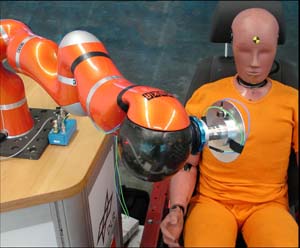
The blows are no accident. Haddadin is part of a research team at the German Aerospace Centre Space Agency (DLR) in Oberpfaffenhofen aiming to transform industrial robots from insensitive drones into smart machines that can work alongside humans. He is testing the first industrial robot capable of sensing when it hits someone.

“Accidents happen,” he says. “We have to accept that when people start to work more closely with robots they will sometimes hit people.”

Today’s industrial robots are a far cry from anything people could work with. Safety at a typical car factory, where robots work tirelessly at high speeds penned in behind physical barriers, consists of keeping people and robots apart. If a person breaches a barrier, sometimes an alarm sounds and the robots stop. But if someone was hit, the robots would just soldier on blissfully unaware.

To tackle this, the DLR researchers started by smashing robotic arms weighing up to 2.5 tons into the head of a crash test dummy at different speeds. To the researchers’ surprise, none was capable of delivering a blow rated worse than “very low” on the scale used by the car industry. Roboticists had assumed such impacts would be lethal, says Haddadin.

Although this was reassuring, an industrial robot could still trap or crush a person by being unaware that it had hit them. So the next step was giving a robotic arm the ability to detect an impact and react appropriately.

A person landing a blow feels the shock of the impact thanks to specialized stretch receptors in their muscles and joints. Haddadin has given a robot arm the same “kinesthetic” sense by embedding torque sensors in each of its six joints. Made from a collection of metal foil devices that change their electrical resistance when under tension in a particular direction, they give constant feedback on the direction and magnitude of the forces felt by the arm.

Haddadin recorded the pattern of torque changes his robot arm feels during normal activity and programmed it to stop moving if it senses something unexpected. Then he gamely put the arm to the test, allowing it to hit him in the stomach, chest, forehead and arm at speeds of up to 2.5 meters per second. Luckily, it performed as expected. Though he was “definitely concerned” when the blows began, Haddadin says “it took me only a very short time to get used to them.”

Once it has stopped, the arm uses its motors and torque sensors to support its own weight. This ensures it doesn’t keep moving due to gravity or inertia and cause further harm. Then the arm can simply be pushed aside. “You give it a push and it just floats away. It feels like it weighs only a few grams,” says Haddadin. The robot can feel the direction it is being pushed in and use its motors to help out.

The arm also uses its torque sensors for more sophisticated responses. The direction of an unexpected movement allows it to differentiate a co-worker’s guiding hand from an unintended collision, preventing it from stopping unnecessarily. Meanwhile the magnitude of the movement allows it to tell the difference between a big hit and a soft collision. It responds to the latter with a gentle nudge that signals “get out of my way” to its human co-worker.

You can read more about it here.

Share This Story

Looking for a reprint of this article?
From high-res PDFs to custom plaques, order your copy today!

Recommended Content

JOIN TODAY
To unlock your recommendations.

Already have an account? Sign In

  • Made in the U.S.A.

    Consumer Products Manufacturing: Made in the USA

    Supply chain lessons learned during the coronavirus...
    Automated Assembly Systems
    By: Austin Weber
  • Best Practices for Press-Fit Assembly

    Best Practices for Press-Fit Assembly

    In manufacturing, ironclad formulas for success are hard...
    Assembly Presses
    By: Jim Camillo
  • aem0523leader-tesla1.jpg

    Tesla Rethinks the Assembly Line

    Engineers at Tesla Inc. have developed a new process that...
    Automotive Assembly
    By: Austin Weber
Manage My Account
  • eMagazine Subscription
  • Assembly Newsletters
  • Online Registration
  • Subscription Customer Service
  • Manage My Preferences

More Videos

Sponsored Content

Sponsored Content is a special paid section where industry companies provide high quality, objective, non-commercial content around topics of interest to the ASSEMBLY audience. All Sponsored Content is supplied by the advertising company and any opinions expressed in this article are those of the author and not necessarily reflect the views of ASSEMBLY or its parent company, BNP Media. Interested in participating in our Sponsored Content section? Contact your local rep!

close
  • ultrasonic welding
    Sponsored bySonobond Ultrasonics

    Engineering Efficiency in High-Performance Assembly: How Ultrasonic Welding Enhances Throughput, Reliability and Quality

  • UV curing system
    Sponsored byDymax

    Why UV Intensity Alone Doesn’t Define Curing Performance

  • wooden pallets
    Sponsored byLEAN Manufacturing Products

    Eliminating Waste on the Shop Floor: Applying Lean Principles to Improve Manufacturing Efficiency

Popular Stories

ASSEMBLY News Now, episode-30: Volvo Redesigns EV Manufacturing

Volvo Redesigns EV Manufacturing

Boeing CEO Kelly Ortberg announces 1 billion investment

Boeing Plans $1 Billion Wichita Investment, Workforce Training Center

automated consumer goods assembly system

Best Practices for Cycle Time Optimization

Watch the latest episode of ANN now!

Events

July 24, 2025

From Shop Floor to CFO: How Manufacturers Are Closing the Loop Between Operations and Finance

On Demand Learn how manufacturers are bridging the gap between the shop floor and ERP systems to gain real-time visibility, streamline operations, and kick-start digital transformation—without waiting years.

Sponsored by:

PicoStratusGreen
July 30, 2025

Buffer Analysis and Design Fundamentals for Manufacturing Excellence

On Demand In this presentation, Dr. Herman Tang shares practical insights from his industry experience and research on buffer management in manufacturing operations.

View All Submit An Event

Poll

Difficult Assembly Processes

Which assembly process gives you the most difficulty?
View Results Poll Archive

Products

Manufacturing Cost Policy Deployment (MCPD) Profitability Scenarios: Systematic and Systemic Improvement of Manufacturing Costs

Manufacturing Cost Policy Deployment (MCPD) Profitability Scenarios: Systematic and Systemic Improvement of Manufacturing Costs

See More Products
Register for webinar - Modernizing Automotive Assembly: Why Upgrading Legacy MES is a Business Imperative

Related Articles

  • Tectorius

    Q&A: When it comes to fasteners, ‘the devil is in the details’

    See More
  • 2006 Plant of the Year: When it Comes to Being Green, Lear's in Gear

    See More

Related Products

See More Products
  • building a sus.jpg

    Building a Sustainable Lean Culture An Implementation Guide

  • integration.jpg

    Integration of Mechanical and Manufacturing Engineering with IoT: A Digital Transformation

  • OIP.jpg

    Is Quality Just a Word We Use?

See More Products
×

Never miss the latest news and trends driving the manufacturing industry

Stay in the know on the latest assembly trends.

JOIN TODAY!
  • RESOURCES
    • Advertise
    • Contact Us
    • Directories
    • Manufacturing Division
    • Store
    • Want More?
  • SIGN UP TODAY
    • Create Account
    • eMagazine
    • Newsletters
    • Customer Service
    • Manage Preferences
  • SERVICES
    • Marketing Services
    • Reprints
    • Market Research
    • List Rental
    • Survey/Respondent Access
  • STAY CONNECTED
    • LinkedIn
    • Facebook
    • Instagram
    • YouTube
    • X (Twitter)
  • PRIVACY
    • PRIVACY POLICY
    • TERMS & CONDITIONS
    • DO NOT SELL MY PERSONAL INFORMATION
    • PRIVACY REQUEST
    • ACCESSIBILITY

Copyright ©2026. All Rights Reserved BNP Media, Inc. and BNP Media II, LLC.

Design, CMS, Hosting & Web Development :: ePublishing