Assembly magazine
Home
Subscription Customer Service
Online
Industry Headlines
AssemblyBlog
ASSEMBLYtv
Assembly Radio
Web Extras
Buyers Guide
Showrooms
Product Review
How To Guides
Webinar
Ask ASSEMBLY
Calendar of Events
eNewsletter
Current Issue
Cover Story
Features
Departments
Digital Edition
Resources
Archives
Job Search
White Papers
Industry Links
Website Review
E-Cards
Market Research
List Rental
Classified Ads
ASSEMBLY Info
June 2009 BPA Statement
Subscribe
About Assembly
Staff Directory
Advertise
Reprints
2010 Plant of the Year Nomination Form
Search in: EditorialProductsCompanies
A Discrete Alternative
by Austin Weber
January 1, 2001

ARTICLE TOOLS
EmailEmailPrintPrintReprintsReprintsshareShare


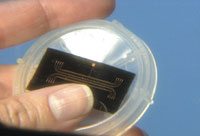
Optical integrated circuits allow fiber optic component manufacturers to take advantage of high-volume semiconductor assembly processes. Photo courtesy Lumera Inc.


Traditionally, fiber optic devices have been assembled using various discrete components. Some observers believe integrated optical components, photonic chips and wafer scale manufacturing provide an answer to the assembly woes that have been plaguing the industry.

Companies such as Bookham Technology (Abingdon, Oxfordshire, UK), Digital Optics Corp. (Charlotte, NC), Lightwave Microsystems Corp. (San Jose, CA) and Nanovation Technologies Inc. (Miami) have developed processes to manufacture components based on silicon chips. By using this technology, the companies take advantage of standard, high-volume semiconductor assembly processes that offer much higher yields.

"While traditional fiber optic component manufacturers combine discrete elements, such as lasers, lenses and filters, in manually assembled devices, we can achieve the same functionality in a single integrated silicon chip," says Andy Cornish, vice president of manufacturing at Bookham Technology. Cornish boasts that this process significantly reduces the cost, time and complexity of assembling fiber optic components.

Scalable, high-volume production permits a wide variety of optical components to be manufactured using established process steps developed by the semiconductor industry. "Conventional optical devices require considerable skill and manual manipulation to attach and align optical fibers," Cornish points out. "Our technology allows for a much simpler fiber attachment, resulting in easier and quicker device packaging and interfacing."


Austin Weber
webera@bnpmedia.com
Senior Editor

|PrintEmail

Did you enjoy this article? Click here to subscribe to the magazine.

Most Emailed Articles

  1. Welding: Turning on a Spot
  2. Wind Turbines Demand Reliable Components
  3. In Indiana, Government Jobs Outpace Factory Jobs
  4. Assemblers Harness Wind Power
  5. AIA: Actuators Facilitate Automatic Welding
  6. Assemblers Harness Wind Power
  7. The Pros and Cons of Cells
  8. Automated Assembly: Get Agile
  9. Robotic Ultrasonic Welding
  10. Mixed-Mode Manufacturing: Software Strategy Is Everything

Top Searches

  1. Lean Workstation
  2. leak testing
  3. torque
  4. lean
  5. wave solder
  6. Plants
  7. model t
  8. fuel cell
  9. robots
  10. ritter

Most Popular Articles

  1. Mind the Gap 2/20/08
  2. Leading Lean: Build on Your Success 12/17/07
  3. Assembly in Action: Supplier Key to Machine Builderís Success 5/25/07
  4. Ball Grid Array Soldering 1/25/08
  5. Putting the Squeeze on Rivets 12/17/07
  6. Nanotechnology Transforms Lithium-ion Batteries 2/4/08
  7. Successful Design For Assembly 2/26/07
  8. Leading Lean: Make Everything Visual 6/25/07
  9. Leading Lean: Your Lean Library 11/27/07
  10. Select a Workstation for Lean Manufacturing 7/16/07
© 2010 BNP Media. All rights reserved. | Privacy Policy
Your Feedback