Do Your Fasteners Need a Preapplied Thread-Locker?
Thread-lockers keep fasteners from loosening due to vibration. Here are insights into how, why and when to use fasteners with preapplied thread-lockers.
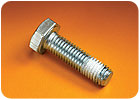
Around 1968, the automotive industry began using fasteners with preapplied anaerobic adhesive for thread-locking. The first such application was to lock and seal a screw in a carburetor. Today, thread-lockers are used in every industry.
Quality control is the main reason for using thread-lockers. In the long run, avoiding warranty claims and product failures has a positive affect on a company’s reputation and sales. By understanding the mechanisms and uses of thread-lockers, engineers can choose the best options for securing joints.
Thread-lockers can be mechanical or chemical, and the Industrial Fastener Institute (IFI) has developed standards for both. IFI standards 124, 125, 524 and 525 cover thread-lockers for fasteners with external threads, while standards 155, 160, 555 and 560 cover those for fasteners with internal threads. Most industries have adopted their own standards modeled on these specifications.
The two most widely used chemical thread-lockers are anaerobics and epoxies. Anaerobics are one-component adhesives derived from methacrylates, a monomer related to acrylic. The original thread-locker, they’re called anaerobic because they cure in the absence of oxygen and the presence of metal ions.
An epoxy is a thermosetting polymer that cures when mixed with a catalyst, or hardener. Epoxies are known for their excellent adhesion and their resistance to heat and chemicals. They can be modified in myriad ways by adding mineral fillers, flexibilizers, viscosity reducers, colorants, thickeners, accelerators and adhesion promoters.
Chemical thread-lockers can be applied to fasteners by the assembler, or the process can be outsourced to an applicator. When applied on the assembly line, chemical thread-lockers are supplied as one- or two-part liquid adhesives. When preapplied to a fastener, chemical thread-lockers are supplied as microencapsulated beads embedded in a resin. When the fastener is installed, the beads break, releasing the adhesive and initiating the curing process.
Mechanical thread-lockers don’t bond to a fastener so much as increase friction between the mating threads. This makes it more difficult for the fastener to move. Nylon is the most common material for mechanical thread-locking. Nylon cannot be applied to fasteners in-house, but must be preapplied in a processing plant. The process requires the fastener to be heated to at least 425 F to fuse the nylon to the threads.
Fasteners treated with a mechanical thread-locker normally require a higher installation torque, because they rely on thread jamming for their thread-locking properties. On the other hand, chemical thread-lockers have lubricating properties that reduce installation torque but, once cured, result in much higher locking strengths than mechanical thread-lockers. Indeed, mechanical thread-lockers have less then half the strength of adhesives.

If application of thread-lockers is not your primary business, your labor force will be better employed assembling your product, not applying adhesives.
DIY or Preapply?
If an assembler only treats a small number of fasteners with thread-lockers, it may not be a cost advantage to outsource the fasteners for preapplication of an adhesive or sealant. However, depending on the thread size, it’s usually most cost-effective to outsource an entire yearly quantity at one time.There are many advantages to outsourcing the application of thread-lockers to fasteners, including eliminating the possibility of running out of adhesive during production. If application of thread-lockers is not your primary business, your labor force will be better employed assembling your product, not applying adhesives.
Perhaps the biggest advantage of preapplying thread-lockers is simply that engineers can be certain the adhesive will actually be on the fastener, in the correct amount and in the correct location. When line personnel apply liquid adhesives during assembly, the process is prone to error. The adhesive may not get dispensed on some fasteners, or it might not be applied in the right spot.
Similarly, with preapplied thread-lockers, engineers can be sure their torque specifications will be met, because the amount of adhesive applied to each fastener will be carefully controlled. In fact, applicators typically provide test data indicating the tightening torque and breakaway torque for the material.
Another advantage is that engineers need not worry about housekeeping or contamination issues. There is no liquid mess or sloppy run-off. Excess liquid thread-locker can be problematic, because some adhesives attack plastics. If a liquid adhesive is applied to a screw for plastic components, the run-off can harm the product. Preapplied threadlockers will not harm plastics, which is why a growing number of electronics assemblers are using these materials in their products.
Lastly, preapplying a thread-locker saves assemblers time and money. Liquid adhesives often need a primer to stick to the metal surface of a fastener. The preapplication process eliminates this step. Moreover, every drop of liquid adhesive costs money-and not just for the material itself. Assemblers also need to factor in the cost of waste, dispensing equipment, and cleaning and maintenance.
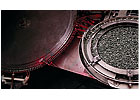
The biggest advantage of preapplying thread-lockers is simply that engineers can be certain the adhesive will actually be on the fastener, in the correct amount and in the correct location.
Mechanical vs. Chemical Locking
The choice between mechanical and chemical thread-lockers depends on several factors, including cost. If the fastener will be adjusted or taken in and out several times, a mechanical thread-locker is needed. A fastener treated with a mechanical thread-locker can be inserted and removed three to five times. Under most circumstances, chemical adhesives are for one-time use.The strength of the locking material is another consideration. The tightening torque and breakaway torque will vary depending on the fastener diameter and the specific thread-locker. Mechanical thread-lockers require more tightening torque, but less breakaway torque. Chemical thread-lockers require less tightening torque, but provide the most breakaway torque.
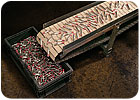
When preapplied to a fastener, chemical thread-lockers are supplied as microencapsulated beads embedded in a resin. When the fastener is installed, the beads break, releasing the adhesive and initiating the curing process.
Choosing an Adhesive
Which thread-locker to preapply to the fastener is up to the assembler. However, the applicator can provide guidance on choosing the right material. The size and type of fastener, the type of metal, and the plating material will help determine which thread-locker to use.Epoxies are ideal for small-diameter fasteners. Epoxies are solvent-thinned and normally applied using a flow-coat system. That means the screw passes through a thin stream of epoxy. This method concentrates the optimum amount of adhesive onto the small threads. Water-based adhesives are normally thicker and cannot be thinned to as free-flowing a consistency as solvent-based epoxies.
The thicker consistency of water-based adhesives mandates that they be rolled onto the fastener. Large-diameter fasteners-from 0.25 inch on up-are ideal candidates for water-based adhesives. There are exceptions. Some water-based adhesives can lock small screws, and some solvent-based epoxies work on larger screws.
When minimal locking strength is required, mechanical thread-lockers are the first choice. Nylon is also the least expensive thread-locking material.
How much thread-locker to apply depends on the strength requirements of the joint. For optimum locking, the thread-locker should be applied in a band at least as wide as the diameter of the fastener. In other words, if the fastener is 0.25 inch in diameter, the coated area should be 0.25 inch long. A good rule of thumb is to apply as much adhesive as the thickness of the mating nut. If the fastener is going into a tapped hole, vary the width of the adhesive as necessary for maximum locking strength. Each thread of adhesive will add to the locking strength of the joint.

Most applicators provide testing services to ensure that assemblers have chosen the right thread-locker.
Testing Thread-Lockers
Testing is critical to providing a quality product, and most applicators provide testing services to ensure that the right thread-locker has been chosen. The number of fasteners tested varies, and the process takes only a couple of days. Once production begins, the applicator will usually test a few fasteners pulled at random from different batches, just to ensure that the thread-locker and the coating process meet IFI, automotive or customer standards.Since most mating parts are too large or expensive to be used for testing, the fastener is assembled into an industry-standard nut or a tapped fixture for testing. For chemical thread-lockers, the testing process can begin once the material is fully cured-usually 24 to 72 hours at room temperature. Heating the fasteners in a lab oven to at least 150 F for approximately 45 minutes can accelerate the curing process.
Though the automotive industry has established clear thread-locking standards, most industries assess thread-lockers by measuring the maximum tightening torque and the minimum breakaway torque. An uncoated fastener may lose 15 percent to 30 percent of its seating torque when unscrewed. In other words, an uncoated fastener tightened to 100 in-lb would lose 15 to 30 in-lb due to relaxation of the joint. A thread-locker should prevent that torque loss and provide a locking strength beyond the seating torque.
Testing will reveal whether the thread-locker is too strong or not strong enough. It will help engineers determine how many threads should be coated and whether the coverage should be moved up or down the fastener.
Looking for a reprint of this article?
From high-res PDFs to custom plaques, order your copy today!