Power Tools: Technology Makes an Impact
New technology gives impact wrenches the ability to measure torque and angle.
The impact wrench is hardly new. In fact, this year marks the 75th anniversary of the introduction of the impact wrench by Ingersoll Rand in 1934.
That’s a good long run for any product, much less one for tightening threaded fasteners. The technology is so simple—impact wrenches give you a lot of speed and power in a small, lightweight package.
Assemblers shouldn’t confuse longevity with stagnation, however. The impact wrench on today’s assembly lines is not the same the tool that automotive mechanics have been using to bang down lug nuts for decades. New technology has made the tools lighter, quieter and more durable. Cordless models have been available for a few years now, and new technology has recently been introduced that gives impact wrenches the ability to measure and control torque and angle.
As its name implies, an impact wrench delivers torque in a series of short bursts created by the impact of a swinging hammer on an anvil. The hammer is connected to the output shaft of a pneumatic or electric motor. The anvil is connected to the driveshaft of the tool. When the fastener is running free, the hammer and anvil move together. When the socket encounters resistance from the fastener, the hammer rotates independently, striking the anvil once or twice with each revolution of the output shaft, depending on the tool.
If you need to drive a nail into a piece of wood, you don’t push on it with a continuous force. You pound it in with a series of impacts. The momentum of the swinging hammer drives the nail through. An impact wrench works in much the same way.
Because impact wrenches apply torque to the fastener in short bursts, reaction force is minimal, even when applying hundreds of foot-pounds of torque. This design also means that impact wrenches have a very high power-to-weight ratio. For example, the LMS 37 impact wrench from Atlas Copco Tools and Assembly Systems weighs just 6 pounds, but it can deliver as much as 352 ft-lbs of torque.
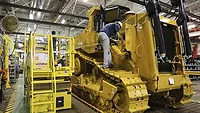
These advantages make impact wrenches ideal for tightening large fasteners in products such as heavy trucks, agricultural equipment, construction machinery and railcars.
Impact wrenches come in a wide range of sizes, from a 1/4-inch hex drive, pistol-grip model to a 3.5-inch square drive, two-handled behemoth. The former weighs 2.4 pounds, has a free speed of 15,000 rpm, delivers 1,500 impacts per minute, and applies a maximum torque of 250 ft-lbs. The latter weighs 599 pounds, has a free speed of 295 rpm, delivers 500 impacts per minute, and applies a maximum torque of 80,000 ft-lbs.
Impact wrenches are available in pistol-grip, in-line and D-handled models. The end of the driveshaft can be hexagonal, square or splines.
Industrial-quality cordless impact wrenches were introduced in 2006 and are now produced by Ingersoll Rand, Milwaukee Electric Tool Corp. and Makita USA Inc. For example, Ingersoll Rand offers cordless impact wrenches in 7.2-, 14.4- and 19.2-volt models equipped with nickel-cadmium or lithium-ion batteries. Drive sizes range from 1.4-inch hex to 1/2-inch square. To reduce weight, the housing is made from an engineered composite with a metal subframe.
With an air tool, you’re limited by the air hose in terms of what you can reach. You also need access to a compressor. The portability of cordless tools is very attractive to a lot of manufacturers.
On the other hand, pneumatic impact wrenches have fewer moving parts than their cordless cousins and will typically be lighter and more powerful than comparably sized battery-powered tools, says Carter. For example, Ingersoll Rand’s 2900 series pneumatic impact wrench with a 3/8-inch square drive has a free speed of 10,000 rpm and delivers 1,500 impacts per minute. It weighs 2.5 pounds and delivers a maximum torque of 180 ft-lbs. In contrast, Ingersoll Rand’s Model W150 14.4-volt cordless impact wrench with a 3/8-inch square drive has a free speed of 2,200 rpm and delivers 3,000 impacts per minute. It weighs 5 pounds, including the battery pack, and delivers a maximum torque of 150 ft-lbs.

Ergonomic Concerns
Although impact wrenches apply a lot of torque with little reaction, there are trade-offs. One is excessive noise. A pistol-grip pneumatic impact wrench with a 1/2-inch square drive produces a noise level ranging from 89 to 96 decibels. A D-handled tool with a 1-inch square drive produces a noise level ranging from 94 to 110 decibels. In contrast, a pulse tool generates a noise level of 80 decibels, a pneumatic nutrunner with an automatic shut-off clutch produces a noise level of 77 decibels, and a DC electric nutrunner produces a noise level under 70 decibels.
On Ingersoll Rand’s Max line of impact tools, the company changed the air porting and used different materials in the exhaust to make the tools quieter.
Another trade-off is excessive vibration. According to a 2007 study conducted by the National Institute for Occupational Safety and Health (NIOSH), the handle of an impact wrench vibrates with an average acceleration of 6.6 meters per second squared. In comparison, a pneumatic nutrunner with an automatic shut-off clutch vibrates at 2.5 meters per second squared. A pulse tool vibrates at 2.1 meters per second squared.
To avoid cumulative trauma disorders, NIOSH advises assemblers to avoid operating impact wrenches for more than 4.5 hours per day.
“Impact wrenches should not be used for high-volume assembly,” admits Hans Mandahl, product manager for assembly tools at Atlas Copco. “If you have to use an impact wrench for 8 to 10 hours per day, it could be harmful.”
New Technology
Until recently, another trade-off with impact wrenches has been torque control and accuracy. In most cases, the assembler would simply hold the trigger until he judged the fastener was tight enough. Not surprisingly, the actual torque applied to the fastener could vary by 30 percent to 50 percent.
However, new technology has improved the torque control capability of these tools. For example, Atlas Copco’s impact wrench has an adjustable mechanism that shuts off the tool when a preset number of impacts, or hits, have been applied to the fastener. “You can set the dial to deliver, say, 10 hits and then shut off the air,” explains Mandahl. “That eliminates a lot of operator influence.”
In the tool crib, engineers can run experiments to correlate a specific number of hits with the desired torque level. “If the torque is too low, then you increase the number of blows on the dial and measure again,” says Mandahl.
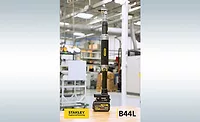
Stanley Assembly Technologies has introduced the first impact wrench equipped with an electronic torque transducer. Because impact wrenches apply torque in short bursts, measuring and controlling their torque electronically has been nearly impossible.
Stanley found a way around the problem by applying a technology originally developed by Magna-Lastic Devices Inc. for measuring torque produced by rotating shafts in vibrating machinery, such as harvesters, helicopters and winches.
The technology works like this: The wrench’s output shaft is magnetized. When torque is applied to the shaft, it creates highly repeatable changes in the shaft’s magnetic field. Electromagnetic coils surrounding the shaft detect those changes and send the signals to an electronic controller. Software translates the signals into meaningful torque data that can be used for closed-loop control of the fastening process. An additional sensor can be added to measure and control angle.
When a preset torque and angle have been reached, the controller automatically shuts off air to the tool, says Doug Versele, global product manager for industrial and automotive power tools at Stanley. The controller has 24-volt I/O for connecting to a PLC and Ethernet ports for sending fastening data to a shop-floor network. The wrench is equipped with a headlight to illuminate the workpiece. The light turns green if the fastener has been tightened correctly; it shines red if it hasn’t.
The tool’s pin-clutch design enhances the ability of the electronics to control torque. The clutch applies torque in smaller increments than the traditional twin-hammer mechanism found in most impact wrenches. It’s not the same level of control as a continuous-drive DC electric tool, but you can get a Cpk of 1.67 ±10 percent on a well-designed joint.
Looking for quick answers on assembly and manufacturing topics? Try Ask ASM, our new smart AI search tool. Ask ASM
Looking for a reprint of this article?
From high-res PDFs to custom plaques, order your copy today!