What to Look for in a Lighting System
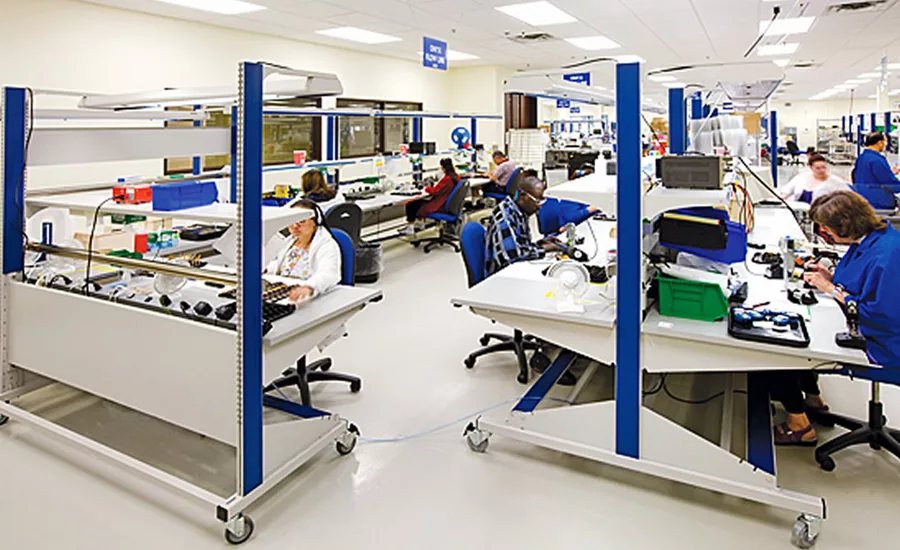
Several different types of lighting systems are available for assembly workstations. Here's some advice on what to look for.
ASSEMBLY recently asked a group of experts to explain the features of a good lighting system. Participants included: Kurt Greissinger, vice president of Lean Factory America LLC; Erica Rice, formerly marketing director at Production Basics and now founder of the marketing firm, BrandStalk; David Seay, president of ProActive Process Solutions Group; Bob Simmons, national sales manager at Pro-Line; David Trinks, sales manager at Sunnex Inc.; and David Verrill, applications support manager at IAC Industries Inc.
GREISSINGER: The key here is that the solutions are designed as a system. This means that a suite of lighting products is available to select based on the application and that they all work together flawlessly. This system idea also includes the ability to mount the light easily to the workstation and to have it operate in concert with power strips. A correctly designed lighting system allows for daisy-chaining lights together within the station when multiple lights are needed, or to daisy-chain them station-to-station.
Switches should be placed at an ergonomic level and allow the light to be turned off independently of the power strip to facilitate the recharging of power tools when the station is not in use. Variable-length keyed cables allow for integration into workstation designs of varying size and don't require an electrician to be on staff to hard-wire the solutions.
Products should be low weight to allow for easy installation by one person. And, they should produce the highest quality of light: glare-free, flicker-free, without producing operator shadows on the workpiece.
Cost of ownership should be low and should not be construed as just the purchase price. Rather, costs should also be considered in terms of power consumption, lamp life and maintenance. The ability to easily adjust and position lights at the work surface is a must. Uniform illumination of the work surface is also important.
RICE: A good lighting system should have overhead illumination at each workstation and a task light. Be aware of over-lighting, which can cause eyestrain and uses unnecessary energy.
SEAY: Easily adjustable, variable intensity and quality construction are important. Remember, in most cases, the lighting is placed above the employee. You do not want mounting brackets or support arms to give way.
SIMMONS: A good lighting system will allow the light to be positioned by the operator so they may light the area where it is required. With our standard overhead light and frame, the light fixture slides in and out and also tilts. No tools are required to adjust the light; it adjusts with knurled knobs. This allows operators to position the light on the point of the work surface where they need it most. This also lets operators tilt the light away from them to reduce glare and fatigue.
Another important feature is an on-off switch. This allows the operator to shut off the light when not needed to save energy or reduce light. If other equipment is plugged into the power supply, it is not practical to shut down the power supply just to shut off the light.
Besides overhead lighting, magnification lighting is available. This is a light that mounts either to the edge of the work surface or on an extendable arm.
TRINKS: Selection of an appropriate system depends on many factors, such as positioning, robust construction and ease of use. But, [any lighting system] should include a robust mounting base, weighted significantly to counterbalance the fixture, provide secure anchoring points or easily attachable mechanisms such as C-clamps or friction flip devices. It should contain an easily accessible switch, a cord of appropriate or appreciable length, and surfaces that dissipate heat to decease the likelihood of receiving a burn. The design should also not contain any sharp edges and provide enough rigidity to support the bulb housing and head while maintaining some flexibility to position the lamp in the desired location.
VERRILL: In the case of overhead lighting, I would say that height adjustability is a must. While most of us think of the light fixture being mounted at the top of a workstation’s upright structure, having the ability to easily adjust the light closer to the work surface maintains flexibility. This is especially true in cases where a different operator is introduced into the work area, or if your product types change from time to time. It’s better to put a few extra dollars into some versatility upfront than to possibly need more expensive retrofits at a later date.
Ideally, the operator should have the ability to adjust the depth and angle of the light fixture without tools. This allows each fixture to be tailored to their individual preferences without having to select different light fixtures for each operator.
Some manufacturers still prefer simple benches with instrument shelves, much as you would see in a laboratory setting. When using an under-shelf light fixture, be certain to select a design that does not glare into the operator’s eyes.
Looking for quick answers on assembly and manufacturing topics? Try Ask ASM, our new smart AI search tool. Ask ASM
Looking for a reprint of this article?
From high-res PDFs to custom plaques, order your copy today!